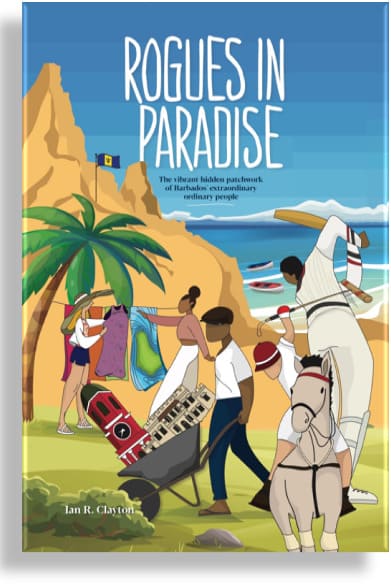
Throughout history, rogues have been misunderstood. Too often, the word is treated as an insult — a label for those who defy convention or bend the rules. Yet rogues are vital to society. They challenge the status quo, think differently, and dare to push boundaries.
In my study and research, the rogues I’ve encountered are far from scoundrels. They are vibrant, resourceful, irreverently charming — embodiments of the island’s cultural spirit. In this book, rogue is a badge of honour: a celebration of those who carve their own paths.
These characters — historical figures, modern icons, and everyday people — reflect Barbados’s complex heritage. Barbados was the case study for my project. It is a tiny island in the Caribbean that has astonished the world with its innovation and creativity. It was the first British Slave society in the New World and was the prototype for plantation capitalism. To understand this is to understand the people and the island itself: layered, contradictory, deeply rooted in history, and constantly evolving. Rogues in Paradise tells their stories, revealing the humanity in rebellion, the wisdom in the unconventional, and the strength in what refuses to be tamed. This is explored further in the RoguesCulture Manifesto.
But the story does not end with emancipation, independence, or republic. The pressures shaping identity have simply changed form.
Today, the rogue spirit matters more than ever. We are entering an era shaped by artificial intelligence, algorithmic influence, and digital acceleration. Culture is being flattened into data. Identity risks becoming performance — curated, commodified, and optimised for visibility rather than lived experience. In such a climate, the rogue is not a troublemaker but a guardian of conscience. The rogue questions the machine, resists easy categorisation, and insists on humanity in systems designed for efficiency. The unfinished work of identity is not confined to slavery or colonialism; it now unfolds in the architecture of technology itself. Rogues in Paradise is therefore not only a reflection on history but also a meditation on how we hold onto self, memory, and cultural depth in an age that threatens to smooth everything into sameness.
My journey with Barbados began in the 1960s, when I first arrived to manage hotels after completing studies in the United Kingdom. After further study in Canada, I moved into the development of environmental and tourism information systems, eventually returning to Barbados in 1995 with a digital atlas project supported by the Canadian government.
Working alongside a talented Barbadian team, we launched the Barbados Tourism Encyclopedia in 1996 — an ambitious effort to document the island’s heritage, tourism, and business life in digital form. Through that work, I came to see beyond the postcard image. I began to understand the island’s deeper rhythms — its resilience, contradictions, humour, and quiet strength.
The book I thought I was writing — a portrait of an island beyond its postcard beauty — gradually revealed itself as something far deeper: a reckoning with slavery, discrimination, cultural resilience, and the unfinished work of identity in an age of technological upheaval. And in telling these stories, I began to see that the struggle for culture and identity is not only historical — it is unfolding again in our own time. See Rogues Reframed
By Author Ian R Clayton
Pre-Screening Rogues In Paradise Available Now