Barbados: RoguesCulture Identity in Motion
Barbados was once called “Little England,” its laws and institutions modelled on Britain. Yet the island’s identity begins elsewhere—in Africa, and in the coral bones of the island itself. Identity is a river: fed by memory, steered by choice. Africans were forcibly brought here by the English; their languages, beliefs, and communal values endured in creole forms. To be Bajan is to live between the bones of the earth and the stories of the people.
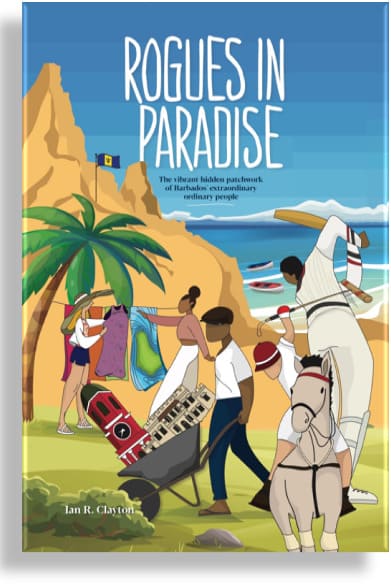
Based on the book Rogues in Paradise – download sample chapters >>>
African Roots: Forced and Enduring
Beginning in the 1600s, the English transported tens of thousands of Africans to Barbados as slaves to work the sugar plantations. From the Bight of Biafra came more than 62,000 Igbo, Efik, and Ibibio; from the Gold Coast, nearly 59,000 Akan; from the Bight of Benin, about 45,000 Yoruba, Ewe, and Fon; and from Central Africa, roughly 29,000 Kongo. .[5] Torn from largely agrarian, communal societies and thrust into a brutal system of enslavement, they carried memory, ritual, and resilience across the Atlantic. Over centuries, those cultural threads wove themselves into the fabric of Barbadian life—heard in speech and proverb, felt in kinship and faith, tasted in kitchens, and celebrated in music and masquerade.
A Colony That Stayed British — And Land That Held
Unlike many Caribbean islands that changed rulers repeatedly, Barbados remained under continuous British control. That constancy shaped institutions, education, and habits. But identity here was formed not only by governance; it was also shaped by geology. Geologically unique in the Lesser Antilles, Barbados is built on sedimentary rock and uplifted coral reefs. Layer by layer, sea and limestone raised the island—bright coral sands, gullies dense with vegetation, headlands facing the trade winds. This physical steadiness echoes its political continuity, giving culture space to grow and roots to deepen.
A Caribbean Contrast
Elsewhere in the Caribbean, identity evolved through repeated upheaval. Jamaica forged a fierce culture of open rebellion—helped by mountainous terrain that sheltered Maroon communities and enabled large uprisings. [2,7] St. Lucia changed hands often between French and British rule, forcing language and law to turn over again and again. Barbados, by contrast, was comparatively steady: a low-lying island of tightly packed cane estates under dense militia surveillance. Resistance here took different forms—everyday acts of refusal and endurance—though it also flared into revolt, most famously in Bussa’s Rebellion (1816).
Elsewhere in the Caribbean, geography sometimes enabled more sustained rebellion. Jamaica’s mountainous interior, including regions such as Cockpit Country, sheltered Maroon communities and allowed resistance movements to consolidate.
Planters in the 1700s often labelled Gold Coast–origin Africans in Jamaica as “Coromantee” (largely Akan speakers) and, in their own writings, described them as especially prone to rebellion. Modern historians show that this label was partly a stereotype and partly a response to real, large-scale uprisings such as Tacky’s Revolt (1760–61). (1760–61).[1] The point is not that any people were inherently “warriors,” but that planter perceptions, military traditions carried from West African states, and Jamaica’s geography made open resistance more feasible—and more feared.
Law and demography mattered too. Barbados codified slavery early (Slave Code, 1661) [3] and became a tightly controlled plantation “slave society,” while Jamaica imported very large numbers of African-born captives in the mid-eighteenth century…raising the share of recent arrivals who could draw on West African organisational experience. Historians such as Jerome S. Handler and Edward Rugemer note that Barbados, with its early Slave Code of 1661, became a tightly controlled “slave society,” while Jamaica’s demographics created space for different repertoires of resistance—not fixed national “characters.”
Demography and place mattered as much as origin. Barbados drew heavily from the Bight of Biafra (Igbo, Ibibio, Efik), the Gold Coast (Akan), the Bight of Benin (Yoruba, Ewe, Fon), and Central Africa (Kongo),[5] while Jamaica received large Akan/Coromantee and Central African cohorts and had mountains that let resistance to consolidate.[6,7] It isn’t that one people were “peaceful” and another “warrior,” but that different mixtures and landscapes produced different repertoires of resistance—from Maroon wars to satire, spirit practice, and day-to-day survival.
From “Little England” to the Republic
For generations, many Bajans looked to England as a model of civility, power, and prestige. Yet beneath that overlay lived something else: geography and geology, African memory and community. When Barbados became a republic in 2021, the change was constitutional and symbolic—a claim of full selfhood, a recognition that the island’s identity is not borrowed but born here, from land and people alike.
The Debate of Reparations
Today, as reparations are debated, identity is asked to hold many truths at once: the reality of slavery, the weight of colonial rule, and the pride of survival. Some fear that dwelling on the past traps the future; others warn that ignoring it erases justice. Grounded in land—in gullies, coral reefs, and geological time—identity can do both: remember without being consumed and move forward without forgetting.
Surviving, Creating, Choosing
Despite brutality, Bajans created: songs and satire, rituals and recipes, mutual aid and faith traditions. The landscape is part of that story too—coral beaches, shimmering reefs, trees gripping the gully walls—reminders that forces larger than us shape the world, and that people shape meaning in return. As Errol Griffith reminds us, change lies not in anger, but in choice. Identity is not only inherited; it is practised—stories selected, values affirmed, futures imagined.
New Arrivals, Living Identity
Identity doesn’t only look backwards; it grows in the present. Barbados is welcoming newcomers—regional migrants, returnees from the diaspora, knowledge workers, creatives—each bringing languages, recipes, and rituals that meet Bajan ways of speaking, laughing, and living. The old idea of “Little England” yields to something more creole and contemporary: fish fry meets food truck; tuk band meets Afrobeats; Kadooment shares a road with new festivals. There is pride and curiosity in the mix, and there are pressures too—housing, wages, classrooms, clinics.
Hospitality remains a Bajan virtue, but identity is now negotiated daily— in markets and minibuses, churches and mosques, on beaches and back steps. The question isn’t whether immigration changes identity; it’s how we choose to shape that change—through fairness, welcome, and a clear story of who “we” are becoming.
Reflection: Identity in Motion
Barbados is a case study in transformation: a people brought by force, a land lifted by nature, a culture set apart by history and geology yet stitched together by resilience and choice. To be Bajan is to live with many currents—ancestral, colonial, geological, and now migratory—and to decide, again and again, how those currents shape what comes next.
Video Summary
RoguesCulture Identity Series
- The Spoils of Identity in the Face of Colonialism
Colonial systems reshaped identity through power, law, and economics, using Barbados as an early case study of cultural disruption and resilience. - Barbados: Identity in Motion
Identity evolves through migration, culture, and adaptation, with Barbados as a living example of a history- and community-shaped identity. - Identity Across Cultures: The World Order
Expands the conversation globally by examining how language, geography, religion, and history shape identity across societies. - Africa: Origins and Echoes of Identity
The influence of African heritage and cultural memory across the Atlantic world and the Caribbean diaspora. - Cosmic Identity
A philosophical reflection on identity beyond nationality—considering humanity’s shared cultural and existential connections. - Identity: AI vs Ancestry in 2026
As artificial intelligence reshapes communication and creativity, this essay asks what remains uniquely human—and how ancestry and cultural memory help keep identity grounded. - Identity and the Future
How Identity may evolve as societies adapt to rapid technological, cultural, and economic change.
- Who Needs Identity Anyway?
Questions whether identity still matters in a globalised world—and why belonging and cultural continuity may be more important than ever. - Identity Is Fragile
How identity can be distorted, politicised, or manipulated, and why cultural awareness is essential to protect it.
- AI, Quantum Computing, and Power
Examines how emerging technologies could reshape global power structures—and the future of human identity itself.
Based on the book RoguesinParadise– Pre-screening sample available now>>>
Related Blogs
Rogues Re-Framed: https://roguesinparadise.com/britains-first-slave-society-the-barbados-prototype/
Why: https://roguesinparadise.com/barbados-britains-laboratory-for-slavery/
Sources & Notes
- Planter perceptions, “Coromantee” (Akan) & uprisings in Jamaica
Vincent Brown, Tacky’s Revolt: The Story of an Atlantic Slave War (Belknap/Harvard, 2020). Link to the Harvard University Press. Also see a short overview at the National Humanities Centre. - Terrain & Maroon strongholds (Cockpit Country / mountainous refuge)
UNESCO World Heritage Centre — Cockpit Country Protected Area (Tentative Listing).
National Library of Jamaica — background on the Maroons and interior strongholds.
(Optional) Recent scholarship on Cockpit Country’s landscape/conflict (link a reputable journal piece). - Barbados as early “slave society” & the Slave Code (1661)
Jerome S. Handler, “An Early Edict on Slavery in English America” (text and analysis of 1661 law).
Edward B. Rugemer, “The Development of Mastery and Race in the Comprehensive Slave Codes of the Greater Caribbean,” William & Mary Quarterly (2013).
Context: Black Perspectives (AAIHS) on Barbados as “the first Black slave society.” - Bussa’s Rebellion (Barbados, 1816) & forms of resistance
Hilary McD. Beckles, “The Slave-Drivers’ War: Bussa and the 1816 Barbados Slave Rebellion,” Boletín de Estudios Latinoamericanos y del Caribe 39 (1985).
Beckles memorial lecture/commentary (e.g., at Yale GLC).
Barbados Museum & Historical Society — “Bussa: The 1816 Revolution in Barbados.”
(For debate/primary materials, see posts/essays by Jerome S. Handler.) - Origins of enslaved Africans in Barbados (provenance regions)
SlaveVoyages / Trans-Atlantic Slave Trade Database — provenance by colony: Bight of Biafra & Gold Coast for Barbados (Igbo, Ibibio, Efik; Akan), plus Bight of Benin and Central Africa.(If you prefer a secondary explainer, link to your own Rogues in Paradise pages that summarise these data.) - Jamaica’s demographic mix & timing; maroonage context
Brown (2020) for Akan/“Coromantee” cohorts and the 1760–61 revolts.
J. Morgan (doctoral study) or another reputable demographic study on Jamaica’s intake patterns (include the university repository link).
Treaty/stronghold context for Accompong (1739) and other Maroon communities via an authoritative source (e.g., NLJ or a recognised academic press). - Classic monograph on the Jamaican Maroons
Mavis C. Campbell, The Maroons of Jamaica, 1655–1796: A History of Resistance, Collaboration & Betrayal (Africa World Press, 1990/1988). (Publisher or library link.)