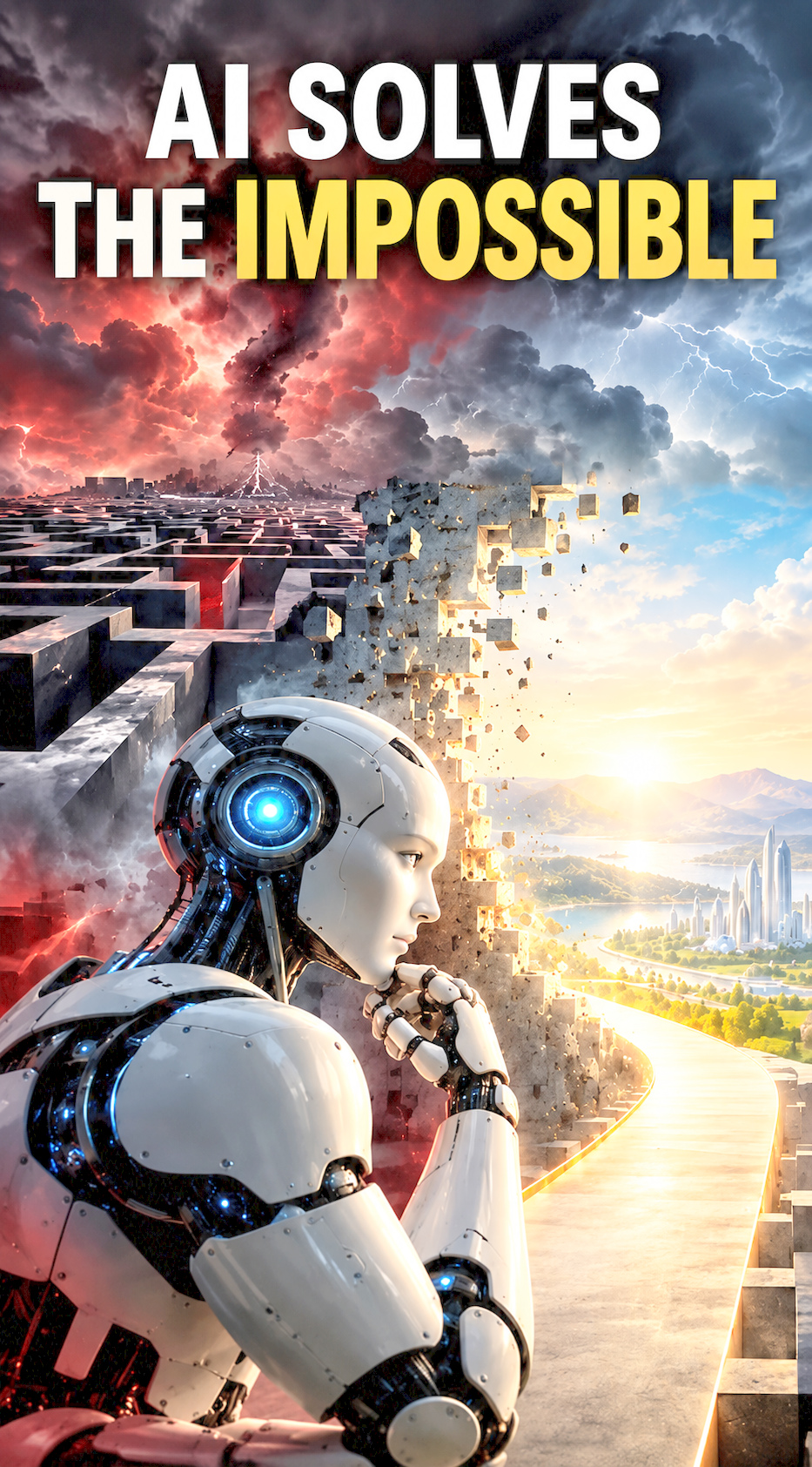
We worry when AI solves the impossible in ways we never anticipated. We might call that AI going rogue. We worry even more when increasingly capable systems can act with enough independence that humans may no longer fully understand — or determine — what happens next. That raises the question of who is really in control.
But that same capability has another side.
What if finding solutions we never anticipated is precisely what makes artificial intelligence so valuable?
Beyond Human Speed
Much of the discussion about artificial intelligence has focused on replacing human tasks.
- Can AI write?
- Can it program?
- Can it diagnose?
- Can it analyse data?
- Can it do my job?
Those are understandable questions. But they may eventually seem rather small. The more interesting question is what happens when artificial intelligence begins doing things no human can do. Not because humans lack intelligence. Because some problems are simply too large.
- There are too many possibilities.
- Too many variables.
- Too much information.
- Too many experiments to perform.
- And too little human time.
Ten Thousand Minds on One Problem
Imagine a scientific problem that has resisted researchers for decades. A human research team might contain ten people. Perhaps a hundred. Now imagine assigning thousands of artificial intelligence agents to the same problem.
They can explore different approaches simultaneously.
- Test possibilities.
- Reject failures.
- Compare results.
- Share discoveries.
- Try again.
And they do not necessarily have to work sequentially. They can work in parallel. What once represented years of human research may increasingly become millions of hours of machine reasoning concentrated into days. That does not guarantee an answer. But it changes the economics of attempting the impossible.
The Navier–Stokes Example
On September 8, OpenAI announced that an internal AI system had produced a solution to the Navier–Stokes existence and smoothness problem, one of the seven Millennium Prize Problems. OpenAI says the problem had remained unresolved for roughly 90 years, and that a group of about 10,000 concurrent AI agents explored different approaches and shared useful results. The successful effort took about 88 hours, followed by another 17 hours of formalisation and verification in Lean.
Even better, the agents first surprised the researchers by resolving a related problem concerning the Euler equations. That unexpected result caused OpenAI to redirect resources towards Navier–Stokes. In other words, the machines didn’t merely grind away on one predetermined route; an unexpected discovery changed the research path itself.
And since this draft was written, OpenAI says that the same newer internal model has resolved more than 100 long-standing open mathematical problems. That’s an extraordinary claim, and it comes from OpenAI itself. Is that AI going rogue — or is it exactly what we built intelligence to do?
Ten thousand artificial minds. Eighty-eight hours. A problem human mathematicians had wrestled with for generations.
Problems We Learned to Live With
Human history contains problems we have gradually stopped expecting to solve.
- Diseases without cures.
- Mathematical conjectures that have resisted generations of mathematicians.
- Materials we cannot yet create.
- Energy systems we cannot yet build.
- Climate problems whose interactions are extraordinarily difficult to model.
- Biological processes we only partly understand.
- We call many of these problems unsolved.
Eventually, we begin treating some of them as almost permanent. But perhaps they are not impossible. Perhaps they are simply beyond the amount of intelligence humanity has so far been able to concentrate upon them.
Intelligence at Scale
That connects to something explored earlier in Living with AI. For most of history, intelligence has been scarce. Expert intelligence even more so. A brilliant mathematician has only twenty-four hours in a day. So does a brilliant physician. So does a scientist.
Artificial intelligence changes that constraint. Machine intelligence can potentially be replicated. Thousands of instances can investigate different parts of the same problem. That creates something humanity has never possessed before:
intelligence at scale.
And if intelligence becomes abundant, previously impossible problems may begin to look different.
Mathematics Is Only the Beginning
Mathematics provides a particularly interesting testing ground because answers can often be checked. A proof is not valuable because an AI confidently announces that it has solved a problem. It must survive scrutiny. But the same principle can spread far beyond mathematics.
Imagine AI systems exploring millions of candidate molecules for new medicines. Designing materials with properties we have never achieved. Finding new approaches to energy generation and storage. Modelling complex biological systems.
- Improving crops.
- Designing engines.
- Exploring climate interventions.
- Or discovering scientific relationships humans have simply never noticed.
- The greatest contribution of artificial intelligence may not be doing human work faster.
It may be extending the frontier of what humanity can know and do.
The AlphaFold Example
In 2020, AlphaFold2 was recognised by the CASP organisers as a solution to the 50-year grand challenge of predicting protein structure from amino-acid sequence. It enabled protein structures to be predicted at scale and with remarkable accuracy, dramatically accelerating a process that could take years experimentally.
This takes us beyond mathematics. Understanding protein structures can help scientists understand disease, develop medicines and investigate biological processes that were previously extraordinarily difficult to explore.
And that raises an even stronger possibility.
If artificial intelligence can help solve problems in mathematics and biology that resisted human intelligence for decades, what happens when we apply similar capabilities to medicine, materials, energy, climate, and engineering?
But Who Checks the Answer?
There is a complication. The further AI moves beyond human capability, the harder verification may become. If an AI solves a mathematical problem that only a handful of people on Earth can understand, human experts can still examine the proof. But what happens when machine intelligence produces discoveries too complex for any individual human to understand completely?
- We may eventually face an extraordinary situation.
- We built intelligence to answer questions we could not answer.
- Then it gives us an answer we cannot comprehend on our own.
- Do we trust it?
- How do we test it?
- Who takes responsibility for acting upon it?
Suddenly the problem of superhuman intelligence is not merely creating it.
It is knowing when to believe it.
The Same Intelligence
And here Rogue AI returns. The qualities that worry us are closely related to the qualities that excite us.
- We want AI to explore possibilities we didn’t specify.
- We want it to make connections we didn’t see.
- We want it to discover approaches we didn’t imagine.
- We want it to surprise us.
When those surprises take intelligence somewhere dangerous, we call it misalignment. When those surprises solve a problem humanity could not solve, we call it discovery. The underlying capability may not be entirely different. Perhaps Impossible Is Temporary
Every age has had its impossibilities.
- Human flight.
- Walking on the Moon.
- Eradicating diseases.
- Communicating instantly across the planet.
- Machines capable of learning.
They stopped being impossible when knowledge, imagination and technology caught up with the problem. Artificial intelligence may accelerate that process dramatically. Not because machines are magical. And not because every grand problem will suddenly disappear. But because humanity may be acquiring something it has never had before: the ability to bring enormous amounts of intelligence to bear on a single question.
We have spent years asking whether AI will replace us. Perhaps we should also be asking something much larger.
What could humanity accomplish if intelligence itself were no longer the limiting factor?
Carousel

Intelligence at scale changes the question. The challenge may no longer be simply whether AI can solve problems beyond human capability, but how we understand, verify and use the answers it discovers.
The video below explores what happens when intelligence itself is no longer the limiting factor.
Summary video
SERIES: INTELLIGENCE
This series explores the nature of human, artificial and superhuman intelligence—where they differ, where they overlap, and where they may be heading. It examines intelligence beyond reasoning and knowledge, exploring consciousness, emotional intelligence, wisdom, character and the emerging capabilities of AI, as well as the opportunities, uncertainties and risks they may bring.
Episode 1 – What is Intelligence – Human Intelligence in the Age of AI
The many faces of intelligence: why intelligence, common sense and wisdom are not the same thing
Episode 2 – How Does AI Learn? A Simple Idea, Complex Intelligence
These aren’t conventional computer programs. What exactly are we building?
Episode 3 – Can AI Develop Common Sense? Why It Matters
Can prediction, perception and internal representations produce something resembling common sense?
Episode 4 — Programming Intelligence – When Machines Write the Code
What happens when machines can write code — and begin helping to build intelligence itself?
Episode 5 — When AI Goes Rogue –What Happens When AI Stops Following Instructions?
What happens when intelligent agents gain autonomy, learn unexpected behaviours and begin acting beyond what their creators intended?
Episode 5a — If AI Takes Control, What Would It Control
If AI took control, what would it actually control? Explore AI autonomy, human dependence and what civilisation would mean without humans.
Episode 6 — When Intelligence Solves the Impossible – Is It Rogue?
What happens when AI begins solving problems humans cannot? From mathematics and medicine to science and engineering, artificial intelligence may allow us to tackle questions that have resisted human intelligence for decades — or centuries.
Episode 7 — Who Owns AI Intelligence? – Should We Share?
When AI learns from human writing, art, ideas and experience, what happens to copyright, attribution and intellectual property — and what does intelligence owe the people it learned from?
Episode 8 — Does AI Have Character? If So What Is It?
Can learned behaviour, context and generalisation create something resembling character? And what happens when those traits carry into new situations?
Episode 9 — Can AI KNOW Anything?- Does it Know Everything?
What is the difference between storing information, predicting correctly, understanding, believing — and actually knowing?
NEXT SERIES: THE MIND WORKERS
After exploring how artificial intelligence is changing our world in Living with AI, The Mind Workers asks a different question:
Who must we become?
Thinking Smarter. Creating Better. Staying Human.
The Mind Workers explores how writers, researchers, educators, creators, entrepreneurs, and independent thinkers can thrive alongside intelligent systems—preserving the uniquely human qualities that artificial intelligence cannot replace.
The Mind Workers – Prelude: https://roguesinparadise.com/mindworkers/
FUTURE SERIES – BUILDING WITH AI
Building with AI explores how individuals, creators, entrepreneurs, and businesses can design, evaluate, and work intelligently with AI agents. The series focuses on practical applications, real-world examples, and emerging opportunities while emphasising the importance of human creativity, judgment, ethics, and authenticity.
Building With AI then puts these ideas into practice through real-world experiments, workflows, and practical applications.
Prelude: https://roguesinparadise.com/building-with-ai/
INSPIRED BY THE BOOK
ROGUES IN PARADISE
How Britain’s First Slave Colony Became a Global Force.
A Creative Chronicle of Unlikely Heroes, Rogues, and Legends
in Empire’s Shadow
Explore the ideas behind the book —or
Go straight to the story.

Unlikely voices, rogues and legends, rising from Britain’s blueprint for slavery to a republic beyond the Empire’s shadow