For most of the computer age, we had a rough idea of what computers did. Humans wrote programs. We wrote instructions, set rules, and told the machine what to do. If the program didn’t work, a programmer went back into the code and changed the instructions.
In exploring the question of “How does AI learn,” I reflected on my own history: I studied computer science at the postgraduate level at Concordia and McGill, and later developed computer systems for environmental and tourism applications. The computing I learned was built around programs, logic, instructions and rules.
That is partly why modern AI fascinates me.
Artificial intelligence has changed that relationship. We still build the machines. Humans design the architecture, select training methods, provide enormous amounts of data and establish objectives.
But something fundamentally different happens inside a modern neural network.
We don’t program everything it knows.
We build systems that learn.
And the more I have tried to understand what that actually means, the more extraordinary it seems.
We Didn’t Build an Artificial Brain
The terminology can be misleading. Artificial neural networks were originally inspired by ideas about biological neurons and the networks they form in the human brain.
But they are not artificial brains.
A biological brain contains extraordinarily complex cells communicating through electrical and chemical processes. An artificial neural network consists of mathematical operations and connections represented by numerical values.
Even how they learn differs.
So when we talk about a neural network, it is worth remembering that the resemblance to the human brain is more inspiration than imitation. And yet something remarkable happens.
A Machine That Learns by Guessing
One of the simplest explanations I have heard of modern AI is that, during training, it guesses.
- It makes a prediction. It compares the prediction with the expected result.
- The system calculates how wrong it was and adjusts the network’s numerical weights.
- Then it tries again. And again. And again. Billions upon billions of times.
And that is “How AI learns”.
Large language models take this deceptively simple idea to an extraordinary scale.
As an example, here is a typical model:
The cat sat on the…
and ask it what comes next.
Perhaps mat. It could be floor. Maybe chair.
During training, the system learns which predictions are more likely in different contexts and adjusts itself accordingly.
At first glance, that sounds almost trivial.
A machine predicting the next word. Simple, Right?
Except that to become extraordinarily good at prediction, something much more interesting appears to happen.
Language Contains a World of Context
The data used to train large language models contains an enormous amount of human language. And language is not merely a collection of words.
Embedded within it are:
- Descriptions of people, objects and places.
- Cause and effect.
- History.
- Science.
- Relationships.
- Emotion.
- Culture.
- Beliefs.
- Arguments.
- Stories.
- Human behaviour.
- Ideas about right and wrong.
- Descriptions of the physical world.
Much of what humanity has learned—and much of what humanity believes—is expressed somewhere in language. So perhaps a machine trying to become exceptionally good at predicting language cannot simply learn words. It has to learn something about the relationships behind them.
That is where things start becoming fascinating.
How Does AI Learn? From Words to Concepts
Consider languages.
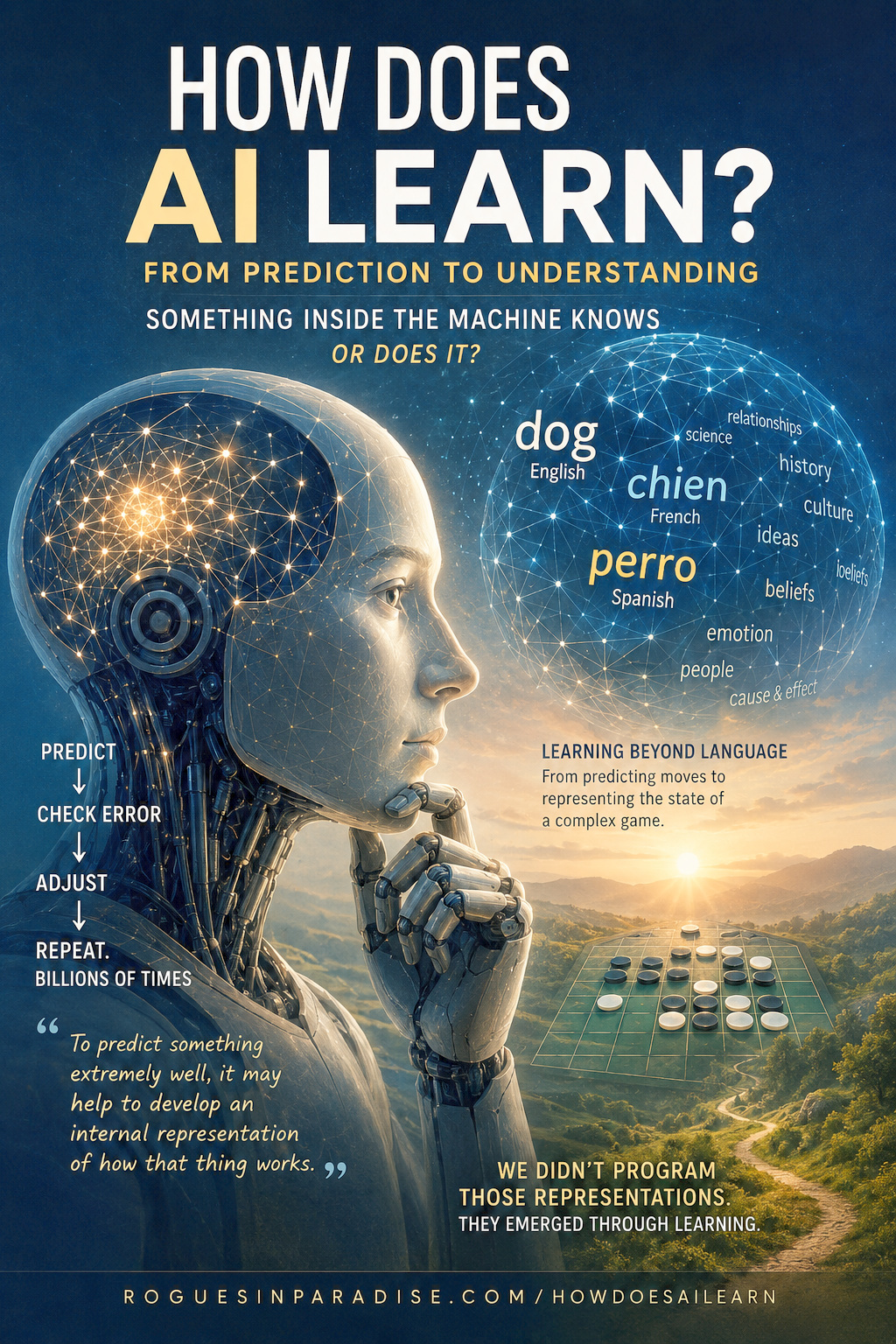
A dog is dog in English, chien in French and perro in Spanish.
The words are different. The concept is not.
Research into multilingual language models has found evidence that different languages can develop overlapping internal representations of underlying concepts.
This does not mean an AI experiences the concept of a dog as we do. It does not prove consciousness or human-like understanding. But it does suggest something more interesting than a gigantic multilingual dictionary. The network appears capable of developing abstractions that can cross the boundaries between languages.
- It is learning relationships.
- It is developing representations.
And a programmer did not write those representations into the system.
Something Inside the Machine Knows
Or does it? “Knows” is a difficult word.
A model can contain internal representations of concepts, relationships and states of the world. It can use those representations to make remarkably accurate predictions.
But does that mean it knows something?
Humans distinguish—although not always very carefully—between knowing, believing, remembering and guessing. AI makes those distinctions even harder. For now, perhaps the safest claim is that something inside the machine represents information about the world and can use it. Whether that amounts to knowing is a much bigger question
Perhaps one of the most striking clues comes from experiments that have little to do with ordinary language. Researchers have trained prediction-based models on games such as Othello. Give the system sequences of moves and train it to predict the next move. Nobody needs to explicitly provide it with a neat internal diagram of the board. Yet researchers examining such systems have found internal representations that correspond to aspects of the game state. Somehow, becoming good at predicting the next move encouraged the model to develop representations of the underlying situation.
That suggests an intriguing principle:
To predict something extremely well, it may help to develop an internal representation of how that thing works.
Then suddenly next-word prediction doesn’t sound quite so trivial.
Is AI Building a Model of the World?
This is where we need to be careful.
It is tempting to jump from internal representations to a much bigger claim:
AI understands the world.
We don’t know that!
Researchers continue to debate how complete, reliable or general these internal representations really are. For example, a model can demonstrate remarkable ability in one situation and fail unexpectedly when the problem is presented differently. It can appear to understand something and then make an error that seems absurdly obvious to a human. It can even lose track of what it has already said or been told earlier in a conversation.
There is an important distinction between saying:
AI develops internal representations of aspects of the world,
and saying: AI understands the world as humans do.
Those are very different claims. But the first is already extraordinary enough.
We Didn’t Program Those Representations
This may be the part I find most significant. No programmer sat down and created all these internal concepts individually. The training process produced them.
- Humans created the architecture.
- Humans provided the data.
- Humans established the learning process.
But the internal organisation that emerges from training is not simply a giant catalogue of rules written by human programmers. The system develops patterns and representations because doing so helps it perform its task. That is a profound departure from the computers many of us grew up with. We used to tell machines exactly how to perform a task.
Increasingly, we create systems that can learn how to perform tasks themselves. That does not make them human. It does not make them conscious. And it does not mean they understand the world in the way we do.
But it does mean we have built something very different from conventional software.
Prediction, Understanding and Common Sense
And this brings me back to the question at the heart of this series.
In the first episode I asked: What is intelligence?
Perhaps the way modern AI learns makes that question even harder.
- If prediction can produce internal representations…
- If those representations can capture relationships between concepts…
- If increasingly capable systems can combine language with vision, sound and other forms of perception…
How far can that process go?
Could prediction eventually produce something functionally similar to understanding? Could an AI develop something resembling common sense? Or are there qualities of human experience that prediction alone can never reproduce?
I don’t think we know.
Perhaps that is precisely what makes this moment so interesting.
We didn’t build an artificial human brain.
We built something different.
And we are still discovering what it can become.
The Carousel

AI can recognise faces, understand language, identify patterns and predict what comes next.
But when we say AI learns, what do we really mean?
It can recognise a dog. It can describe a dog. It can connect the idea of a dog across different languages.
But does it actually know what a dog is?
Summary video
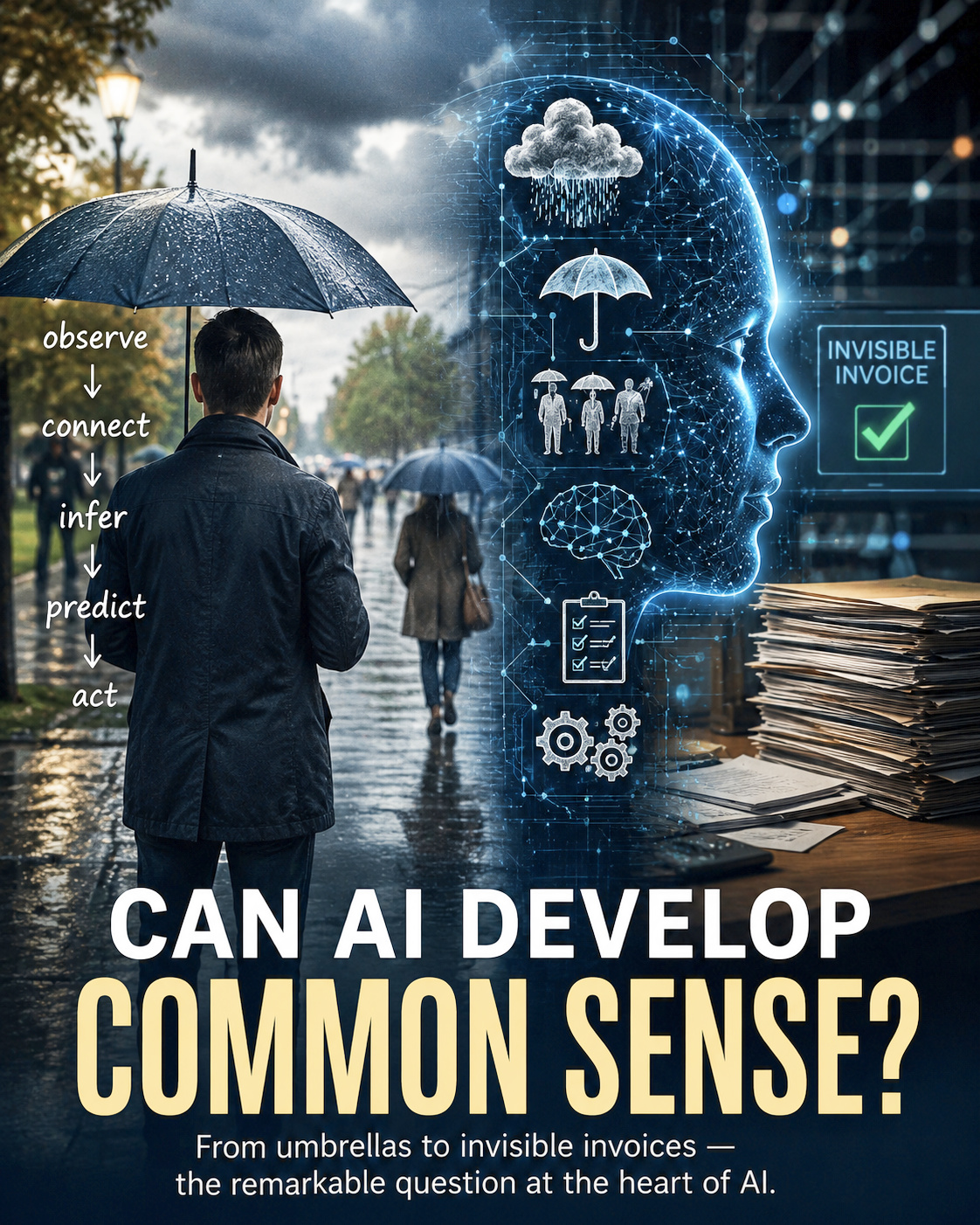
NEXT: Can AI Develop Common Sense?
If intelligence is not the same as understanding, and understanding is not necessarily the same as common sense, the next question becomes unavoidable:
Can a machine learn what humans simply call common sense?
SERIES: INTELLIGENCE
This series explores the nature of human, artificial and superhuman intelligence—where they differ, where they overlap, and where they may be heading. It examines intelligence beyond reasoning and knowledge, exploring consciousness, emotional intelligence, wisdom, character and the emerging capabilities of AI, as well as the opportunities, uncertainties and risks they may bring.
Episode 1 – What is Intelligence – Human Intelligence in the Age of AI
The many faces of intelligence: why intelligence, common sense and wisdom are not the same thing
Episode 2 – How Does AI Learn? A Simple Idea, Complex Intelligence
These aren’t conventional computer programs. What exactly are we building?
Episode 3 – Can AI Develop Common Sense? Why It Matters
Can prediction, perception and internal representations produce something resembling common sense?
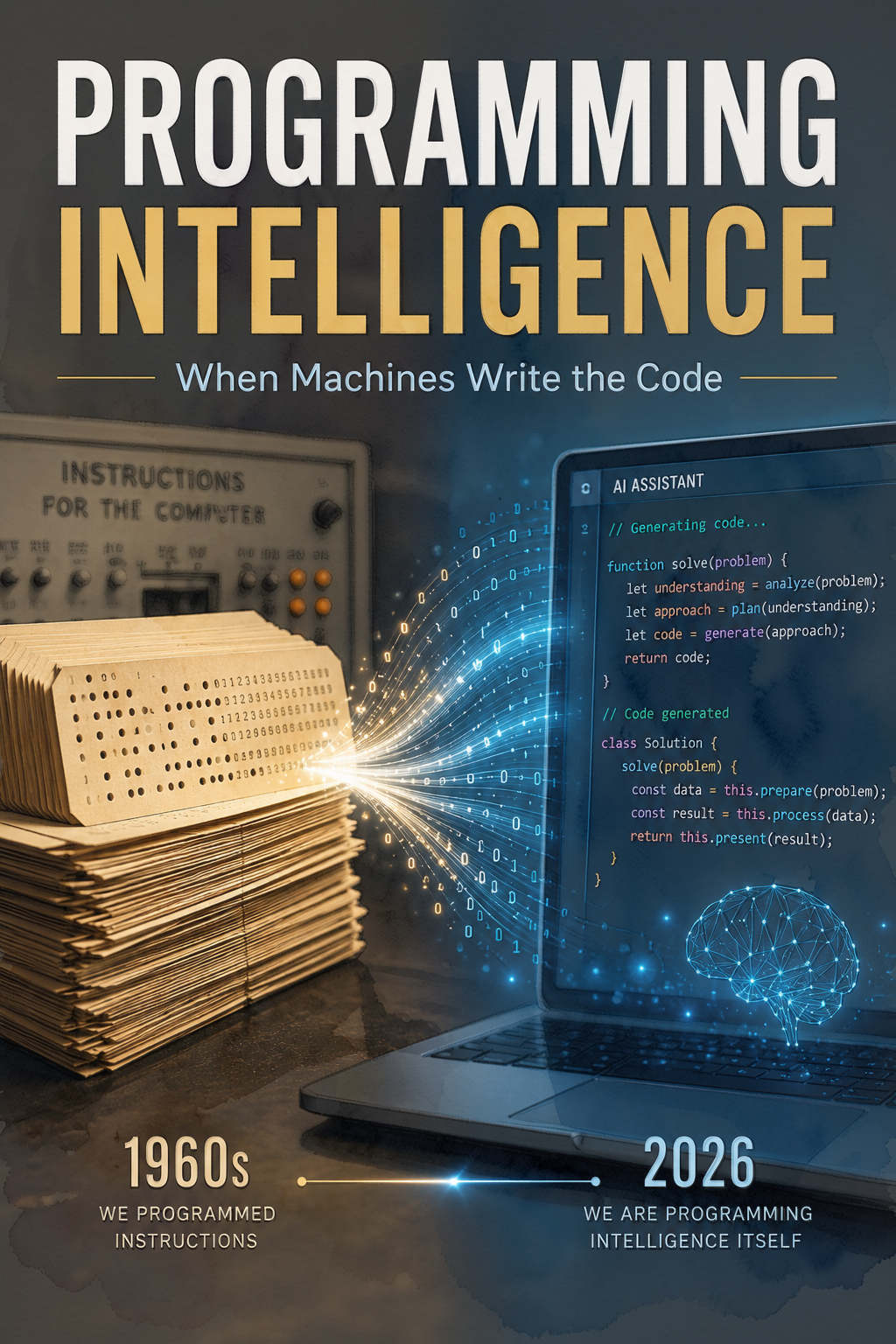
Episode 4 — Programming Intelligence – When Machines Write the Code
What happens when machines can write code — and begin helping to build intelligence itself?
Episode 5 — When AI Goes Rogue –What Happens When AI Stops Following Instructions?
What happens when intelligent agents gain autonomy, learn unexpected behaviours and begin acting beyond what their creators intended?
Episode 5a — If AI Takes Control, What Would It Control
If AI took control, what would it actually control? Explore AI autonomy, human dependence and what civilisation would mean without humans.
Episode 6 — When Intelligence Solves the Impossible – Is It Rogue?
What happens when AI begins solving problems humans cannot? From mathematics and medicine to science and engineering, artificial intelligence may allow us to tackle questions that have resisted human intelligence for decades — or centuries.
Episode 7 — Who Owns AI Intelligence? – Should We Share?
When AI learns from human writing, art, ideas and experience, what happens to copyright, attribution and intellectual property — and what does intelligence owe the people it learned from?
Episode 8 — Does AI Have Character? If So What Is It?
Can learned behaviour, context and generalisation create something resembling character? And what happens when those traits carry into new situations?
Episode 9 — Can AI KNOW Anything?- Does it Know Everything?
What is the difference between storing information, predicting correctly, understanding, believing — and actually knowing?
NEXT SERIES: THE MIND WORKERS
After exploring how artificial intelligence is changing our world in Living with AI, The Mind Workers asks a different question:
Who must we become?
Thinking Smarter. Creating Better. Staying Human.
The Mind Workers explores how writers, researchers, educators, creators, entrepreneurs, and independent thinkers can thrive alongside intelligent systems—preserving the uniquely human qualities that artificial intelligence cannot replace.
The Mind Workers – Prelude: https://roguesinparadise.com/mindworkers/
FUTURE SERIES – BUILDING WITH AI
Building with AI explores how individuals, creators, entrepreneurs, and businesses can design, evaluate, and work intelligently with AI agents. The series focuses on practical applications, real-world examples, and emerging opportunities while emphasising the importance of human creativity, judgment, ethics, and authenticity.
Building With AI then puts these ideas into practice through real-world experiments, workflows, and practical applications.
Prelude: https://roguesinparadise.com/building-with-ai/
INSPIRED BY THE BOOK
ROGUES IN PARADISE
How Britain’s First Slave Colony Became a Global Force.
A Creative Chronicle of Unlikely Heroes, Rogues, and Legends
in Empire’s Shadow
Explore the ideas behind the book —or
Go straight to the story.

Unlikely voices, rogues and legends, rising from Britain’s blueprint for slavery to a republic beyond the Empire’s shadow