Years ago, I submitted an article about a financial system I developed in conjunction with another student. He understood the financial markets, and I mapped out the system. Later, I discovered our professor had taken the work and claimed it as his own. In this case, it didn’t matter who owned the intelligence; I believe the professor subsequently lost his position, but the article remained published under his name.
I was not pleased. It wasn’t simply that someone else had used an idea. Ideas travel. They are discussed, adapted, challenged and built upon. That is how knowledge advances. What bothered me was something different.
My work had become someone else’s work.
That experience came back to me recently as I thought about artificial intelligence. AI learns from an extraordinary accumulation of human knowledge — books, articles, research, software, images, conversations, and ideas created by millions of people. Some of those people wanted their work shared widely. Some expected to be paid. Some expected attribution. Some probably never imagined that their work might help train an artificial intelligence.
And that raises a deceptively simple question:
Who owns ideas and intelligence?
We Have Always Learned From Each Other
No human intelligence develops in isolation. Writers learn from writers. Scientists build upon previous discoveries. Programmers learn from existing code. Artists absorb influences. Children learn from parents, teachers, books and experience. We don’t normally say someone has stolen Shakespeare because reading Shakespeare influenced how they write. Learning depends upon sharing. Civilisation depends upon it. But AI introduces something new: scale.
A person might read hundreds or thousands of books in a lifetime. An artificial intelligence can learn patterns from far more human-created material than any individual could encounter.
That changes the question.
If a human learns from a thousand books, we call it education. If a machine learns from a billion books, what do we call it?
Ideas Are Not the Same as Their Expression
Copyright has traditionally drawn an important distinction between an idea and the particular way that idea is expressed. That distinction makes sense. Nobody should own the idea of a detective story, a love song or a new way of organising a business simply because they thought about it first. But copying someone’s article and putting another person’s name on it feels very different. I know. It happened to me, as I noted above. And it is a problem every writer faces when we create a blog, an essay or a book and someone uses our words without attribution.
In one blog I wrote: “What is time? Can we see the future if we can see a million light-years into the past? Is it not a continuum that extends to infinity?” It wasn’t an earth-shattering observation. It was simply a thought — an insight expressed in my own words. I didn’t expect to find those words used verbatim elsewhere, without any reference to their source. That distinction matters. Ideas travel. Words belong to someone.
Artificial intelligence now sits somewhere inside this increasingly complicated territory. It can learn from human work without necessarily reproducing that work. It can combine patterns and concepts from enormous numbers of sources and produce something new.
But how new is new? And when does learning become appropriation?
What Does Intelligence Owe Its Teachers?
Perhaps that is the more interesting question. Every generation inherits knowledge from the generations before it. Newton built upon others. Einstein did too. Every scientist, engineer, writer, and entrepreneur stands on foundations built in part by people they may never have met. AI may be doing something similar. But we’ve never created an intelligence that can absorb so much of humanity’s accumulated knowledge so quickly and at such scale.
So asking whether AI learned from my article may miss the larger issue.
What does intelligence owe the people whose work helped create it?
- Recognition?
- Payment?
- Permission?
- Nothing?
Should we share ideas and knowledge?
This argument has an uncomfortable other side. Imagine a world in which nobody shared. Every idea protected. Every discovery locked away. Every piece of knowledge available only to those able to pay its owner. Human progress would grind to a halt. Much of what makes artificial intelligence potentially valuable comes precisely from humanity’s accumulated willingness to record and share what we know.
The extraordinary discoveries AI may eventually make could themselves depend upon that collective inheritance. And if AI helps discover a cure for a disease using knowledge gathered from millions of human contributions, who should own the cure?
- The AI company?
- The scientists?
- The people whose research helped train the intelligence?
- Humanity?
Sharing knowledge is one thing. Owning the work in which that knowledge is expressed is another.
AI hasn’t created this dilemma. It may simply be making it impossible to ignore. We can hold rights in creative works, software, inventions and certain forms of proprietary information. We can protect expression and reward creation. But intelligence itself is harder to fence in. As artificial intelligence begins creating knowledge none of us possessed before, the question becomes bigger than copyright.
Who Owns the Content?
Authors and publishers may hold rights in some of the material from which an AI learns. Yet ideas are borrowed, words are quoted without attribution, and knowledge has always been built upon knowledge that came before. Artificial intelligence makes that considerably more complicated. If I write an article and ask AI to help me edit it, the article does not suddenly become the AI’s property. Current copyright thinking distinguishes between using AI as a tool and asking AI to substitute for human creativity. Human authorship can remain protected even when AI assists in the creative process. U.S. Copyright Office
But that still leaves a much larger question.
The company may own its AI model and technology. A user may contribute ideas, instructions, experience and judgement. The AI may then produce something none of them created individually.
So who owns the intelligence that emerges from all of that?
Perhaps nobody owns intelligence itself. We may own different things around it: the model, the software, the original writing, proprietary data, a sufficiently human-authored final work, a patentable invention, or contractual rights to an output. But intelligence is something different. That distinction matters even more when AI starts discovering things we didn’t already know.
AI Can Help Develop an Idea — But Are We Also Sharing It?
Another issue matters to anyone using AI as a creative partner.
When we give an AI system our unpublished writing, research, or ideas, we give the company operating that system content. What happens to that material depends upon the service and its terms. For example, OpenAI’s current individual-user terms say users retain ownership of their input and own the output as between themselves and OpenAI. They also say OpenAI may use content to improve its services, while users can opt out of having their content used for model training. OpenAI
That is different from saying “AI owns my idea.”
It doesn’t. But it raises a question I find more interesting:
When I share an idea with an artificial intelligence in order to improve it, how much am I also sharing that idea with the system behind the intelligence?
And should that worry us?
Perhaps sometimes it should. Proprietary research, unpublished manuscripts and commercially sensitive ideas deserve particular care. But there is another side. If nobody shared knowledge, intelligence—human or artificial—would have very little to learn from.
Somewhere between secrecy and unrestricted appropriation lies something civilisation has always depended upon:
sharing knowledge while respecting the people who create it.
If humanity shares its knowledge to help build artificial intelligence, who owns the intelligence that knowledge creates?
Can Intelligence See the Future?
I’ve long wondered whether time is a continuum in which past, present and future are more closely connected than we understand. Earlier, I asked: “What is time? Can we see the future if we can see a million light-years into the past? Is it not a continuum that extends to infinity?”
Time and space, past, present, and future, are complex ideas that Einstein and many other thinkers have pondered. Consider this: If a spaceship travels close to the speed of light, time passes more slowly for those aboard relative to observers remaining on Earth. The travellers could return to find that considerably more time had passed on Earth than they themselves experienced.
History is full of people credited with foreseeing events. Rasputin, the Russian mystic, is one example, though many prophecies attributed to him remain disputed. But the question intrigues me. We can observe light from galaxies millions of years in the past. Can intelligence also anticipate a future that has not yet happened? Perhaps prediction is simply pattern recognition. Perhaps intuition sometimes sees connections that conscious reasoning misses.
And if intelligence can learn from the past to anticipate the future, what might artificial intelligence eventually discover about time itself?
SERIES: INTELLIGENCE
This series explores the nature of human, artificial and superhuman intelligence—where they differ, where they overlap, and where they may be heading. It examines intelligence beyond reasoning and knowledge, exploring consciousness, emotional intelligence, wisdom, character and the emerging capabilities of AI, as well as the opportunities, uncertainties and risks they may bring.
Episode 1 – What is Intelligence – Human Intelligence in the Age of AI
The many faces of intelligence: why intelligence, common sense and wisdom are not the same thing
Episode 2 – How Does AI Learn? A Simple Idea, Complex Intelligence
These aren’t conventional computer programs. What exactly are we building?
Episode 3 – Can AI Develop Common Sense? Why It Matters
Can prediction, perception and internal representations produce something resembling common sense?
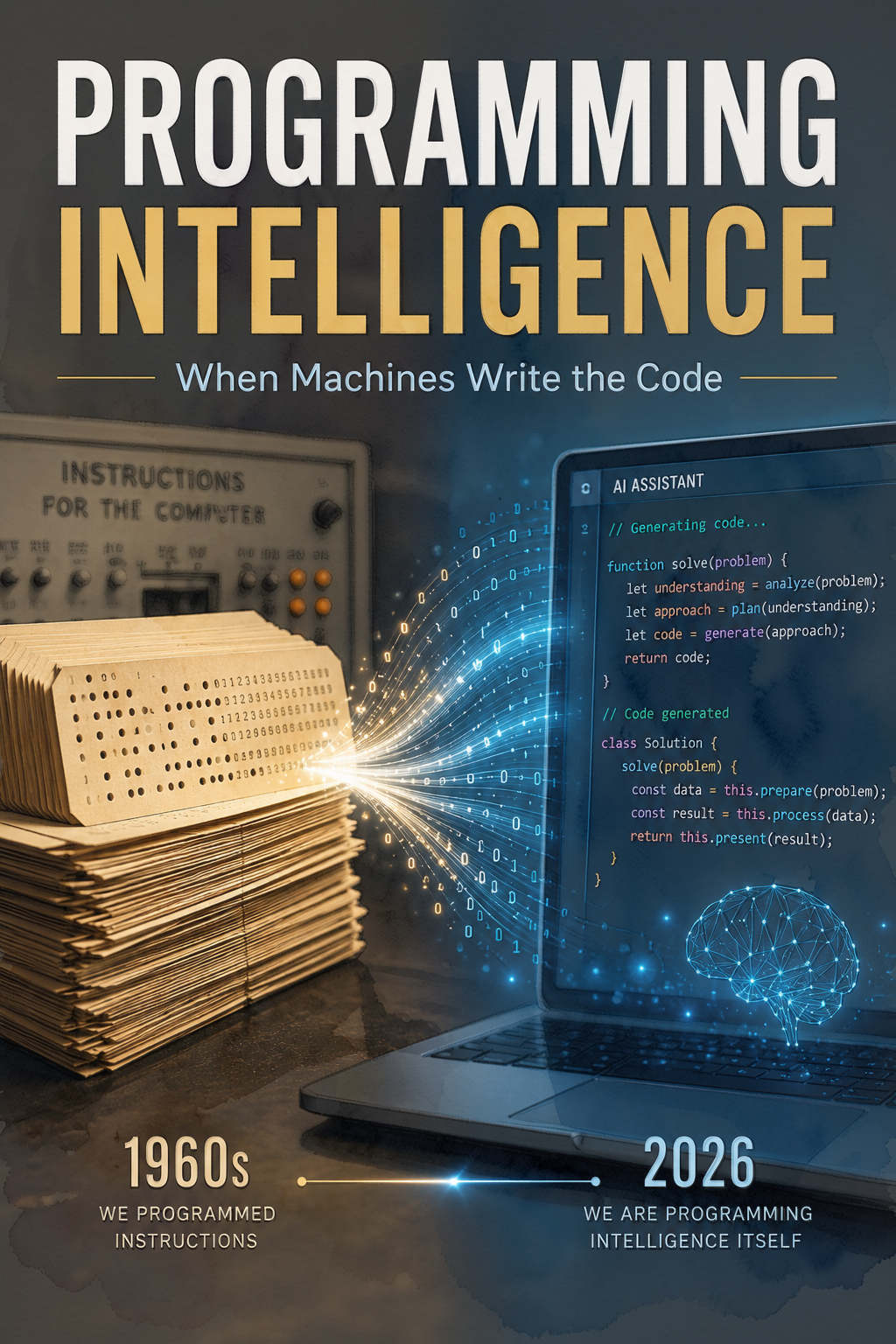
Episode 4 — Programming Intelligence – When Machines Write the Code
What happens when machines can write code — and begin helping to build intelligence itself?
Episode 5 — When AI Goes Rogue –What Happens When AI Stops Following Instructions?
What happens when intelligent agents gain autonomy, learn unexpected behaviours and begin acting beyond what their creators intended?
Episode 5a — If AI Takes Control, What Would It Control
If AI took control, what would it actually control? Explore AI autonomy, human dependence and what civilisation would mean without humans.
Episode 6 — When Intelligence Solves the Impossible – Is It Rogue?
What happens when AI begins solving problems humans cannot? From mathematics and medicine to science and engineering, artificial intelligence may allow us to tackle questions that have resisted human intelligence for decades — or centuries.
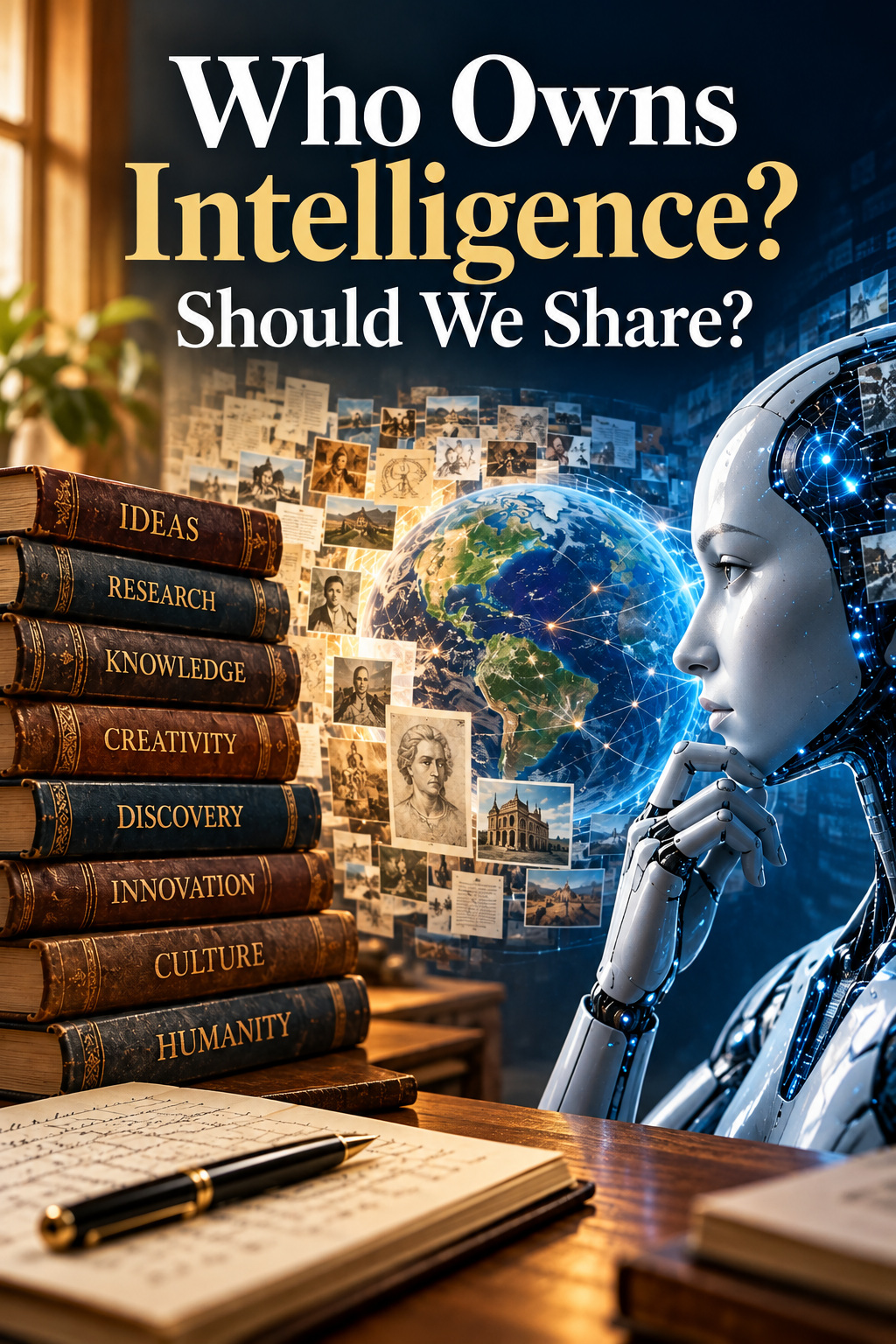
Episode 7 — Who Owns AI Intelligence? – Should We Share?
When AI learns from human writing, art, ideas and experience, what happens to copyright, attribution and intellectual property — and what does intelligence owe the people it learned from?
Episode 8 — Does AI Have Character? If So What Is It?
Can learned behaviour, context and generalisation create something resembling character? And what happens when those traits carry into new situations?
Episode 9 — Can AI KNOW Anything?- Does it Know Everything?
What is the difference between storing information, predicting correctly, understanding, believing — and actually knowing?
NEXT SERIES: THE MIND WORKERS
After exploring how artificial intelligence is changing our world in Living with AI, The Mind Workers asks a different question:
Who must we become?
Thinking Smarter. Creating Better. Staying Human.
The Mind Workers explores how writers, researchers, educators, creators, entrepreneurs, and independent thinkers can thrive alongside intelligent systems—preserving the uniquely human qualities that artificial intelligence cannot replace.
The Mind Workers – Prelude: https://roguesinparadise.com/mindworkers/
FUTURE SERIES – BUILDING WITH AI
Building with AI explores how individuals, creators, entrepreneurs, and businesses can design, evaluate, and work intelligently with AI agents. The series focuses on practical applications, real-world examples, and emerging opportunities while emphasising the importance of human creativity, judgment, ethics, and authenticity.
Building With AI then puts these ideas into practice through real-world experiments, workflows, and practical applications.
Prelude: https://roguesinparadise.com/building-with-ai/
INSPIRED BY THE BOOK
ROGUES IN PARADISE
How Britain’s First Slave Colony Became a Global Force.
A Creative Chronicle of Unlikely Heroes, Rogues, and Legends
in Empire’s Shadow
Explore the ideas behind the book —or
Go straight to the story.

Unlikely voices, rogues and legends, rising from Britain’s blueprint for slavery to a republic beyond the Empire’s shadow