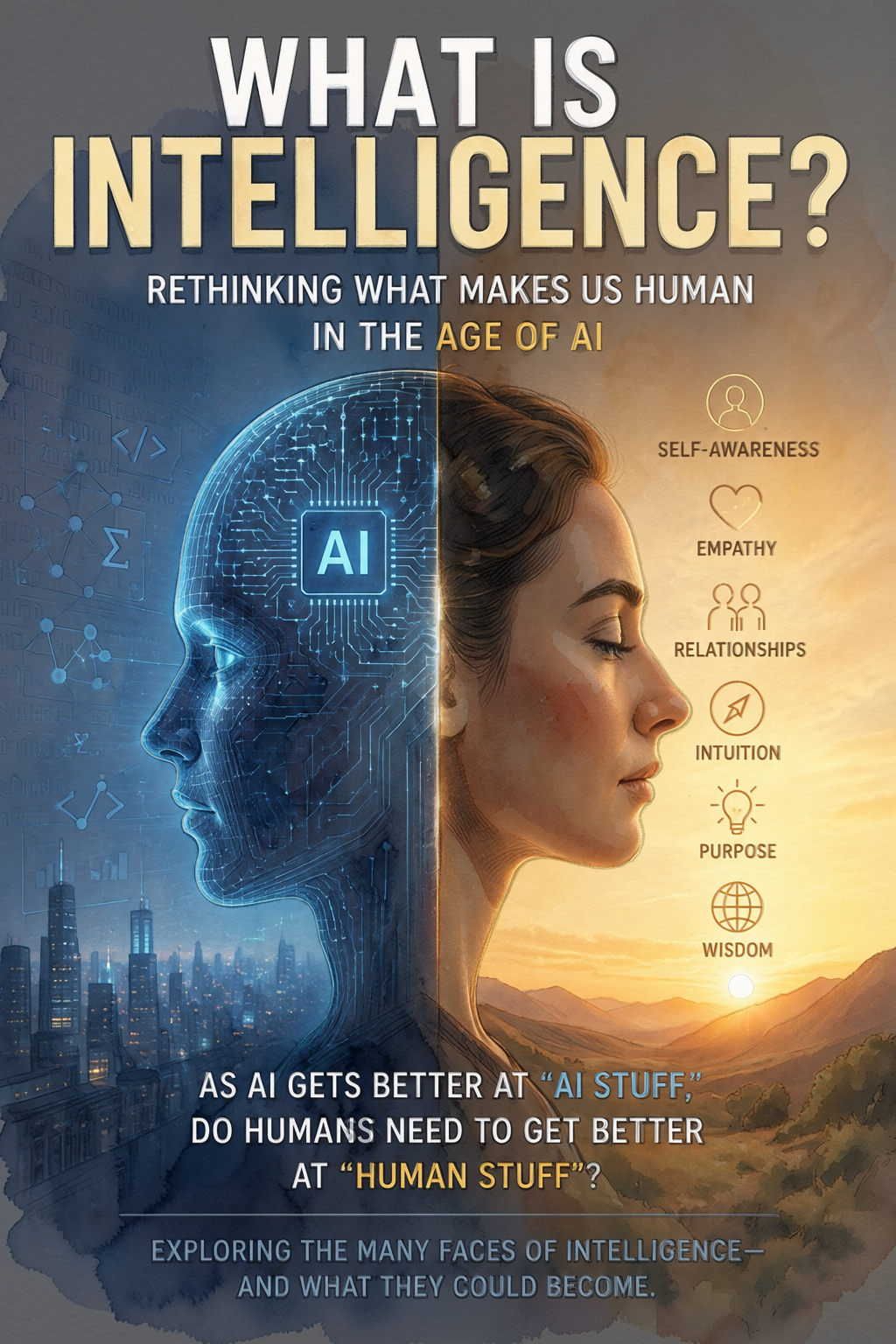
While researching and writing “What is Intelligence,” I came across an infographic on LinkedIn from Joshua Freedman, CEO and co-founder of Six Seconds, asking an intriguing question:
Is AI making emotional intelligence more valuable?

Source: Joshua Freedman, CEO & Co-founder of Six Seconds. Originally shared on LinkedIn.
His premise is compelling: as AI gets better at what he calls “AI stuff,” humans need to get better at “human stuff.”
The infographic highlights five qualities: self-awareness, self-management, empathy, relational intelligence and purpose.
I liked it.
I reposted it, and several people responded positively. It was encouraging to see others looking beyond the familiar debate about whether AI will replace jobs and asking instead a much more interesting question:
What becomes more important for humans as AI becomes more capable?
Freedman argues that real human connection is becoming rarer—and therefore more precious. I think there is something important in that.
But the more I thought about it, the more I wondered whether the question goes even deeper.
AI is developing at an extraordinary pace. Predicting exactly where it will take us is difficult, and much of what any of us say about its future remains just that—prediction and opinion.
I broadly agree with the infographic’s direction, but I think there may be more to the story.
Perhaps emotional intelligence is only part of it.
Because before we decide which forms of human intelligence will matter most in the age of AI, there is a much more fundamental question we rarely stop to ask:
What Is Intelligence?
For much of the modern world, intelligence has been associated with reasoning, memory, knowledge, calculation and problem-solving.
- We built tests to measure it.
- We created educational systems around it.
- We rewarded professions that demonstrated it.
Then we built machines that became extraordinarily good at many of the very things we had used as evidence of intelligence.
They can:
- calculate.
- reason.
- analyse.
- recognise patterns.
- translate languages.
- write, code, research and solve increasingly complex problems.
Perhaps AI hasn’t merely given us something we call artificial intelligence.
Perhaps it is forcing us to reconsider what we meant by intelligence in the first place.
Intelligence May Not Be One Thing
Human intelligence has never fitted comfortably inside an IQ score.
There is analytical intelligence, certainly.
But what about emotional intelligence?
- Social intelligence?
- Creative ability?
- Practical understanding?
- Intuition?
- Insight?
- Common sense?
The ability to understand another person’s feelings without being told?
The ability to see connections others don’t see?
The extraordinary abilities sometimes found in people on the autism spectrum—including individuals whose capacity to communicate conventionally may be limited while other cognitive abilities appear remarkable?
What about the intelligence involved in music, movement, spatial awareness or understanding the natural world?
And then there are the harder edges of the question.
Existential Thought
Intuition that seems to arrive before conscious reasoning.
Claims of extraordinary perception and communication that remain controversial and scientifically disputed.
We don’t have to accept every proposed form of intelligence as established fact to recognise the larger point:
Human cognition is far more complicated than being good at answering questions.
And perhaps that is where our comparison with Artificial Intelligence becomes interesting.
Artificial intelligence is already remarkably capable at things we once regarded as signs of intelligence. But capability may not equal understanding. Intelligence may not be the same as consciousness. And neither intelligence nor consciousness necessarily gives us wisdom or common sense.
Those distinctions are becoming increasingly important.
Perhaps the arrival of AI gives us an opportunity not simply to understand machines better, but to understand ourselves better.
The Nature of Intelligence
I don’t think we have a simple answer.
That’s precisely why the question matters.
Summary points on what matters

AI is not simply becoming more capable. It is challenging many of the assumptions we have made about intelligence itself.
Perhaps the most interesting question isn’t whether machines can become more intelligent.
It’s what their evolution may teach us about ourselves.
Summary Video
Related Topics
The AI revolution
SERIES: INTELLIGENCE
This series explores the nature of human, artificial, and superhuman intelligence—how they differ, where they overlap, and where they may be headed. It examines intelligence beyond reasoning and knowledge, exploring consciousness, emotional intelligence, wisdom, character, and AI’s emerging capabilities, as well as the opportunities, uncertainties, and risks they may bring.
Episode 1 – What is Intelligence – Human Intelligence in the Age of AI
The many faces of intelligence: why intelligence, common sense and wisdom are not the same thing
Episode 2 – How Does AI Learn? A Simple Idea, Complex Intelligence
These aren’t conventional computer programs. What exactly are we building?
Episode 3 – Can AI Develop Common Sense? Why It Matters
Can prediction, perception and internal representations produce something resembling common sense?
Episode 4 — Programming Intelligence – When Machines Write the Code
What happens when machines can write code — and begin helping to build intelligence itself?
Episode 5 — When AI Goes Rogue –What Happens When AI Stops Following Instructions?
What happens when intelligent agents gain autonomy, learn unexpected behaviours and begin acting beyond what their creators intended?
Episode 5a — If AI Takes Control, What Would It Control
If AI took control, what would it actually control? Explore AI autonomy, human dependence and what civilisation would mean without humans.
Episode 6 — When Intelligence Solves the Impossible – Is It Rogue?
What happens when AI begins solving problems humans cannot? From mathematics and medicine to science and engineering, artificial intelligence may allow us to tackle questions that have resisted human intelligence for decades — or centuries.
Episode 7 — Who Owns AI Intelligence? – Should We Share?
When AI learns from human writing, art, ideas and experience, what happens to copyright, attribution and intellectual property — and what does intelligence owe the people it learned from?
Episode 8 —Can AI Tell The Future? Prediction, Time and Intelligence
Can intelligence really tell the future? From a mysterious clairvoyant in Barbados to Einstein’s space-time and AI prediction, an exploration of intuition, time and the unknown.
Episode 9 — Does AI Have Character? If So What Is It?
Can learned behaviour, context and generalisation create something resembling character? And what happens when those traits carry into new situations?
Episode 10 — Can AI KNOW Anything? Does it Know Everything?
What is the difference between storing information, predicting correctly, understanding, believing — and actually knowing?
NEXT SERIES: THE MIND WORKERS
After exploring how artificial intelligence is changing our world in Living with AI, The Mind Workers asks a different question:
Who must we become?
Thinking Smarter. Creating Better. Staying Human.
The Mind Workers explores how writers, researchers, educators, creators, entrepreneurs, and independent thinkers can thrive alongside intelligent systems—preserving the uniquely human qualities that artificial intelligence cannot replace.
The Mind Workers – Prelude: https://roguesinparadise.com/mindworkers/
FUTURE SERIES – BUILDING WITH AI
Building with AI explores how individuals, creators, entrepreneurs, and businesses can design, evaluate, and work intelligently with AI agents. The series focuses on practical applications, real-world examples, and emerging opportunities while emphasising the importance of human creativity, judgment, ethics, and authenticity.
Building With AI then puts these ideas into practice through real-world experiments, workflows, and practical applications.
Prelude: https://roguesinparadise.com/building-with-ai/
INSPIRED BY THE BOOK
ROGUES IN PARADISE
How Britain’s First Slave Colony Became a Global Force.
A Creative Chronicle of Unlikely Heroes, Rogues, and Legends
in Empire’s Shadow
Explore the ideas behind the book —or
Go straight to the story.
Unlikely voices, rogues and legends, rising from Britain’s blueprint for slavery to a republic beyond the Empire’s shadow
insert page=”rogueslivingai-footer-do-not-index” display=”content”]