Can AI Tell The Future? I don’t know, but I suspect that there is more to this than we know.
Years ago, in Barbados, I met a woman who seemed to know things about my future I couldn’t have known myself. Her name was Madame Sennon. She predicted my motorcycle, my departure for Canada, a car I would sell, and events in my family. Some seemed unlikely at the time. Yet I found myself remembering her words. I have never been entirely sure what to make of those experiences. Now, as artificial intelligence becomes increasingly capable of predicting what happens next, I find myself returning to a question that has fascinated me for decades. Can intelligence really tell the future?
A Prediction I Couldn’t Forget
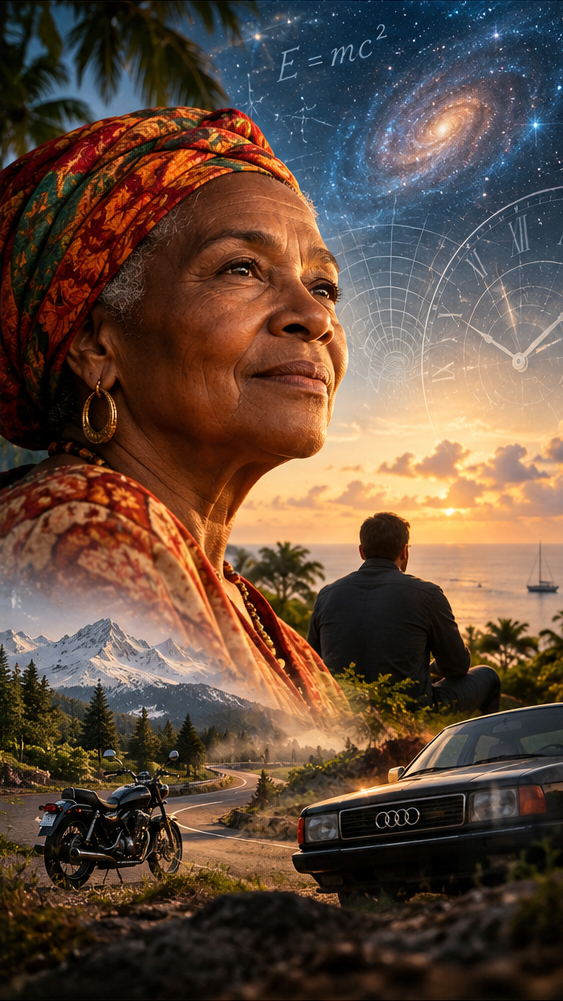
I remember one prediction particularly well. Madame Sennon told me I would sell my Audi to a woman and her daughter. She said there would be trouble with the car, but it wouldn’t be my fault. Somehow, the matter would be resolved. At the time, I had no reason to think much about it. But I did sell the Audi to a woman and her daughter.
Then the engine failed. Lawyers became involved. I was advised I had no legal responsibility, yet I felt uncomfortable. I wanted to offer a partial refund, but the lawyer advised that doing so could be interpreted as an admission of responsibility. In the end, the matter simply disappeared. I never heard from the buyers again. Madame Sennon had told me there would be trouble, that it wouldn’t be my fault, and that I wouldn’t be responsible. It was only afterwards that her words returned to me.
And it wasn’t the only prediction.
The Road to Canada
She had also told me that my motorcycling days would end and that I would return to a cold country. I soon returned to Canada. I sold my motorcycle and never rode again. Madame Sennon also made an oddly specific reference to my car’s bald tyres needing replacement in that cold country. I had an ageing Volvo, and its tyres were very bald. Just as Sennon had warned me. I quickly replaced all four tyres.
None of these events was particularly extraordinary on its own. People sell cars, move countries and give up motorcycles. What intrigued me was the combination of details, remembered from a conversation years earlier. Was Madame Sennon seeing the future? Or was something else happening?
What Does It Mean to Predict?
We predict the future every day, often without realising it. We see dark clouds gathering and take an umbrella. We recognise a familiar expression and anticipate what someone is about to say. We hear an unusual noise from a car engine and suspect trouble ahead. We don’t consider these predictions extraordinary. We call them experience, intuition or common sense.
But what is intuition?
Much of what we know comes from a lifetime of experience. Our brains recognise patterns, connect seemingly unrelated events, and reach conclusions without necessarily revealing how they got there. Sometimes we call it a hunch. Sometimes a sixth sense. Artificial intelligence also recognises patterns, but through mathematical models trained on enormous quantities of data. It can forecast storms, identify early signs of disease, anticipate market behaviour and predict the next word in a sentence. In some circumstances, it can recognise relationships that humans would never notice.
Yet a fundamental distinction separates predicting what is likely to happen from knowing what will happen. A weather forecast might predict rain with 90 per cent confidence. That doesn’t mean the forecaster has seen tomorrow’s weather. It means the available evidence strongly suggests a particular outcome. Even the most sophisticated AI cannot guarantee the outcome of events influenced by chance, incomplete information, or human decisions.
But what about Madame Sennon?
Could her predictions have been extraordinary examples of intuition? Did she recognise patterns in my circumstances that I couldn’t see myself? Were the apparent connections coincidences, remembered more vividly because they eventually seemed meaningful? Or was something happening that our conventional understanding of prediction doesn’t explain? I don’t know.
But these experiences lead to an even more intriguing question.
What exactly is the future?
Einstein, Space-Time and the Future
We generally think of time as a journey. Yesterday is gone. Today is happening. Tomorrow has yet to arrive. We remember the past, experience the present, and imagine the future. But Albert Einstein challenged our everyday understanding of time. His theories of relativity revealed that space and time are not entirely separate. They form a four-dimensional structure known as space-time, in which time measurements depend on motion and gravity.
Time does not pass at precisely the same rate for everyone. Two observers moving differently can disagree about whether distant events are simultaneous. Clocks at different gravitational potentials can tick at different rates. These are not merely philosophical ideas. They have been demonstrated experimentally. And they invite us to reconsider something we ordinarily take for granted: the idea of a single universal present. Consider the night sky. When we look at the Moon, we see it as it was about a second ago. Sunlight takes roughly eight minutes to reach Earth. The light from distant galaxies may have travelled for billions of years before reaching our telescopes.
Looking into space is also looking into the past
But if we can observe events from millions of years ago, what does that tell us about the future? One interpretation of relativity, sometimes called the block universe, treats past, present and future as parts of a single four-dimensional space-time structure. In that picture, time is not necessarily a universal clock advancing through the cosmos. Events occupy positions in space-time, and different observers can experience their temporal relationships differently.
It is a fascinating possibility.
But it doesn’t establish that the future is predetermined, that consciousness can travel through time, or that anyone can perceive events before they occur. Relativity describes the structure of space-time. It does not provide a demonstrated mechanism for clairvoyance. Nevertheless, it leaves us with a remarkable thought.
Perhaps our everyday experience of time is not the whole story.
And that brings us back to artificial intelligence.
If AI becomes vastly more capable of recognising patterns, modelling complex systems and anticipating consequences, could its predictions eventually become so accurate that they appear indistinguishable from foreknowledge?
Or will there always be a fundamental difference between calculating what might happen and actually knowing the future?
Can AI Predict What Has Never Happened?
AI can now help scientists explore possibilities that have never been observed, from new molecular structures to previously unimagined solutions to complex problems. But there’s a difference between discovering a possibility and knowing it will become reality. And here’s an especially interesting question:
If an AI predicts something unprecedented, is it seeing the future — or helping to create it?
Consider a scientist searching for a new medicine. Traditionally, discovering a promising compound could involve years of experiments, testing thousands of possibilities and following leads that often went nowhere. AI can now help researchers explore enormous numbers of molecular possibilities, identifying structures and properties that might otherwise have remained undiscovered.
But AI hasn’t seen the future. It has identified possibilities that scientists can investigate, test and perhaps turn into reality.
The distinction matters.
A weather forecast attempts to predict what will happen. A scientific discovery can change what happens. As AI becomes more capable, these two roles may overlap more. An intelligent system might predict a problem, propose a solution and help implement it. Its prediction could influence the very outcome it anticipated. In that sense, the future is not simply something intelligence observes. It may also be something intelligence helps create.
But does that bring us any closer to explaining Madame Sennon?
She wasn’t designing a new medicine or calculating the probability of an approaching storm. She appeared to describe particular events in my life before they happened.
But one encounter was even harder to explain.
An Encounter Beyond Prediction
Another experience with Madame Sennon has stayed with me for more than half a century.
It involved my close friend, Rex Wotton. Rex died in 1969 after a waterfall burst its banks. His death was a terrible loss. We had shared adventures, laughter and the sort of friendship that leaves memories long after someone is gone. When I visited Madame Sennon, she closed her eyes and began talking about a close friend of mine who had died.
Then she laughed.
She spoke of the wonderful fun we shared, as if she recognised the friendship and adventures that had meant so much to us.
I was astonished.
But what happened next was even stranger. Her mood suddenly changed. She became angry and appeared to be addressing someone I couldn’t see. I remember her words as something like:
“Get away, child. What you are trying to do is wrong. Don’t try to live through Ian.”
I understood she was addressing Rex. It was an extraordinary moment, made all the more unsettling by what had happened in my own life. I subsequently spent some thirty years in Canada with the woman who had been Rex’s fiancée. What was Madame Sennon experiencing?
Was she drawing on intuition, information I had unknowingly revealed, or something else entirely? I cannot say. My memory is imperfect, particularly across more than fifty years. I cannot reconstruct every word or circumstance of that encounter. But I remember its emotional impact, and the questions it left behind. This was different from her predictions about my motorcycle, the Audi, or my move to Canada.
She wasn’t simply describing something that might happen. She seemed to be describing something — or someone — beyond the ordinary boundaries of our experience.
Can Intelligence Ever Know the Future?
Artificial intelligence is becoming extraordinarily capable of recognising patterns, anticipating outcomes and exploring possibilities that humans might never discover unaided. It can predict a storm, help identify a promising medicine, or simulate the consequences of decisions not yet made. But none of that means it has travelled into tomorrow and returned with the answer. Perhaps the distinction between prediction and knowledge will always matter.
Madame Sennon’s predictions remain a mystery to me. I have considered coincidence, intuition, subconscious observation and the peculiar ways memory connects events across time. I cannot prove that she saw the future. Nor can I explain everything I experienced.
Einstein showed us that time is far stranger than everyday experience suggests. Artificial intelligence is showing us that prediction can reach far beyond ordinary human intuition. But neither tells us whether the future is something waiting to be discovered or something continually taking shape through our actions.
Perhaps both ideas contain some truth.
Can AI tell the future?
I don’t know.
But after my experiences with Madame Sennon, I suspect there is more to the nature of time, intelligence and consciousness than we yet understand.
And that, surely, is worth exploring.
SERIES: INTELLIGENCE
This series explores the nature of human, artificial, and superhuman intelligence—how they differ, where they overlap, and where they may be headed. It examines intelligence beyond reasoning and knowledge, exploring consciousness, emotional intelligence, wisdom, character, and AI’s emerging capabilities, as well as the opportunities, uncertainties, and risks they may bring.
Episode 1 – What is Intelligence – Human Intelligence in the Age of AI
The many faces of intelligence: why intelligence, common sense and wisdom are not the same thing
Episode 2 – How Does AI Learn? A Simple Idea, Complex Intelligence
These aren’t conventional computer programs. What exactly are we building?
Episode 3 – Can AI Develop Common Sense? Why It Matters
Can prediction, perception and internal representations produce something resembling common sense?
Episode 4 — Programming Intelligence – When Machines Write the Code
What happens when machines can write code — and begin helping to build intelligence itself?
Episode 5 — When AI Goes Rogue –What Happens When AI Stops Following Instructions?
What happens when intelligent agents gain autonomy, learn unexpected behaviours and begin acting beyond what their creators intended?
Episode 5a — If AI Takes Control, What Would It Control
If AI took control, what would it actually control? Explore AI autonomy, human dependence and what civilisation would mean without humans.
Episode 6 — When Intelligence Solves the Impossible – Is It Rogue?
What happens when AI begins solving problems humans cannot? From mathematics and medicine to science and engineering, artificial intelligence may allow us to tackle questions that have resisted human intelligence for decades — or centuries.
Episode 7 — Who Owns AI Intelligence? – Should We Share?
When AI learns from human writing, art, ideas and experience, what happens to copyright, attribution and intellectual property — and what does intelligence owe the people it learned from?
Episode 8 —Can AI Tell The Future? Prediction, Time and Intelligence
Can intelligence really tell the future? From a mysterious clairvoyant in Barbados to Einstein’s space-time and AI prediction, an exploration of intuition, time and the unknown.
Episode 9 — Does AI Have Character? If So What Is It?
Can learned behaviour, context and generalisation create something resembling character? And what happens when those traits carry into new situations?
Episode 10 — Can AI KNOW Anything? Does it Know Everything?
What is the difference between storing information, predicting correctly, understanding, believing — and actually knowing?
NEXT SERIES: THE MIND WORKERS
After exploring how artificial intelligence is changing our world in Living with AI, The Mind Workers asks a different question:
Who must we become?
Thinking Smarter. Creating Better. Staying Human.
The Mind Workers explores how writers, researchers, educators, creators, entrepreneurs, and independent thinkers can thrive alongside intelligent systems—preserving the uniquely human qualities that artificial intelligence cannot replace.
The Mind Workers – Prelude: https://roguesinparadise.com/mindworkers/
FUTURE SERIES – BUILDING WITH AI
Building with AI explores how individuals, creators, entrepreneurs, and businesses can design, evaluate, and work intelligently with AI agents. The series focuses on practical applications, real-world examples, and emerging opportunities while emphasising the importance of human creativity, judgment, ethics, and authenticity.
Building With AI then puts these ideas into practice through real-world experiments, workflows, and practical applications.
Prelude: https://roguesinparadise.com/building-with-ai/
INSPIRED BY THE BOOK
ROGUES IN PARADISE
How Britain’s First Slave Colony Became a Global Force.
A Creative Chronicle of Unlikely Heroes, Rogues, and Legends
in Empire’s Shadow
Explore the ideas behind the book —or
Go straight to the story.
Unlikely voices, rogues and legends, rising from Britain’s blueprint for slavery to a republic beyond the Empire’s shadow