Beyond Product Marketing is the core of The New Mind Workers. We aren’t traditional marketers—we lead with service and ideas, not products, pioneering a new way to make meaningful work known.
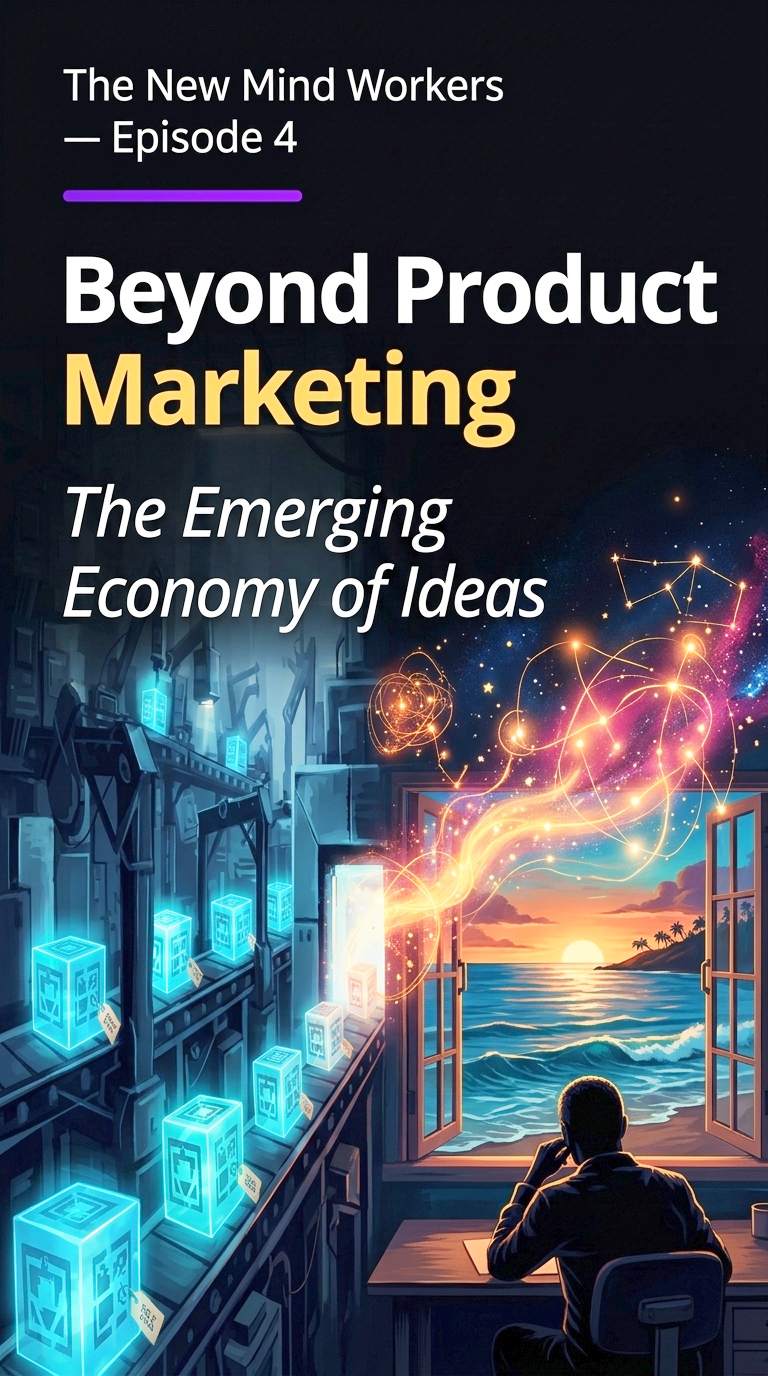
The New Mind Workers — Episode 4
Beyond Product Marketing: The Economy of Ideas
As I have explored this emerging universe of AI tools, one pattern has stood out above the rest. Alongside traditional product-centred marketing, a new focus on mind workers is taking shape. Creative thinking, mindful endeavour, and human intelligence will play a leading role in our future—yet almost every system we use is still built for traditional product sales. And the tools required for each are entirely different.
The Architecture of the Commercial Internet
Look at almost any mainstream marketing platform, analytics dashboard, or new AI software launch today, and you will see the same underlying assumption: you are trying to sell a product. The modern internet was built around funnels, conversions, affiliate commissions, and buyer intent. Every button, algorithm, and automated workflow is designed to move a stranger from a search query to a checkout page as quickly as possible.
There is nothing inherently wrong with commerce. Products and services keep the world moving.
But what happens when your greatest asset is not a physical product or a software subscription—but an idea, a body of research, a story, or a lifetime of lived experience?
Inside the “AI Agent Farm”
Recently, I studied the launch of a new wave of automated AI marketing platforms. Their pitch is revealing—not because it is unique, but because it captures where commercial AI is heading. The old model of AI content was simple and passive: you prompted a machine to write a blog post, published it on a website, and hoped Google or social media would somehow send traffic your way. Most of the time, those generic sites sat empty.
The new model replaces passive tools with coordinated teams of AI agents. A central coordinator agent directs specialised sub-agents—one to research trending buyer questions, another to build websites, another to generate videos and articles, and an analyst agent to track clicks and commissions.
Instead of building one thoughtful project, users are encouraged to “plant” dozens of automated sites across different niches, treat content as a numbers game, and let the software scale whichever site harvests the most affiliate commissions.
- From a purely technical standpoint, the orchestration is clever. Coordinated agents with shared memory can research, adapt, and learn from real-world feedback far better than a single chatbot ever could.
- From a human standpoint, however, it reveals a profound divide.
Commercial Agent Farms vs. The Mind Worker’s Studio
When intelligent agents are built purely for product extraction, they optimise for volume, speed, and transaction.
Mind Workers’ needs are beyond product marketing.
- The Starting Point
Commercial Agent Farms begin with an affiliate offer, a product, or a local lead niche.
The Mind Worker’s Studio begins with an original question, a research insight, or a lived story. - The Role of AI Agents
Commercial Agent Farms mass-produce properties and hunt for active buyers.
The Mind Worker’s Studio organises knowledge, tests assumptions, and simplifies sharing. - The Core Strategy
Commercial Agent Farms plant dozens of sites and scale whatever converts fastest.
The Mind Worker’s Studio creates one substantial work and shares it thoughtfully. - The Success Metric
Commercial Agent Farms measure clicks, leads, and short-term commissions.
The Mind Worker’s Studio measures trust, meaningful dialogue, and intellectual clarity.
A mind worker does not start by asking, “What product is trending today so I can capture commissions?”
Writers, researchers, educators, and independent thinkers start from curiosity. We spend months—sometimes years—gathering evidence, connecting disparate ideas, and trying to understand something worth sharing.
When you force an author or researcher into a toolbox built for affiliate marketing, everything feels slightly misaligned:
- Research tools look for high-volume “buyer keywords” instead of deep, unexplored questions.
- Distribution tools encourage churning out endless variations rather than preserving the integrity of a single original piece.
- Analytics dashboards celebrate fleeting clicks and impressions while ignoring whether anyone actually read, understood, or was moved by the work.
Reimagining the Same Technology for Ideas
Here is the real opportunity—and why we do not need to reject intelligent technology to stay human.
The exact same agent architecture being used to run automated affiliate farms can be reimagined to serve the distinct needs of mind workers.
Imagine an intelligent system designed not to flood the internet with noise, but to act as a thoughtful studio partner:
- A Research Companion that helps you cross-reference your own archives, surface forgotten notes, and challenge your assumptions.
- An Editorial Assistant that helps structure complex ideas into clear articles, audio, or visual presentations without flattening your voice.
- A Mindful Distribution Agent that takes one substantial piece of work and helps share it selectively with the communities that genuinely care—without forcing you to rewrite the same message forty-eight times.
- A Meaningful Lens that measures genuine readership, thoughtful responses, and time saved rather than vanity metrics.
Where is Beyond Product Marketing Headed Next
We are entering an economy where routine information is abundant, but trusted human insight, original synthesis, and creative wisdom are becoming rare, and increasingly valuable. Product marketing will always have its place. But mind workers no longer need to borrow tools built for an assembly line when their real work happens in a studio. Understanding what mind workers truly need—and evaluating which tools actually serve that purpose—is where we are headed next.