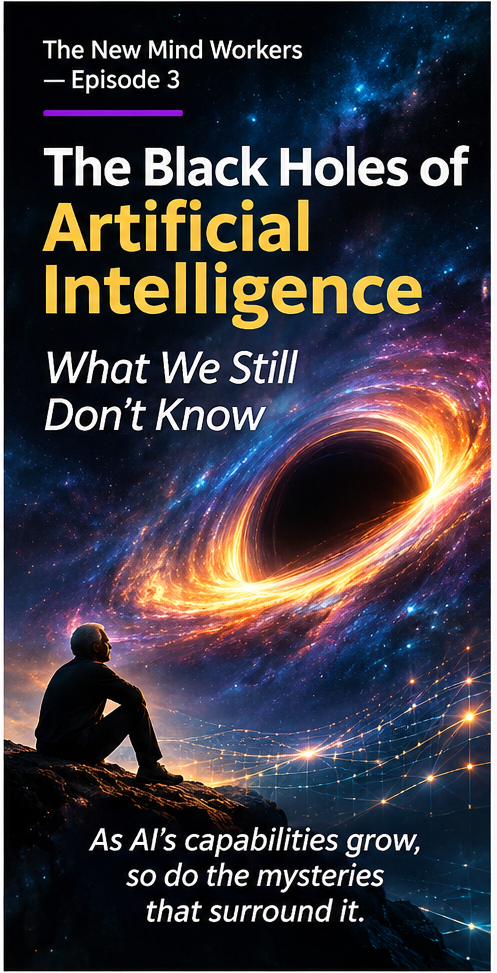
Yet The Black Holes of AI is a deep dive into what we know, what we think we know, and what remains a mystery. At times, I feel swallowed by these black holes myself. The deeper I venture into the world of artificial intelligence, the more I discover how much I don’t understand. Yet it is precisely this gravitational pull of the unknown that makes the journey so fascinating.
The New Mind Workers — Episode 3
Beyond Artificial Intelligence
We are remarkably comfortable giving names to things we barely understand. We call it artificial intelligence. We speculate about artificial general intelligence. Increasingly, we speak of superintelligence. Each new term suggests a progression towards something greater. But do we really understand what is progressing?
I find myself questioning whether artificial intelligence still adequately describes what is emerging. When machines begin to solve problems that have defeated human experts, the distinction between artificial and superhuman intelligence becomes increasingly interesting. We tend to imagine intelligence developing in stages. Yet nature has no obligation to follow our definitions, and neither does technology.
- What if extraordinary intellectual capabilities emerge alongside equally extraordinary gaps in understanding?
- What if intelligence is not a ladder but a landscape — with peaks, valleys and unexplored territories?
- And like the universe itself, intelligence has its black holes.
Beyond the Event Horizon – The Black Holes of AI
Black holes reveal their presence through the movement of stars, the distortion of light and the behaviour of matter caught in their gravitational pull. We can observe their effects without seeing what lies beyond their event horizons. There is an intriguing parallel with artificial intelligence. Imagine a system discovering a relationship between seemingly unrelated phenomena. It produces a result that works, yet its internal reasoning appears to sit behind an event horizon we cannot cross. We can observe its gravitational pull — the consequences of its discoveries — without fully understanding what happens inside. Unlike a cosmic event horizon, this boundary may not be absolute. Research into AI interpretability may reveal much that currently escapes us. But some forms of intelligence could still exceed our capacity to comprehend them.
What happens when we can verify a discovery without understanding how it was made? Until now, human understanding has been our ultimate intellectual reference point. We have relied on our ability to examine evidence, challenge assumptions and explain discoveries. We may increasingly find ourselves working with knowledge that we can test but cannot fully comprehend.
That would represent a profound change in our relationship with knowledge itself.
The Intelligence We Cannot Measure
We measure artificial intelligence against human performance. We devise tests, establish benchmarks and celebrate when machines outperform us. But these measurements tell us how well machines perform tasks we already recognise as requiring intelligence. What about forms of intelligence we have never encountered? A benchmark is necessarily a product of what we already know. It may reveal extraordinary capabilities, but it cannot easily measure something we have not conceived of. It seems that some of the most significant developments in intelligence will occur outside the boundaries of our measurements.
The mystery is not simply what lies beyond the event horizon. It is whether we would recognise the signs of something unfamiliar emerging.
The Gravitational Pull of Intelligence
There is another dimension to the black hole of AI metaphor. As artificial intelligence becomes more capable, its gravitational pull on human society grows. We turn to it for information, research, creative inspiration, advice and increasingly for decisions. Businesses reorganise around it. Education adapts to it. Entire industries are drawn into its orbit. The more useful it becomes, the more difficult it may be to imagine working without it.
Yet capability and understanding do not necessarily develop at the same pace. Our dependence on intelligent systems could grow faster than our understanding of them. This raises a different question. Not whether artificial intelligence will become more powerful, but whether we will retain sufficient independence of thought as its influence grows.
Can we benefit from its gravitational pull without surrendering our own intellectual direction?
Intelligence Beyond Imagination
Throughout history, our imagination has been constrained by our experience. We imagined flying machines by observing birds. We developed mechanical transport to replace horses. Early computers were conceived as machines that could calculate. In fact, some of the greatest possibilities of these technologies lay beyond their original purpose. What might artificial intelligence become that we have not yet imagined?
Much of our thinking about AI remains centred on familiar human activities — writing, programming, researching, designing and solving problems. These are merely the beginnings. We are judging an emerging intelligence largely by its ability to reproduce our own intellectual achievements. Its most remarkable contribution may eventually lie in doing things we have never conceived of doing.
There are at least three dimensions to the unknown:
- What we do not yet understand.
- What we may never be capable of understanding.
- What we have not even imagined.
The last is perhaps the most intriguing. We cannot ask questions about possibilities that have never occurred to us. Nor can we prepare for discoveries whose significance lies outside our experience.
The black holes of AI may conceal possibilities as extraordinary as they are mysterious.
Navigating the Black Holes of AI
We do not need to understand everything about artificial intelligence before putting it to work. But we do need a mindset that recognises the limitations of both human and machine intelligence.
For mind workers — writers, researchers, educators, creators and independent thinkers — this is more than a technological challenge. It is a question of how we think, how we exercise judgement and how we retain intellectual independence. The tools we need are not necessarily those that automate the most tasks or generate the most content. They are those that help us explore possibilities, question assumptions, evaluate evidence and develop ideas without losing sight of their purpose. We need systems that support independent thought rather than encourage intellectual dependency. We need platforms that value original thinking, research and creativity rather than simply rewarding the volume of activity. Above all, we need to preserve the freedom to question the intelligence we increasingly rely upon.
The next stage of The New Mind Workers is a practical journey. We will examine the tools, platforms and strategies available to us, evaluate their merits, experiment with new ways of working and explore what might be built differently. We will not have all the answers. Nor should we expect artificial intelligence to provide them all.
There will always be unexplored territories. And the most important quality a mind worker can cultivate is not the ability to find answers, but the curiosity to venture beyond them.
Ideas you can act on. Tools you can use. Strategies that make sense.
Create with curiosity. Work with purpose. Live with pleasure.
Working Smarter. Staying Human.
SERIES: THE NEW MIND WORKERS — IDEAS YOU CAN ACT ON
After exploring how artificial intelligence is changing our world in Living with AI, and examining the nature of intelligence in The Intelligence Series, The New Mind Workers asks two different questions:
Who must we become? How should we work?
The series explores how writers, researchers, educators, creators, entrepreneurs and independent thinkers can thrive alongside intelligent systems while preserving human creativity, curiosity and judgement. Moving beyond conventional product-centred marketing, we explore the distinct needs of mind workers through independent research, practical experiments, platform evaluations and intelligent workflows.
Ideas you can act on. Tools you can use. Strategies that make sense.
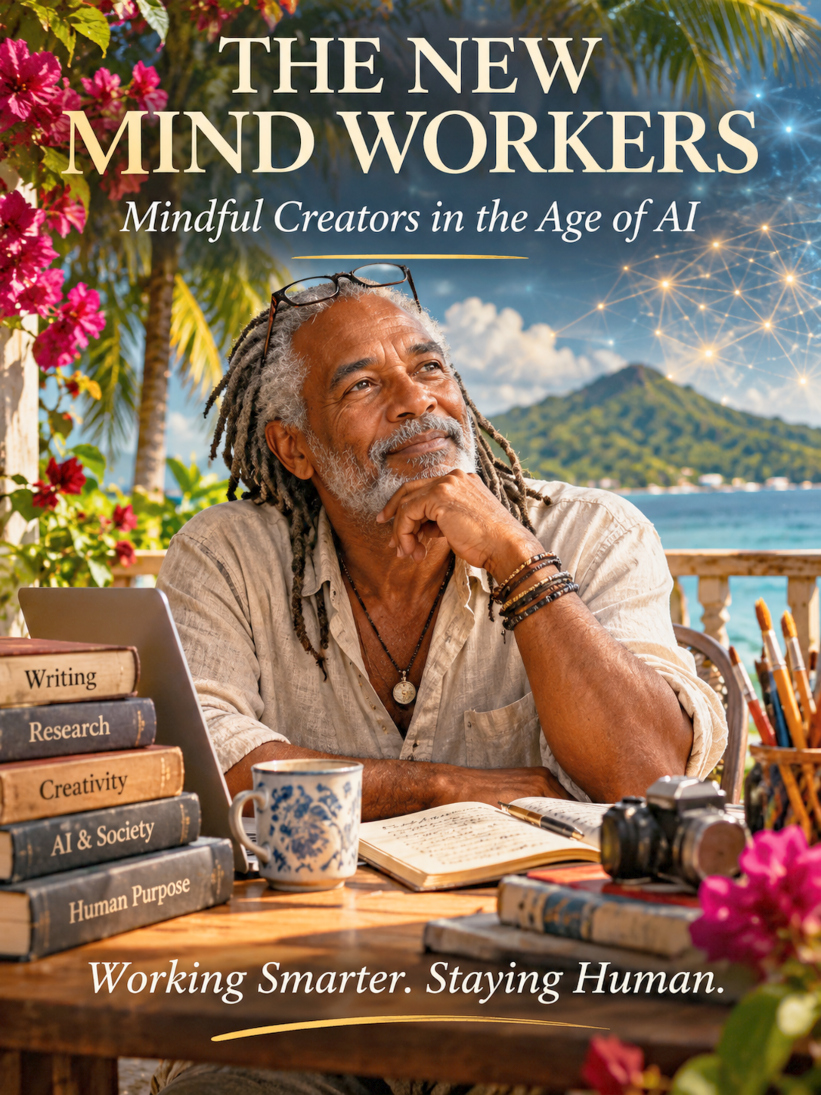
Episode 1. The New Mind Workers — Working Smarter, Staying Human
Introducing a new generation of knowledge workers adapting to the age of artificial intelligence. The New Mind Workers explores the changing nature of work and the opportunities for human creativity, research, education and independent thinking.
roguesinparadise.com/thenewmindworkers/
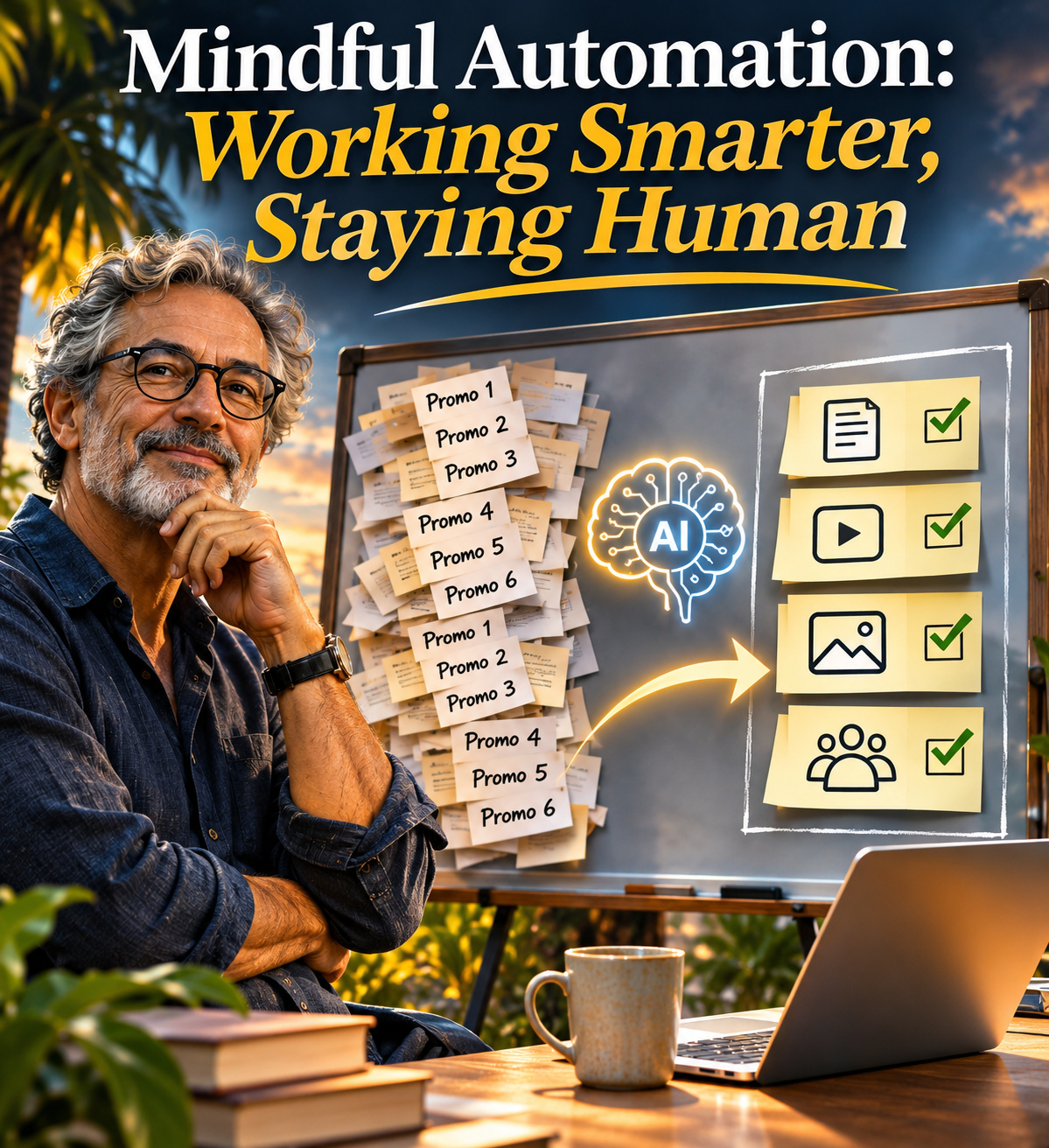
Episode 2. Mindful Automation — When Less Is More
Artificial intelligence can help us research, write, create and distribute ideas faster than ever. But are we using these remarkable tools to do better work — or simply to do more of it? Sometimes the smartest automation is the work we decide not to do.
roguesinparadise.com/mindfulautomation/
Episode 3. The Black Holes of Artificial Intelligence — What We Still Don’t Know
Coming next
As artificial intelligence develops capabilities that exceed our own in certain domains, fundamental questions remain about knowledge, understanding, superintelligence, purpose and wisdom.
Before placing greater reliance on intelligent systems, we should explore what we understand about them — and what remains a mystery.
THE PRACTICAL JOURNEY — ACTIONABLE THOUGHTS
From understanding intelligence to putting it to work, the following articles will explore practical strategies, real-world experiments and independent evaluations of the tools and platforms available to mind workers.
Episode 4. The Mind Workers’ Toolbox
An evolving, independent guide to intelligent tools and platforms for writers, researchers, educators and creators. What works, what doesn’t, and what genuinely adds value?
Episode 5. Where Should Mind Workers Publish?
Exploring publishing platforms, social networks, scholarly communities and content distribution services. Where do ideas find meaningful audiences, and which platforms deserve our time?
Episode 6. Create Once. Share Intelligently.
Developing practical workflows that reduce repetition, simplify publishing and preserve the integrity of original ideas across multiple platforms.
Episode 7. SEO Beyond Product Marketing
Exploring how mind workers can build visibility, authority and readership in an online economy largely designed around selling products. From traditional search and backlinks to AI-powered discovery.
Episode 8. Measuring What Matters
Looking beyond impressions, shares and automated activity to evaluate genuine readership, meaningful engagement, intellectual value, cost and time saved.
Episode 9. Building the Mind Workers’ Platform
Bringing together what we have discovered through research, experimentation and practical experience. Can we connect existing technologies and intelligent agents to create a system that better serves the distinct needs of mind workers? Our earlier exploration, Building with AI, provides a starting point for this journey.
The New Mind Workers is evolving. We will question assumptions, evaluate technologies, experiment with new approaches and share what we discover along the way. The articles become the research. Our daily work becomes the experiment. The platform becomes a possible outcome.
Create with curiosity. Work with purpose. Live with pleasure.
Working Smarter. Staying Human.