What Does Bajan Mean Beyond a Dictionary Definition?
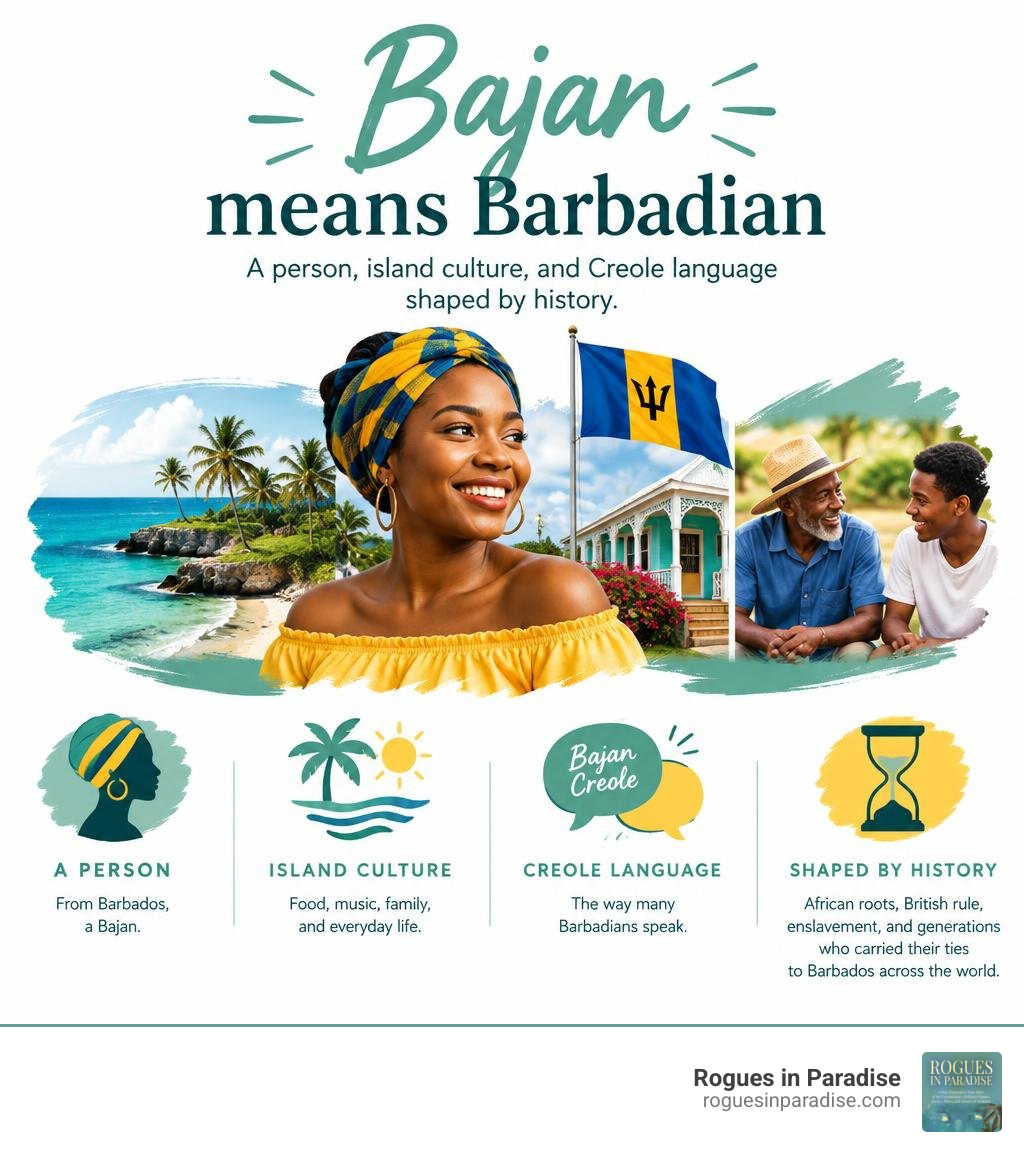
Bajan means Barbadian. It can describe a person from Barbados, something connected to the island, or Bajan Creole, the language many Barbadians speak in everyday life. The word is a shortened form of Barbadian, pronounced “BAY-jən.”
But a definition only gets us so far. Bajan identity also lives in food, humor, family stories, and the way people speak. Its history includes African roots, British rule, enslavement, and generations who carried their ties to Barbados across the world. This guide looks at those connections without reducing the island to a postcard.
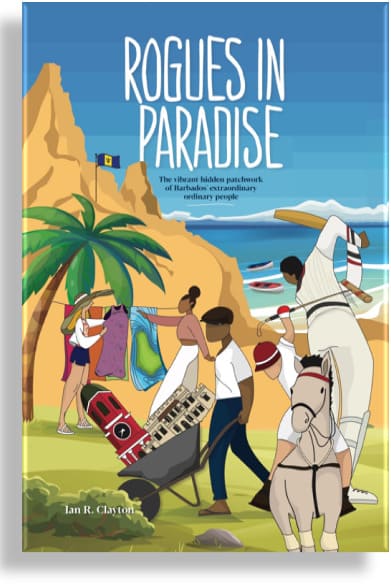
I’m Ian R Clayton, author of Rogues in Paradise and founder of its companion podcast. From more than five decades of professional experience, I explore what the word bajan reveals about Barbados’s people and past.
What Does Bajan Mean, and Where Does the Identity Come From?
Bajan is both a noun and an adjective. As a noun, it means a person from Barbados; as an adjective, it describes something Barbadian, such as Bajan cooking or Bajan music. The word is generally pronounced “BAY-jən,” represented in phonetic notation as /ˈbeɪdʒən/. Dictionaries trace it to a shortened form of Barbadian, in use by the 20th century.
Barbados is a small island nation of about 169 square miles, with a population of almost 300,000. Around 92.4% of its population is of Afro-Caribbean origin. Those figures offer context, but identity is not a census category alone. It is built through family, community, shared experience and the stories people tell about home.
We use “Bajan” as a familiar expression of that connection, while “Barbadian” may sound more formal or appear in official contexts. Our stories about Bajans and the names used for them in different contexts explore how identity can hold many histories at once.

Bajan Origins in Barbados’ History
Barbados’s history shaped the people and culture now described as Bajan. British colonisation brought English rule and institutions to the island. The forced migration and enslavement of people from West and Central Africa profoundly shaped its population, language and customs. Enslaved people were compelled to live under a colonial system, while creating communities and cultural practices that endured through hardship.
Emancipation changed the legal status of enslaved people, but it did not erase the inequalities and social structures built under slavery. Over generations, African traditions and knowledge met British influences and other Caribbean connections. This process of cultural blending is often called creolisation. It shaped a distinct Barbadian identity, rather than simply reproducing either African or British culture unchanged.
“Bim” is a widely used nickname for Barbados. It is often linked to an Igbo expression, though the history of words and their paths between languages can be complex. We can explore the island’s layered heritage through Barbados’s African, British and Caribbean influences and the connections between African roots and Bajan ancestry.
What Is Bajan Creole, and How Does Bajan Differ from Standard English?
Bajan Creole is an English-based creole spoken in Barbados. It developed through language contact in a society shaped by British colonialism and the forced enslavement of Africans. West and Central African languages contributed to its vocabulary and linguistic history, alongside English and other influences.
Ethnologue figures cited for 2018 estimate 260,000 native speakers of Bajan and 30,000 native English speakers in Barbados. These estimates describe native language use; they do not mean that Barbadians use only one way of speaking. Many people move between Bajan and Standard English according to the setting, their audience and the point they want to make.
Standard English is used in formal writing and many official contexts. Bajan is especially prominent in everyday conversation, humor, music and cultural expression. It is primarily spoken, and there is no single standardized spelling system, so written Bajan often varies according to the writer’s pronunciation. For broader background on the island’s languages, see what languages are spoken in Barbados.
| Feature | Bajan Creole | Standard English |
|---|---|---|
| Common settings | Everyday speech, humor, music and informal conversation | Formal writing and many official settings |
| Verb forms | Tense and aspect often use markers rather than changing the verb | Tense is commonly marked through verb forms and auxiliary verbs |
| Pronouns | Includes wunna, a plural form of “you” | Uses “you” for both singular and plural |
| Writing | Spelling varies; there is no single standardized form | Standard spelling conventions are widely used |
How Bajan Creole Works
Bajan is not simply Standard English pronounced differently. It has patterns of grammar and vocabulary of its own. For example, wunna means “you all” or “you plural.” The word is linked to the Igbo pronoun unu, and related forms occur in other Caribbean speech varieties.
Verbs are often not conjugated in the same way as in Standard English. Words such as does, duh and gine can help express habitual action, completed action or the future, with their interpretation depending on the sentence and context. A speaker might say I does guh church to describe a regular habit, or She gine bring it to indicate that she will bring it.
Bajan can also use a zero copula, leaving out a form of “to be” where Standard English would usually include one. Question patterns and pronunciation differ too. In many examples, wha is used in questions about time or place, while questions may rely on intonation. African-derived vocabulary is part of the language’s history, although the origins of individual words are not always certain.
Common Bajan Phrases, Sayings and Humor
A few expressions give a taste of how Bajan words work in everyday life:
- Wunna means “you all.”
- Liming means spending time together or hanging out.
- Dat eaaaaasy can mean “no problem” or “that’s easy.”
- Pear can mean avocado.
- A cutter is a filled bread roll or sandwich, not a cutting tool.
Bajan sayings often deliver a lesson with a grin. “De higha de monkey climb, de more he show he tail” warns that the more someone shows off, the more they may reveal their faults. “Gol teet doan suit hog mout” suggests that something fancy may not suit someone unused to it.
The humor also comes from familiar words taking on local meanings, from exaggeration and from shared knowledge of island life. A Bajan joke can depend on the sound of a phrase, its double meaning or the recognition that everyone knows the same landmark-based directions. We can enjoy more of that insider humor in this collection of Bajan jokes and sayings.
Bajan Culture, Food and Everyday Traditions
Bajan culture is expressed through family and community life, sport, music, celebrations and the ordinary routines that bring people together. Cricket has a long place in the island’s sporting life. Crop Over, a major annual festival with roots in the sugar-cane harvest, brings music, performance and public celebration into the streets.
Homes and architecture are part of that cultural story, too. The chattel house, historically a movable wooden home, became a distinctive feature of Barbadian life and a symbol of resourcefulness under difficult social and economic conditions. Our look at the chattel house and Bajan identity considers why it remains so meaningful.
Everyday customs vary among families, parishes and generations. Sunday may mean church for some households, a shared meal for others, or a welcome pause to visit relatives. We see how these routines fit into Barbados lifestyles and culture without assuming that every Bajan family lives in exactly the same way.
Bajan Food and Shared Customs
Food brings history and community to the table. Flying fish and cou-cou, made with cornmeal and okra, is widely recognized as Barbados’s national dish. Other familiar foods include pudding and souse, macaroni pie, cutters and conkies. Jug jug is associated with special occasions, while black cake is a cherished feature of many Christmas celebrations.
Rum punch is another well-known part of island food culture, often made according to the rhyme “one of sour, two of sweet, three of strong, four of weak.” Local recipes and family preferences differ, so there is no single glass that represents everyone’s version.
The Friday-night fish fry at Oistins is a lively example of food bringing people together. Seafood, conversation and music make it a social gathering as well as a meal. We also tell stories about local character and community in Bajan Yardfowl, where food and humor meet.
Bajan Diaspora, Barbadian Canadians and the Sankofa Pilgrimage
Bajan identity travels with people who leave Barbados and with their descendants. Some maintain close family connections to the island; others rediscover their heritage generations later. The diaspora is not one community with one experience, but a network of people connected to Barbados through ancestry, memory, culture and ongoing relationships.
In Canada, 37,780 people reported full or partial Barbadian ancestry in the 2016 Census. The 2021 Census counted 13,665 Barbadian-born residents. These figures measure different things and come from different years: ancestry claims are not the same as place of birth.
Barbadians migrated to Canada at different times and for different reasons. Early communities formed in places including Whitney Pier in Nova Scotia. Later migration was shaped by changing immigration policies and employment opportunities. The 1955-1967 domestic service program enabled around 1,000 Barbadian women to immigrate through a pathway that required a period of domestic work. Today, Ontario is home to the largest concentration of people with Barbadian ancestry. For more on the community’s history and demographics, see Barbadian Canadians.
From the Cora Voyage to the 2024 Sankofa Pilgrimage
One remarkable chapter of Bajan migration links Barbados and Liberia. In 1865, Barbadians sailed to Liberia aboard the brigantine Cora. Accounts describe 291 official passengers, with 346 people aboard by the time the ship arrived, including stowaways. Their descendants built lives in Liberia, and some families preserved their connections to Barbados across generations.
In May 2024, 422 Liberians descended from Bajan emigrants took part in the Sankofa Pilgrimage, a homecoming that connected family history with a return to ancestral places. The word Sankofa is commonly understood as looking back to retrieve what has been left behind, so that it can inform the future. Participants explored genealogy and history and joined cultural events in Barbados.
The pilgrimage made visible a connection that had endured across the Atlantic for nearly 160 years. Its story also shows how family names, archives and community memories can help people investigate their roots. We explore that journey in a feature on the Bajan homecoming and share more about Bajan genealogy.
Frequently Asked Questions About Bajan Identity
Is Bajan a language, a dialect or a demonym?
It can mean all three, depending on context. “A Bajan” is a person from Barbados, and “Bajan” can describe something Barbadian. Bajan Creole is the English-based creole spoken in Barbados. Calling it a dialect or a language can depend on the context, but it has its own grammatical patterns and is more than an accent.
How do you pronounce Bajan, and what is its origin?
Bajan is pronounced “BAY-jən,” or /ˈbeɪdʒən/. It is a shortened form of Barbadian, with dictionaries recording it as a 20th-century variant.
What are some well-known Bajan sayings and foods?
Wunna means “you all,” liming means socializing, and pear can mean avocado. A well-known saying is “De higha de monkey climb, de more he show he tail.” Familiar foods include flying fish and cou-cou, pudding and souse, macaroni pie, conkies and black cake.
Conclusion
Bajan identity brings language, history, culture and family connections together. It reflects the island’s African roots and colonial past, the creativity of everyday speech, shared food and customs, and the journeys of people who carried Barbados with them around the world.
At Rogues in Paradise, we use stories to connect character, place and history, including the difficult legacies of slavery and colonialism. To explore more about the island and its people, continue with our guide to the people of Barbados.