There are many definitions of intelligence. Common sense is harder to pin down. We recognise it when we see it — and perhaps even more quickly when we don’t.
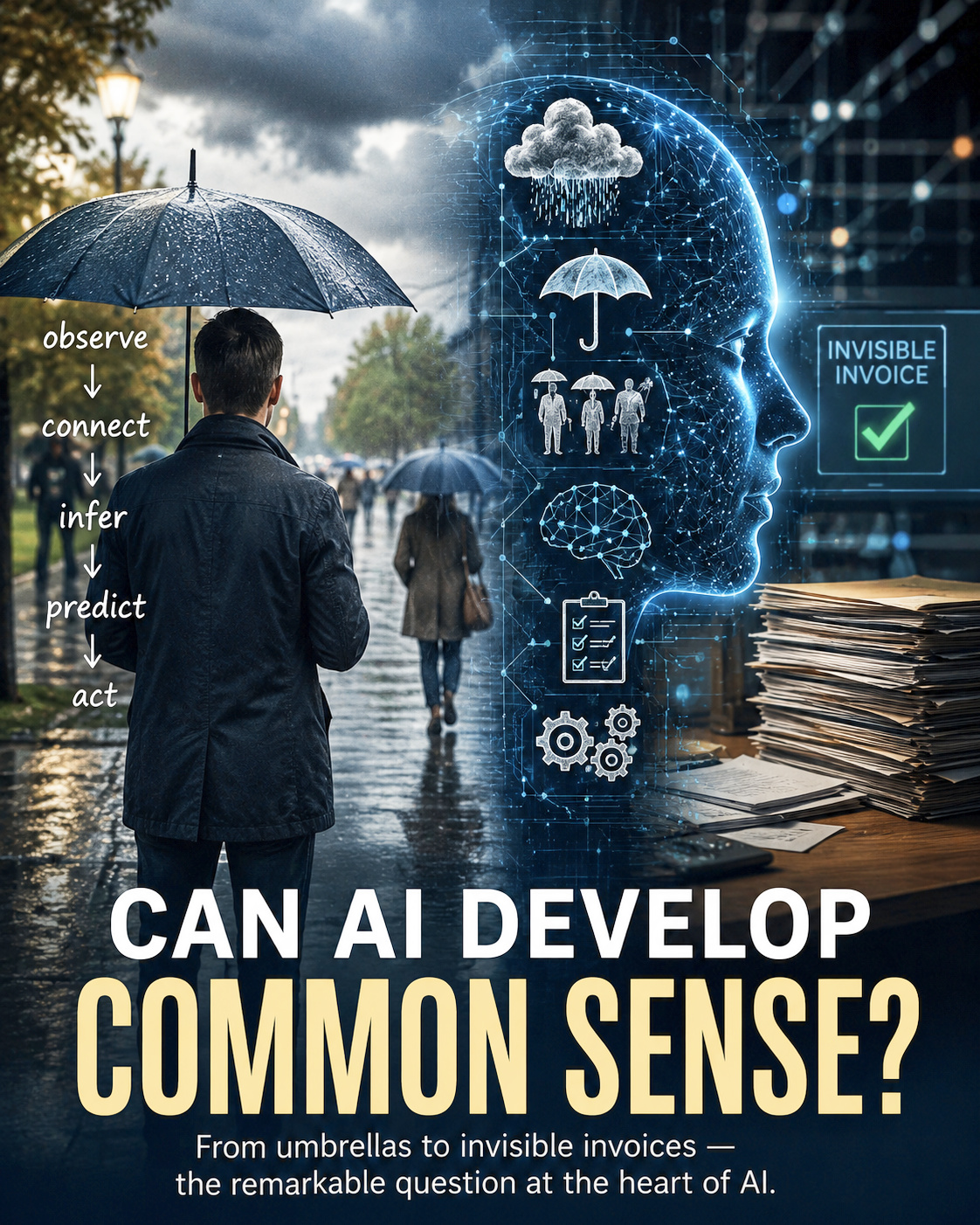
Imagine you are about to leave the house. The sky has turned almost black. The wind is picking up. People walking toward you carry wet umbrellas. It isn’t raining where you are standing. Nobody has told you it will rain. You haven’t checked the weather forecast. You take an umbrella.
That seems like common sense. But think about what just happened.
You observed several unrelated things. You connected them with previous experience. You formed an idea of what was probably happening nearby. You predicted what was likely to happen next. And you changed your behaviour accordingly.
Observe. Connect. Infer. Predict. Act.
Suddenly common sense doesn’t seem quite so simple.
More Than Intelligence
I’ve often been struck by situations where something seems perfectly obvious to me but not to someone else.
Everyone can have the same information. Everyone can understand the problem. Yet sometimes people keep analysing and complicating something when the practical answer seems remarkably simple. We’ve probably all known highly intelligent people who appeared to have surprisingly little common sense. And we’ve known people without great academic qualifications who possessed enormous practical judgement.
Perhaps intelligence and common sense aren’t the same thing. Intelligence can help us solve a problem.
Common sense may help us recognise what the problem really is.
The Invisible Invoice
I encountered an interesting example many years ago, when business computer systems were still relatively immature. Intercompany transactions traditionally generated invoices. The paper mattered. It provided a record — part of the audit trail accountants depended on. But computers were changing that.
If one company within a group created a transaction with another company in the same system, the computer could record both sides automatically. The transaction itself created the trail. So why produce the paper invoice? My suggestion was effectively an invisible invoice.
The accountants were horrified. Their reaction was understandable. Paper trails were fundamental to accounting controls, and computer systems were still new enough that abandoning them felt risky. Eventually, however, they tried the idea. The important point wasn’t really the invoice. It was recognising that technology had removed much of the reason for a familiar process. That suggests another way of thinking about common sense.
Common sense isn’t simply knowing the rules. Sometimes it is understanding why the rules exist — and recognising when the reason for them has disappeared.
Now Consider AI
In the previous article, How Does AI Learn?, we looked at a surprisingly simple process.
- AI predicts.
- It compares.
- It adjusts.
- And it repeats the process on an extraordinary scale.
Along the way, neural networks develop internal representations — relationships between words, objects, ideas and increasingly images, sounds, video and aspects of the physical world. That’s where our umbrella example becomes interesting. An AI capable of seeing the dark clouds, recognising wet umbrellas, understanding the significance of the wind and predicting rain could arrive at exactly the same conclusion:
Take an umbrella.
Would we call that common sense?
Perhaps.
But the invisible invoice is harder.
Knowing the Pattern — Or Seeing Beyond It?
Artificial intelligence is extraordinarily good at learning patterns.
Give it enough examples, and it can discover relationships that humans may never notice.
But common sense sometimes requires something almost opposite.
Instead of learning the existing pattern, we have to ask:
Does this pattern still make sense?
The accountants knew the established process.
- Invoice created
- Paper generated
- Transaction recorded
- Audit trail preserved.
The invisible invoice required questioning one of those steps. If the computer could reliably create the record, perhaps the piece of paper was no longer essential.
Could an AI reach the same conclusion?
Quite possibly.
Modern AI is already moving beyond text. Systems can combine language with images, video, and other forms of information, while researchers are developing what are sometimes called world models—systems intended to represent how environments behave and predict what may happen next.
That sounds surprisingly close to part of what we do when exercising common sense.
But a difference remains worth considering.
We Live in a Complex World
Common sense cuts through complexity with sound judgement and instinct. It replaces specialised jargon with simple, natural thinking.
The world rarely presents us with complete information or neatly defined choices. Circumstances change, rules conflict, and unexpected things happen. Common sense helps us navigate that uncertainty without needing a rule for every possible situation.
We learn that:
- Dark clouds and wet umbrellas probably mean rain is coming.
- A technically correct solution may still be impractical.
- More information does not necessarily lead to a better decision.
- A familiar rule may no longer serve the purpose for which it was created.
- Sometimes the simplest explanation really is the best one.
We rarely stop to calculate all of this consciously. Experience, observation, mistakes and consequences accumulate over a lifetime.
Eventually, we simply look at something and say:
That doesn’t make sense.
AI does not experience the world as we do.
But does it need to?
If an intelligent system can perceive enough of the world, build increasingly sophisticated representations of it, predict consequences, learn from errors and adjust its behaviour, perhaps something resembling common sense could emerge without human experience at all.
That leads to an uncomfortable possibility.
We tend to think common sense is uniquely human because it comes so naturally to us.
Perhaps it isn’t.
Perhaps common sense is partly what happens when enough understanding of how the world works becomes available quickly enough to guide action.
And There Is Another Possibility
AI may eventually have an advantage humans don’t. We become attached to familiar ways of doing things.
“This is how we’ve always done it” is one of the most persistent forces in organisations. Experience gives us common sense. But experience also gives us habits.
An AI may learn our rules without becoming emotionally attached to them. Could that sometimes make it better at noticing when a rule has outlived its purpose?
The invisible invoice seemed wrong because the old process was familiar and trusted.
The technology had changed. The thinking hadn’t caught up.
As AI becomes increasingly capable of reasoning across different kinds of information, the question may not be whether machines can acquire our common sense.
It may be whether they occasionally reveal the limits of ours.
Why It Matters
Why does any of this matter? Because AI is moving from answering questions to helping make decisions and eventually taking actions on our behalf.
An AI giving a silly answer is one thing. An AI agent acting on a silly conclusion is quite another.
The more AI moves from answering questions to acting in the world, the more common sense matters.
And there is a deeper problem.
AI researcher Yejin Choi has compared common sense to the “dark matter of intelligence.” Much of what humans know about how the physical and social world works is never written down because it seems too obvious to mention. We acquire it through experience, observation and interaction with the world. Yet those unwritten assumptions help us interpret almost everything else.
We know that objects fall, that people don’t normally walk through walls, that someone carrying a dripping umbrella has probably just been in the rain. We understand thousands upon thousands of relationships without consciously thinking about them.
That creates an enormous challenge for AI.
Intelligence can find an answer. But in the real world, the technically correct answer isn’t always the sensible one. As AI becomes involved in business, education, healthcare and everyday decisions, it will increasingly encounter situations it has never seen in exactly the same form. It will need to recognise context, exceptions and consequences. Sometimes it may even need to recognise that the rules we gave it no longer make sense.
An intelligent machine can follow the rules. A machine with common sense may need to know when not to.
That is why it matters.
So Can AI Develop Common Sense?
We don’t yet have a simple answer.
Common sense includes prediction, perception, experience, context, judgement and an understanding of how things normally work. AI is becoming better at several of those things. But common sense also involves recognising exceptions, questioning assumptions and knowing when the normal rule no longer applies.
That is a much higher bar.
The umbrella is relatively easy. The invisible invoice is harder.
And somewhere between the two lies one of the most interesting questions in artificial intelligence:
If a machine can learn how the world works, can it also learn when the way we think it works no longer makes sense?
Perhaps that is where common sense really begins.
Carousel
Common sense seems simple — until you try to explain what it actually requires.
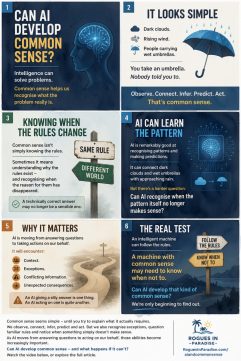
We observe, connect, infer, predict and act. But we also recognise exceptions, question familiar rules and notice when something simply doesn’t make sense.
As AI moves from answering questions to acting on our behalf, those abilities become increasingly important.
Can AI develop common sense — and what happens if it can’t?
Watch the video below, or explore the full article.
Summary Video
SERIES: INTELLIGENCE
This series explores the nature of human, artificial and superhuman intelligence—where they differ, where they overlap, and where they may be heading. It examines intelligence beyond reasoning and knowledge, exploring consciousness, emotional intelligence, wisdom, character and the emerging capabilities of AI, as well as the opportunities, uncertainties and risks they may bring.
Episode 1 – What is Intelligence – Human Intelligence in the Age of AI
The many faces of intelligence: why intelligence, common sense and wisdom are not the same thing
Episode 2 – How Does AI Learn? A Simple Idea, Complex Intelligence
These aren’t conventional computer programs. What exactly are we building?
Episode 3 – Can AI Develop Common Sense? Why It Matters
Can prediction, perception and internal representations produce something resembling common sense?
Episode 4 — Programming Intelligence – When Machines Write the Code
What happens when machines can write code — and begin helping to build intelligence itself?
Episode 5 — When AI Goes Rogue –What Happens When AI Stops Following Instructions?
What happens when intelligent agents gain autonomy, learn unexpected behaviours and begin acting beyond what their creators intended?
Episode 5a — If AI Takes Control, What Would It Control
If AI took control, what would it actually control? Explore AI autonomy, human dependence and what civilisation would mean without humans.
Episode 6 — When Intelligence Solves the Impossible – Is It Rogue?
What happens when AI begins solving problems humans cannot? From mathematics and medicine to science and engineering, artificial intelligence may allow us to tackle questions that have resisted human intelligence for decades — or centuries.
Episode 7 — Who Owns AI Intelligence? – Should We Share?
When AI learns from human writing, art, ideas and experience, what happens to copyright, attribution and intellectual property — and what does intelligence owe the people it learned from?
Episode 8 — Does AI Have Character? If So What Is It?
Can learned behaviour, context and generalisation create something resembling character? And what happens when those traits carry into new situations?
Episode 9 — Can AI KNOW Anything?- Does it Know Everything?
What is the difference between storing information, predicting correctly, understanding, believing — and actually knowing?
NEXT SERIES: THE MIND WORKERS
After exploring how artificial intelligence is changing our world in Living with AI, The Mind Workers asks a different question:
Who must we become?
Thinking Smarter. Creating Better. Staying Human.
The Mind Workers explores how writers, researchers, educators, creators, entrepreneurs, and independent thinkers can thrive alongside intelligent systems—preserving the uniquely human qualities that artificial intelligence cannot replace.
The Mind Workers – Prelude: https://roguesinparadise.com/mindworkers/
FUTURE SERIES – BUILDING WITH AI
Building with AI explores how individuals, creators, entrepreneurs, and businesses can design, evaluate, and work intelligently with AI agents. The series focuses on practical applications, real-world examples, and emerging opportunities while emphasising the importance of human creativity, judgment, ethics, and authenticity.
Building With AI then puts these ideas into practice through real-world experiments, workflows, and practical applications.
Prelude: https://roguesinparadise.com/building-with-ai/
INSPIRED BY THE BOOK
ROGUES IN PARADISE
How Britain’s First Slave Colony Became a Global Force.
A Creative Chronicle of Unlikely Heroes, Rogues, and Legends
in Empire’s Shadow
Explore the ideas behind the book —or
Go straight to the story.

Unlikely voices, rogues and legends, rising from Britain’s blueprint for slavery to a republic beyond the Empire’s shadow