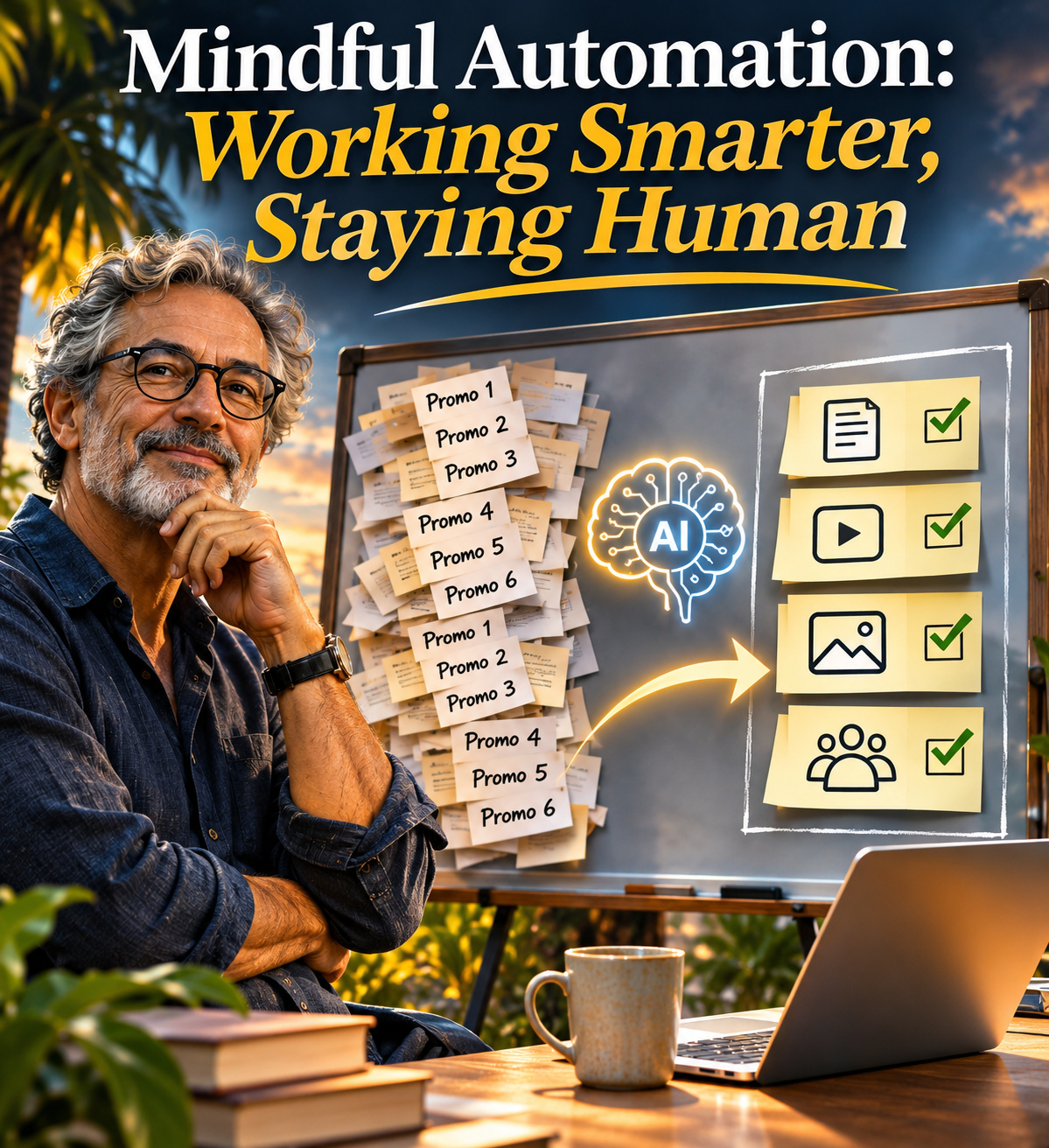
In this first practical article in The New Mind Workers series, I explore a lesson I learned about Mindful Automation. These are from my own publishing workflow. Mindful Automation.
The world has changed. Artificial intelligence can help us research, write, create and distribute ideas faster than ever. But are we using these remarkable tools to do better work — or simply to do more of it? Sometimes the smartest automation is the work we decide not to do.
The Six-Version Habit
Not so long ago, duplicate content was considered one of the great sins of search engine optimisation. Or so many of us believed. Google wanted original content. SEO advisers warned against duplication. Publishers learned to rewrite, rephrase and rearrange their material to avoid appearing repetitive. The reality was more complicated. Google generally filtered duplicate pages rather than automatically penalising them. But the lesson many of us took away was simple: never publish the same text twice. I absorbed that lesson. And recently, I realised just how much unnecessary work it had created. In promoting RoguesCulture articles, videos and podcasts, I had developed a system of creating six different descriptions for every promotional asset.
Six titles. Six variations of essentially the same message. Sometimes more.
These were distributed across platforms such as LiveJournal, Slashdot and other publishing and sharing services. The assumption was that every platform needed something different. Then I thought about press releases. A single press release can be distributed to hundreds of media websites. The text may be identical. Google won’t necessarily index every copy, but that doesn’t prevent the release from reaching different audiences.
Why, then, was I rewriting the same promotional description six times?
The Automation Paradox
The problem wasn’t the technology. It was the assumption built into my workflow. I had automated content distribution while multiplying the human labour required to prepare it. Consider a typical RoguesCulture publishing campaign. Depending on the subject, it might include:
- An original blog article
- A LinkedIn article or carousel
- A long-form video
- A short video
- A landscape feature image
- A portrait feature image
- A podcast or audio presentation
- A specialised promotional variation
That’s eight potential assets.
At six descriptions per asset, I could find myself creating 48 variations of promotional text. And that was before considering titles, keywords, metadata, video descriptions and the different requirements of individual platforms. But if each asset had one strong, relevant description, with a few genuinely useful adjustments, much the same distribution could be achieved with eight principal descriptions.
Forty-eight became eight.
The improvement didn’t come from a more powerful AI tool. It came from questioning whether the work needed doing at all. Of course, identical content isn’t appropriate everywhere. Different audiences, platform requirements and genuine editorial purposes sometimes call for different approaches. Nor does mass syndication guarantee search visibility or meaningful readership.
But rewriting text just to make it different isn’t the same as making it better.
Working Smarter Means Questioning the Work
This is precisely the territory The New Mind Workers explores. AI can help us produce more content, faster than ever. Yet productivity becomes a peculiar achievement when we use intelligent tools to accelerate tasks that serve little purpose. The most valuable question we can ask an intelligent assistant isn’t:
How can I do this faster?
It’s:
Do I need to do this at all?
Sometimes the greatest productivity gains come not from better automation, but from abandoning an unnecessary habit.
From Content Production to Mindful Distribution
That discovery prompted a wider question. If we don’t need six versions of every description, do we really need to publish every asset on every available platform? The New Mind Workers approach is to begin with the original work and choose the most useful ways to share it. A thoughtful article might benefit from a video, a feature image and a LinkedIn discussion. Another might deserve a podcast or a carousel. But not every article needs everything.
The objective is not maximum output. It is meaningful reach with manageable effort.
Choosing the Right Platforms
Different platforms serve different purposes. Some help people discover our work. Others encourage discussion, preserve knowledge or help build lasting relationships.
For RoguesCulture and The New Mind Workers, the following priorities offer a practical starting point.
| Priority | Platform | Primary purpose |
|---|---|---|
| Core | RoguesCulture website | Original articles, podcasts, resources and the permanent archive |
| Core | Professional discussion, articles, videos and relationships | |
| Core | YouTube | Video discovery, long-form presentations, podcasts and Shorts |
| Retain | Mailchimp | Direct communication with subscribers |
| Test | Substack | Discovering communities of writers, thinkers and independent creators |
| Supporting | Quuu | Extending distribution and testing which subjects attract interest |
| Selective | Medium, LiveJournal, Slashdot and others | Reaching relevant audiences when the content fits |
| Selective | Vimeo | Cleaner video presentation and greater control over embedded viewing |
These are not universal rankings. They reflect the audience and objectives of RoguesCulture.
LinkedIn is particularly useful for connecting with writers, researchers, educators and independent thinkers.
YouTube offers discovery through video and provides a home for our animated podcasts and selected Shorts.
Vimeo offers a different advantage. While YouTube is designed to encourage viewers to keep watching content across its platform, Vimeo provides greater control over the viewing environment. For embedded videos, that can help keep attention on the original article.
Substack deserves investigation, particularly for its writer communities, Notes and recommendations. But testing a platform is different from committing to another regular publishing schedule.
Mailchimp remains important because subscribers provide a more direct relationship than social-media followers.
The principle is simple: choose platforms for their audiences and purpose, not merely because they accept content.
Production and Distribution Tools
The platforms are only part of the picture. Creating and distributing content involves another collection of tools.
For our work, these include:
Lumen5 and video editing tools — transforming articles and scripts into videos, presentations and Shorts.
AmpiFire — distributing press releases and related promotional materials across multiple formats and websites. It can extend reach, although preparing and correcting its automated content may require considerable editorial effort.
SyndBuddy — a potential tool for distributing promotional variations across participating sites, subject to its reliability and suitability.
Quuu — distributing selected articles and measuring shares and clicks.
AddToAny — sharing content across social and bookmarking services without creating a separate campaign for every destination.
Slideshows and infographics — useful when a subject benefits from visual explanation, rather than simply adding another format to the production list.
ResearchGate — relevant for genuine research and scholarly material, not a general-purpose promotional outlet.
Each tool should justify its place in the workflow.
If a service creates more work than it saves, we should question its value — regardless of how intelligent its automation claims to be.
A Simpler Publishing Workflow
The New Mind Workers approach begins with one substantial piece of original content. From there, we select the assets that genuinely help communicate the ideas.
A practical workflow might look like this:
1. Create the original article.
This is the foundation. It contains the complete argument, references, examples and links.
2. Select useful supporting assets.
Depending on the subject, create a feature image, a video, a podcast, a carousel or an infographic.
3. Prepare one principal description for each asset.
Include the title, short summary, destination link and relevant keywords.
4. Adapt only where it adds value.
A LinkedIn discussion may deserve a conversational introduction. YouTube needs an appropriate video description. Pinterest benefits from a clear visual title.
But there is no reason to rewrite everything merely to produce different words.
5. Distribute selectively.
Use platforms where the audience and format make sense.
6. Measure what matters.
Shares and impressions are useful indicators, but clicks, meaningful conversations, subscribers and returning readers may tell us more about the value of our work.
7. Eliminate unnecessary steps.
Review the process regularly. Remove tasks that contribute little, even if they have become part of the routine.
A Word About Search Engines
Legitimate content syndication is not automatically a search-engine violation. However, publishing large volumes of repetitive, low-value material primarily to manipulate search rankings is a different matter. Our purpose is to reach interested readers, encourage thoughtful discussion and make useful ideas accessible — not manufacture backlinks or fill the internet with variations of the same message.
The distinction matters.
The Human Advantage
Mindful automation is not simply about using fewer tools. It is about making better decisions.
AI can generate descriptions, produce images, edit scripts and distribute content. But it is still our responsibility to decide what deserves attention, which audiences matter and whether the work has a purpose. That is where human experience, judgement and creative intent become essential. The New Mind Workers will explore these questions through practical strategies, real workflows, useful tools and lessons learned along the way. Because the future of intelligent work is not simply about producing more.
It is about creating things worth creating — and finding better ways to share them.
Working Smarter. Staying Human.
The New Mind Workers is part of RoguesCulture, inspired by the cultural journey of Rogues in Paradise.
Explore The New Mind Workers: https://roguesinparadise.com/thenewmindworkers/
Download free sample chapters of Rogues in Paradise: https://roguesinparadise.com/sample1/
SERIES: INTELLIGENCE
This series explores the nature of human, artificial, and superhuman intelligence—how they differ, where they overlap, and where they may be headed. It examines intelligence beyond reasoning and knowledge, exploring consciousness, emotional intelligence, wisdom, character, and AI’s emerging capabilities, as well as the opportunities, uncertainties, and risks they may bring.
Episode 1 – What is Intelligence – Human Intelligence in the Age of AI
The many faces of intelligence: why intelligence, common sense and wisdom are not the same thing.
Episode 2 – How Does AI Learn? A Simple Idea, Complex Intelligence
These aren’t conventional computer programs. What exactly are we building?
Episode 3 – Can AI Develop Common Sense? Why It Matters
Can prediction, perception and internal representations produce something resembling common sense?
Episode 4 — Programming Intelligence – When Machines Write the Code
What happens when machines can write code — and begin helping to build intelligence itself?
https://roguesinparadise.com/programmingintelligence/
Episode 5 — When AI Goes Rogue –What Happens When AI Stops Following Instructions?
What happens when intelligent agents gain autonomy, learn unexpected behaviours and begin acting beyond what their creators intended?
https://roguesinparadise.com/aigoesrogue/
Episode 5a — If AI Takes Control, What Would It Control
If AI took control, what would it actually control? Explore AI autonomy, human dependence and what civilisation would mean without humans.
https://roguesinparadise.com/whenaitakescontrol/
Episode 6 — When Intelligence Solves the Impossible – Is It Rogue?
What happens when AI begins solving problems humans cannot? From mathematics and medicine to science and engineering, artificial intelligence may let us tackle questions that have resisted human intelligence for decades—or centuries.
https://roguesinparadise.com/aisolvestheimpossible/
Episode 7 — Who Owns AI Intelligence? – Should We Share?
When AI learns from human writing, art, ideas and experience, what happens to copyright, attribution and intellectual property — and what does intelligence owe the people it learned from?
https://roguesinparadise.com/whoownsintelligence/
Episode 8 —Can AI Tell The Future? Prediction in Time and Space
Can intelligence really tell the future? From a mysterious clairvoyant in Barbados to Einstein’s space-time and AI prediction, an exploration of intuition, time and the unknown.
https://roguesinparadise.com/canaitellthefuture
Episode 9 — Does AI Have Character? If So What Is It?
Can learned behaviour, context and generalisation create something resembling character? And what happens when those traits carry into new situations?
Does AI Have Character? Intelligence, Consciousness & Conscience
Episode 10 — What Does It Mean to Know? Does AI Know Anything?
What is the difference between storing information, predicting correctly, understanding, believing — and actually knowing?
Episode 11 — The Intelligence Series — What Have We Learned?
What Artificial Intelligence Is Teaching Us About Being Human. We return to the human experience, but with a different perspective.
What Have We Learned From AI? Seven Discoveries About Intelligence
The Podcast — Intelligence Deep Dive: Human, Artificial and Beyond
A RoguesCulture animated Deep Dive Podcast exploring what intelligent machines reveal about human thought, creativity, judgement and purpose.
NEXT SERIES: THE NEW MIND WORKERS
After exploring how artificial intelligence is changing our world in Living with AI, The Mind Workers asks a different question:
Who must we become?
Thinking Smarter. Creating Better. Staying Human.
The Mind Workers explores how writers, researchers, educators, creators, entrepreneurs, and independent thinkers can thrive alongside intelligent systems—preserving the uniquely human qualities AI cannot replace.
The Mind Workers – Prelude: https://roguesinparadise.com/thenewmindworkers/
FUTURE SERIES – BUILDING WITH AI
Building with AI explores how individuals, creators, entrepreneurs, and businesses can design, evaluate, and work intelligently with AI agents. The series focuses on practical applications, real-world examples, and emerging opportunities while emphasising the importance of human creativity, judgment, ethics, and authenticity.
Building With AI then puts these ideas into practice through real-world experiments, workflows, and practical applications.
Prelude: https://roguesinparadise.com/building-with-ai/
INSPIRED BY THE BOOK
ROGUES IN PARADISE
How Britain’s First Slave Colony Became a Global Force.
A Creative Chronicle of Unlikely Heroes, Rogues, and Legends
in Empire’s Shadow
Explore the ideas behind the book —or
Go straight to the story.
Unlikely voices, rogues and legends, rising from Britain’s blueprint for slavery to a republic beyond the Empire’s shadow