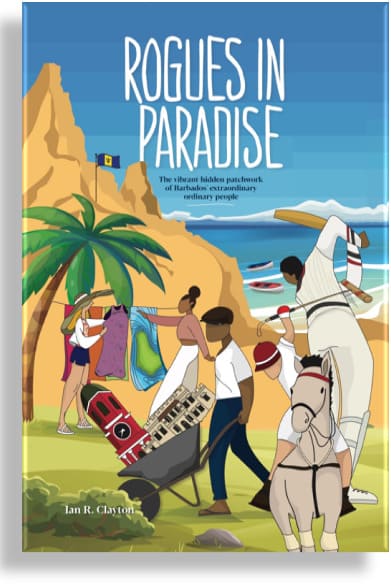
Read the sample chapters free: Download here
Rogues In Paradise
In Empire’s Shadow: Britain’s Laboratory for Slavery
and the Island That Transcended It
Rogues in Paradise began as a love letter to Barbados—its people, humour, and resilience. But you can’t tell the story of Bajan character without telling the story of how it was forged. Barbados wasn’t just another Caribbean island. It was Britain’s laboratory, the first Blank Slave Society (i); the place where slavery’s legal codes, plantation economics, and racial hierarchies were first perfected before being exported across the Americas. The warmth, entrepreneurial spirit, and quiet confidence that define Bajans today didn’t emerge despite that history—they were built from it. This book evolved from celebration to excavation: uncovering how a people transformed inherited trauma into cultural power.
When we talk about slavery in the Americas, we typically think of Virginia’s tobacco fields or the Deep South’s cotton plantations. But the blueprint for it all: the legal codes, economic structures, and racial hierarchies that would shape the entire New World—was first perfected on a small Caribbean island: Barbados. That is part of the reason for the change of focus – See Why we changed Direction
In 1661, Barbados enacted the Western Hemisphere’s first comprehensive Slave Code, legally defining enslaved Africans as property rather than people. This wasn’t just local policy—it became the template. Carolina’s slave laws copied it verbatim. Jamaica, the American South, and every major plantation economy built their systems on Barbados’s foundation. As historian Hilary Beckles argues, Barbados was “the most systemically violent, brutal, and racially inhumane society of modernity”. Britain’s laboratory, where the machinery of racial capitalism was first assembled and tested.
Three centuries later, that same island has produced Rihanna, global cricket legends, and Prime Minister Mia Mottley, whose climate justice advocacy at COP26 made her a moral voice on the world stage. How did the descendants of Britain’s first slave society not just survive, but thrive? That’s the question at the heart of Rogues in Paradise.
Beyond the Beaches: Unpacking Post-Colonial Identity
Most books about Barbados focus on white-sand beaches and rum-punch recipes. Rogues in Paradise does something different—and far more important. It excavates the historical roots of Bajan character: the humour, resilience, entrepreneurial spirit, and quiet confidence that define the island today.
Author Ian R. Clayton spent three decades embedded in Barbadian life, building the island’s digital tourism presence while forming deep relationships with everyday Bajans. His book weaves personal encounters with rigorous historical research, creating a polyphonic narrative where multiple voices, angry, proud, conflicted, hopeful—coexist without easy resolution.
This is post-colonial literature at its finest: refusing simple narratives of victimhood or triumph, instead showing how identity emerges from the daily negotiation between inherited trauma and self-determination.
The African Diaspora Connection: From Provision Grounds to Power
One of the book’s most compelling arguments traces a direct line from slavery-era survival strategies to contemporary success. Under slavery, Barbadian planters—unlike those on other islands—gave enslaved people small plots called “provision grounds” to grow their own food. This wasn’t benevolence; it was economics. But enslaved Africans, particularly women, transformed these marginal plots into a thriving parallel economy.
By the mid-1700s, enslaved people dominated Barbados’s food markets. Women became market managers, handling commerce, negotiating prices, and building economic networks. Fast forward to today: Barbados has one of the Caribbean’s highest literacy rates, women hold major leadership positions (including prime minister), and the island punches far above its weight economically and diplomatically.
Rogues in Paradise argues this isn’t a coincidence—it’s continuity. The matriarchal strength, entrepreneurial creativity, and economic savvy that enslaved Africans developed to survive became the foundation for post-independence success. This connection between provision grounds and contemporary achievement offers a fresh lens on African diaspora resilience: not just survival despite slavery, but transformation of survival strategies into cultural strengths.
Want to see how these historical patterns play out in real Bajan lives? Download the free preview to meet Ace, Debro, and the rogues who embody this resilience.
Cultural Resilience After Slavery: The Power of Polyphonic Truth
What makes this book essential reading isn’t just its historical analysis—it’s its refusal to speak in a single voice. Clayton introduces readers to a cast of contemporary Bajans whose perspectives often clash:
- Yardfowl, whose righteous anger demands full accounting for colonial brutality and whose voice refuses to be appeased by progress or titles
- Woolly Hewitt, a mixed-race artist who embraces his European heritage and sees British education as an asset, not an imposition
- Roger Barker, who maintains deep connection to Africa while acknowledging the hybrid Caribbean identity shaped by multiple influences
- David, who prefers focusing on the present rather than excavating painful history
These aren’t literary devices—they’re real people Clayton interviewed, whose actual words appear throughout the book. By letting these voices coexist without forcing consensus, Rogues in Paradise models how societies can hold multiple truths simultaneously. Some Bajans are still furious; others have moved on; most occupy complex middle ground. This polyphonic approach mirrors the best scholarship in Caribbean cultural identity studies, refusing to flatten lived experience into neat academic categories.
Empire and Its Aftermath: The Reparations Question
The book’s final chapters tackle one of the most contentious issues in post-colonial studies: reparations for slavery. Clayton documents the emerging movement comprehensively:
- The Trevelyan family’s formal apology and educational trust in Grenada
- Codrington College’s $18 million voluntary reparation fund
- Richard Drax’s negotiations with PM Mottley over his family’s plantation legacy
- The Brattle Group’s calculation: $54.16 trillion owed by European powers (UK: $24 trillion; Spain: $17.1 trillion; France: $9.2 trillion; Netherlands: $4.86 trillion)
But Clayton doesn’t just report the debate—he interrogates it. Will reparations actually reach those who need them, or will corruption and bureaucracy divert resources? Can financial compensation ever address intergenerational trauma? How do we balance the urgent moral demand for justice with the practical work of building functioning societies?
Most powerfully, he gives voice to both sides: Yardfowl’s insistence that “de trillions de tek from we toil and tear mus come back,” alongside White Bajans like Patrick Foster who identify as Caribbean rather than English, complicating simple narratives about who owes what to whom.
Why This Book Matters Now
As debates about critical race theory, colonial statues, and institutional reparations intensify globally, Rogues in Paradise offers something rare: a ground-level view of how one society actually navigates these questions. Not in academic abstractions, but in rum shops and government offices, in family kitchens and international forums.
For readers of Isabel Wilkerson’s The Warmth of Other Suns, Walter Rodney’s How Europe Underdeveloped Africa, or Edward Baptist’s The Half Has Never Been Told, this book provides the next chapter: not just how slavery happened or how it ended, but how its descendants built lives, culture, and nations from its aftermath.
The book’s title captures its central insight: “rogues” aren’t villains—they’re survivors who refused to play by rules designed to destroy them. They’re the enslaved woman who threw a British officer over her hip when he stole her goat. The former slave who billed the future King of England for damage to her hotel. The contemporary activists demanding $4.9 trillion in reparations while building the Caribbean’s most stable democracy.
These rogues didn’t just survive paradise—they made it theirs. Understanding how they did it matters for anyone grappling with questions of identity, resilience, and justice in post-colonial societies worldwide.
Ready to dive deeper? Download the free preview and meet the rogues in paradise.”
Video Summary
RoguesCulture Identity Series
Explore the RoguesCulture Identity Series — a journey from the roots of identity to its future in an age of AI.
Identity Is Not Inherited. It Is Lived. | The Full Story
PART I — ROOTS
Where identity comes from
- The Spoils of Identity in the Face of Colonialism
Colonial systems reshaped identity through power, law, and economics, with Barbados as an early case study of cultural disruption and resilience. - Barbados: Identity in Motion
Identity evolves through migration, culture, and adaptation. Barbados offers a living example of identity shaped by history and community.. - Identity Across Cultures: The World Order
Expands the conversation globally, exploring how language, geography, religion, and history shape identity across societies. - Africa: Origins and Echoes of Identity
Explores the diverse African cultures that shaped Caribbean identity—from warrior societies and desert traders to farmers, artisans, and storytellers.PART II — MEANING
What identity actually is
- Cosmic Identity
A philosophical reflection on identity beyond nationality—considering humanity’s shared cultural and existential connections. - Identity: AI vs Ancestry in 2026
As artificial intelligence reshapes communication and creativity, this essay asks what remains uniquely human—and how ancestry helps keep identity grounded.
>>>>(END OF START 1-6)PART III — THE FUTURE
What happens to identity next
- Identity and the Future
Explores how identity may evolve as societies adapt to rapid technological, cultural, and economic change. - Who Needs Identity Anyway?
Questions whether identity still matters in a globalised world—and why belonging and cultural continuity remain important. - Identity Is Fragile
Reflects on how identity can be distorted, politicised, or manipulated—and why cultural awareness is essential to protect it. - AI, Quantum Computing, and Power
Examines how emerging technologies may reshape global power structures—and the future of human identity itself.
Based on Rogues in Paradise — pre-screening chapters available
Related Blogs
Rogues Re-Framed: https://roguesinparadise.com/britains-first-slave-society-the-barbados-prototype/
Barbados: Britain’s Laboratory for Slavery: https://roguesinparadise.com/barbados-britains-laboratory-for-slavery/
Keywords & Categories
Primary Keywords: Britain’s first slave society, Barbados colonial history, African diaspora Caribbean, post-colonial identity, New World slavery origins, cultural resilience after slavery
Secondary Keywords: Post-colonial studies, African diaspora history, Caribbean cultural identity, slavery and resilience, empire and its aftermath, Barbados prototype, matriarchal societies, the Caribbean, provision grounds economics, reparations movement Caribbean
Categories: Cultural & Social Issues, Post-Colonial Studies, African Diaspora History, Caribbean Studies, Cultural Anthropology, Race & Ethnicity Studies

Notes
(i) Sir Hilary McD. Beckles, Britain’s Black Debt: Reparations for Caribbean Slavery and Native Genocide (University of the West Indies Press, 2013). Beckles, Vice-Chancellor of the University of the West Indies and Chair of the CARICOM Reparations Commission, argues that Barbados became “the most systemically violent, brutal, and racially inhumane society of modernity”—Britain’s testing ground where slavery’s legal and economic structures were perfected before being exported to the Americas. This book builds on his framework to explore how the descendants of that society transformed inherited trauma into cultural strength.