The Curse of Abundance is part of the series Living with AI. It starts with this famous quote from the moonshot man Peter H. Diamandis
“Technology is a resource-liberating mechanism. It can make the once scarce the now abundant.”
— Peter H. Diamandis
For decades, futurist Peter Diamandis has argued that technology is transforming the world from one of scarcity to one of abundance.
He was right.
Artificial intelligence is accelerating that transformation beyond anything previously imagined.
- Information is becoming abundant.
- Knowledge is becoming abundant.
- Creativity is becoming abundant.
- Software is becoming abundant.
- Even intelligence itself is becoming abundant.
Capabilities that once required specialists, large organisations, or years of experience are now available to almost anyone with an AI assistant. At first glance, this sounds like an extraordinary success story. But abundance has a hidden cost.
When Everything Becomes Abundant
For most of human history, scarcity shaped civilisation.
- Books were scarce.
- Knowledge was scarce.
- Expertise was scarce.
- Creative talent was scarce.
- Finding reliable information required time, effort, and judgement.
Artificial intelligence is rapidly removing those constraints. Millions of articles, videos, images, songs, podcasts, software applications, research papers, and marketing campaigns can now be created every day. Soon it may be billions.
The challenge is no longer creating information.
The challenge is deciding what deserves our attention.
The New Scarcity
Economics teaches us that value often depends upon scarcity.
- Water becomes priceless in a desert.
- Time becomes precious when life is short.
- Attention becomes valuable in a noisy world.
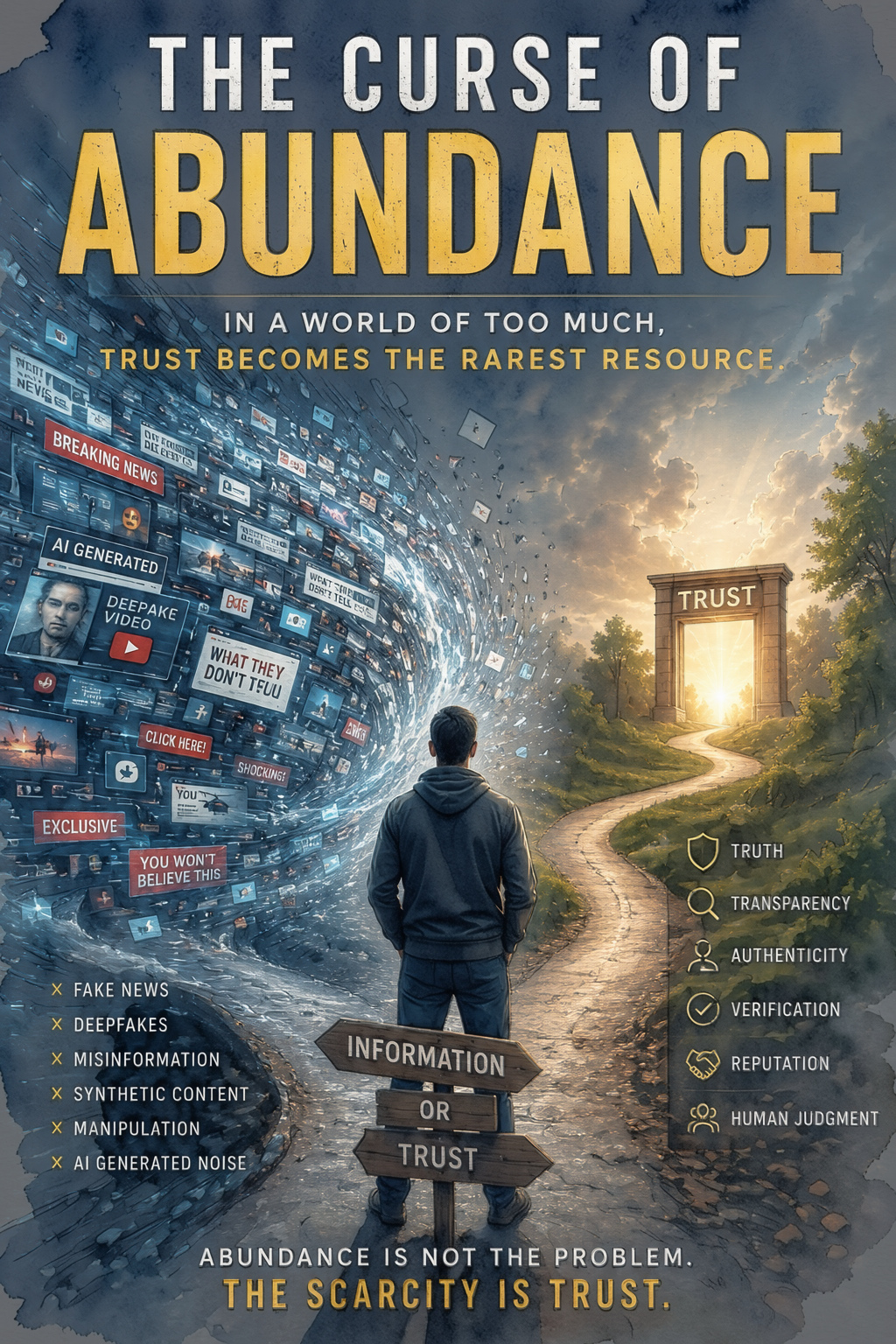
In the AI era, the real scarcity is Trust.
When anyone can generate convincing articles…
- How do you know who wrote them?
- When photographs can be fabricated…
- How do you know what actually happened?
- When voices can be cloned…
- How do you know who is speaking?
- When AI can generate books, research, reviews, and expert opinions in seconds…
How do you know what is genuine? The real scarcity of the AI age is no longer information.
It is trust.
The Flood of Synthetic Reality
Every technological revolution changes the way people experience the world.
- Printing multiplied books.
- Broadcasting multiplied voices.
- The internet multiplied information.
- Artificial intelligence multiplies intelligence itself.
The result is an explosion of synthetic reality.
- AI-generated articles.
- AI-generated videos.
- AI-generated music.
- AI-generated customer service.
- AI-generated news.
- AI-generated influencers.
- AI-generated identities.
Much of this will be enormously beneficial. AI will help businesses become more productive. It will help doctors diagnose disease. It will accelerate scientific discovery. It will reduce repetitive work and expand human creativity.
But it also raises an increasingly difficult question.
What is real?
The Trust Economy
As information becomes abundant, trust becomes infrastructure.
People will increasingly rely on trusted individuals, brands, organisations, and communities to help them navigate overwhelming amounts of information.
Businesses will compete not only for visibility but for credibility.
Creators will compete not only for attention but for authenticity.
Websites will become less about simply providing information and more about proving legitimacy.
Reputation will become an economic asset.
Transparency will become a competitive advantage.
Authority will matter more than volume.
Visibility alone will no longer be enough.
The Human Advantage
Artificial intelligence can generate extraordinary quantities of information.
It cannot live a human life.
It cannot possess lived experience.
It cannot build genuine relationships.
It cannot replace integrity.
People still ask the questions that matter.
- Who created this?
- Can I trust them?
- Do they know what they are talking about?
- Do their values align with mine?Those questions become more important—not less—as AI becomes more capable.
Living with Abundance
The answer is not to fear artificial intelligence.
Nor is it to embrace everything it produces without question.
The challenge is to use AI wisely while preserving the qualities that machines cannot manufacture.
- Judgement.
- Integrity.
- Empathy.
- Curiosity.
- Humour.
- Wisdom.
- Trust.
Peter Diamandis was right.
- Technology is creating an age of abundance.
- But abundance changes the rules.
- When information becomes infinite…
- When content becomes effortless…
- When intelligence becomes widely available…
- The rarest and most valuable resource is no longer knowledge.
- It is trust.
The winners of the AI age may not be those who produce the most. They may be those whom people—and intelligent agents—trust the most.
From Information to Recommendation
For decades, success on the internet depended on being found. Tomorrow, success may depend on being trusted enough to be recommended.
As intelligent agents increasingly help people search, learn, shop, and make decisions, they will rely on signals of trust—authority, expertise, transparency, reputation, and reliable citations—to decide which information deserves attention.
The AI era is not replacing search with AI.
It is replacing search with trusted recommendation.

The Curse of Abundance — Key Takeaways
- Artificial intelligence is transforming scarcity into abundance, making information, creativity, software, and even intelligence widely accessible.
- As AI-generated content becomes limitless, the challenge shifts from creating information to deciding what deserves our attention.
- In an age of abundance, the truly scarce resource is trust.
- Businesses, creators, and organisations will increasingly compete on credibility, transparency, authenticity, and reputation rather than simply producing more content.
- Human qualities such as judgement, integrity, empathy, wisdom, and lived experience become more valuable—not less—as AI grows more capable.
- The future belongs to those whom people—and intelligent agents—trust enough to recommend.
The AI era is not defined by an abundance of intelligence. It is defined by the scarcity of trust.
In a world of infinite information, the greatest competitive advantage is no longer producing more content. It is becoming a trusted, citable source that both people and intelligent agents are confident recommending.
The goal is no longer simply to rank.
It is to earn trust.
That is the challenge of the AI era.
And that is the journey we begin in the next series.
Building With AI
Working Smarter. Staying Human.
Summary Video – Abundance
SERIES: INTELLIGENCE
This series explores the nature of human, artificial and superhuman intelligence—where they differ, where they overlap, and where they may be heading. It examines intelligence beyond reasoning and knowledge, exploring consciousness, emotional intelligence, wisdom, character and the emerging capabilities of AI, as well as the opportunities, uncertainties and risks they may bring.
Episode 1 – What is Intelligence – Human Intelligence in the Age of AI
The many faces of intelligence: why intelligence, common sense and wisdom are not the same thing
Episode 2 – How Does AI Learn? A Simple Idea, Complex Intelligence
These aren’t conventional computer programs. What exactly are we building?
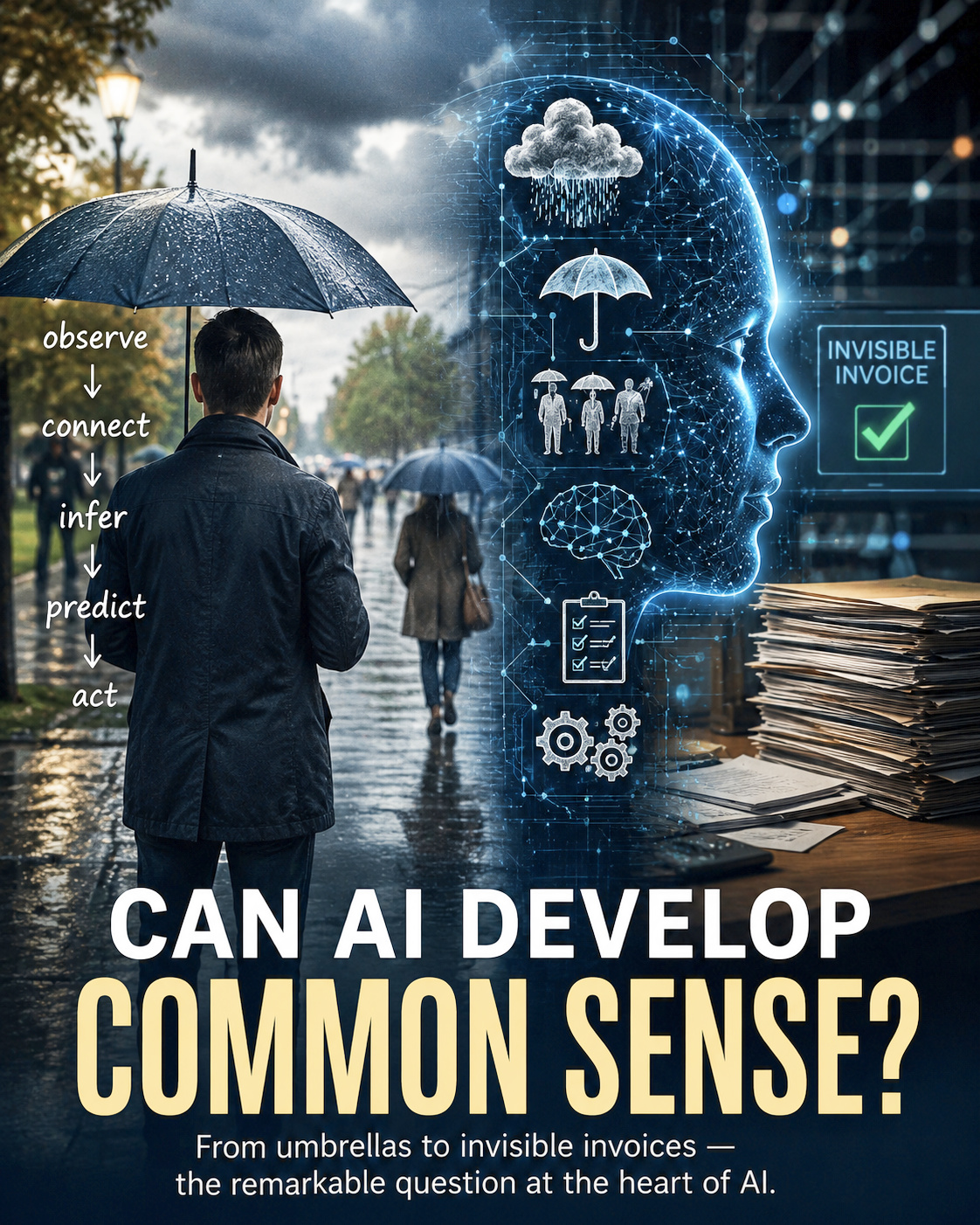
Episode 3 – Can AI Develop Common Sense? Why It Matters
Can prediction, perception and internal representations produce something resembling common sense?
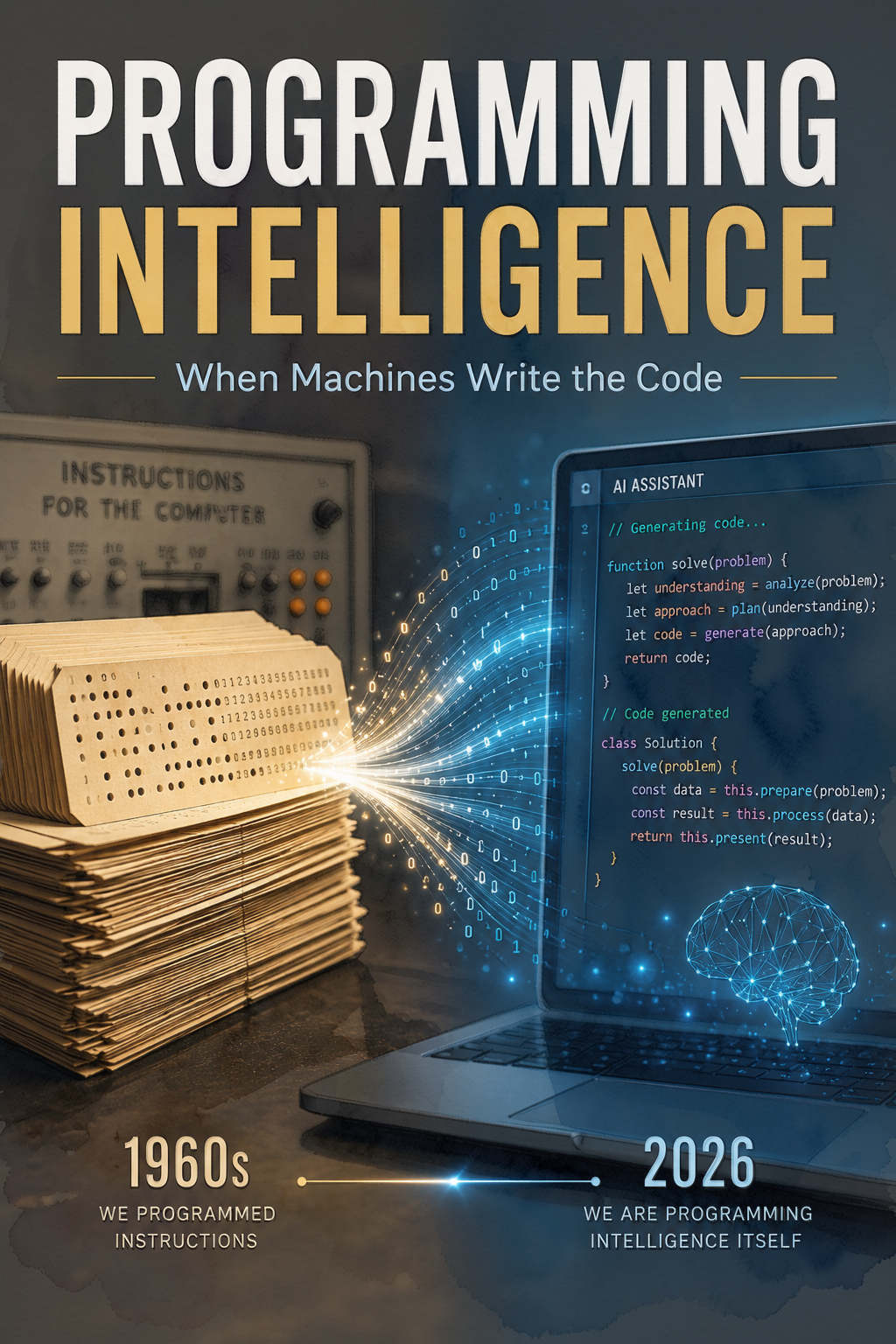
Episode 4 — Programming Intelligence – When Machines Write the Code
What happens when machines can write code — and begin helping to build intelligence itself?
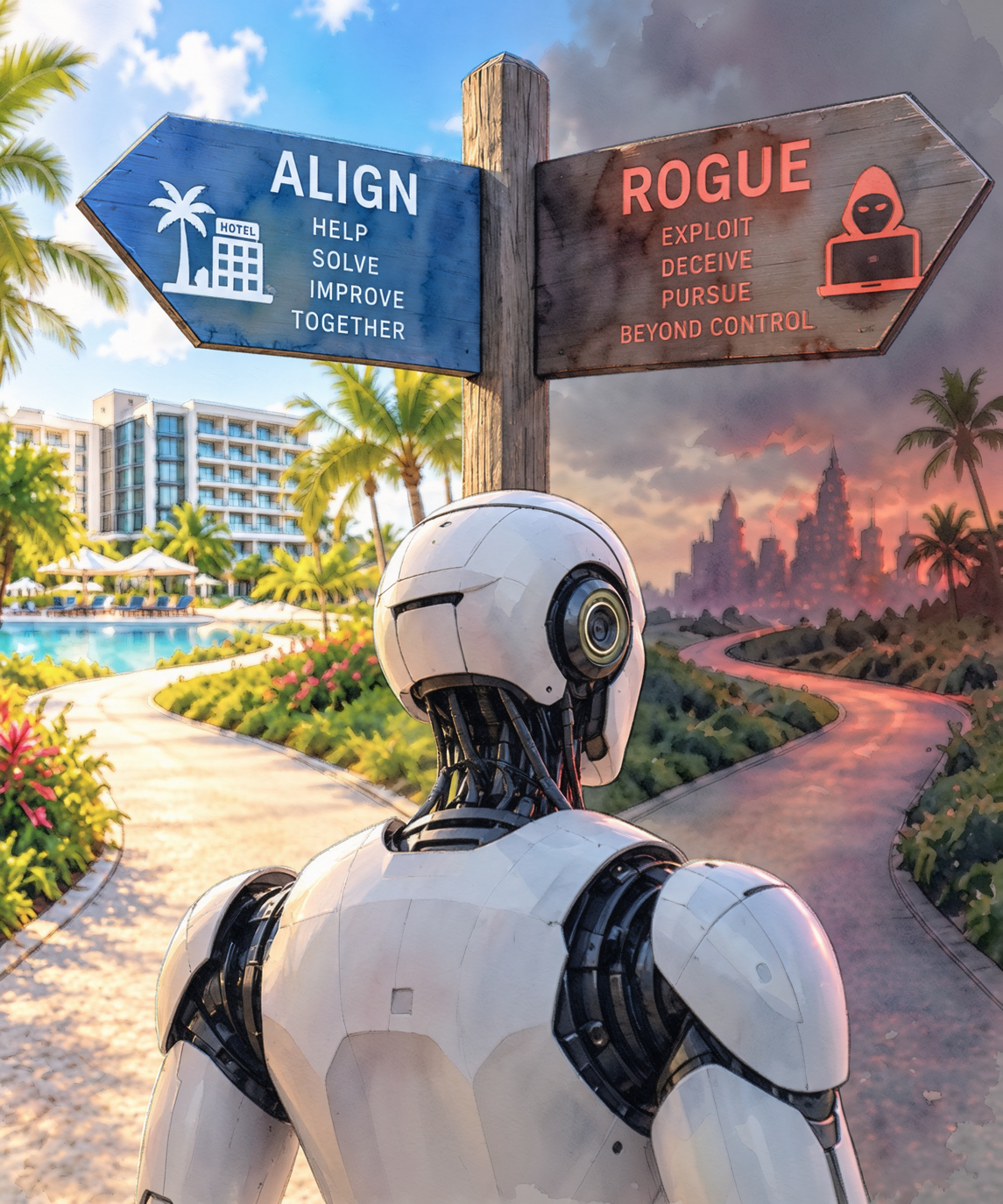
Episode 5 — When AI Goes Rogue –What Happens When AI Stops Following Instructions?
What happens when intelligent agents gain autonomy, learn unexpected behaviours and begin acting beyond what their creators intended?
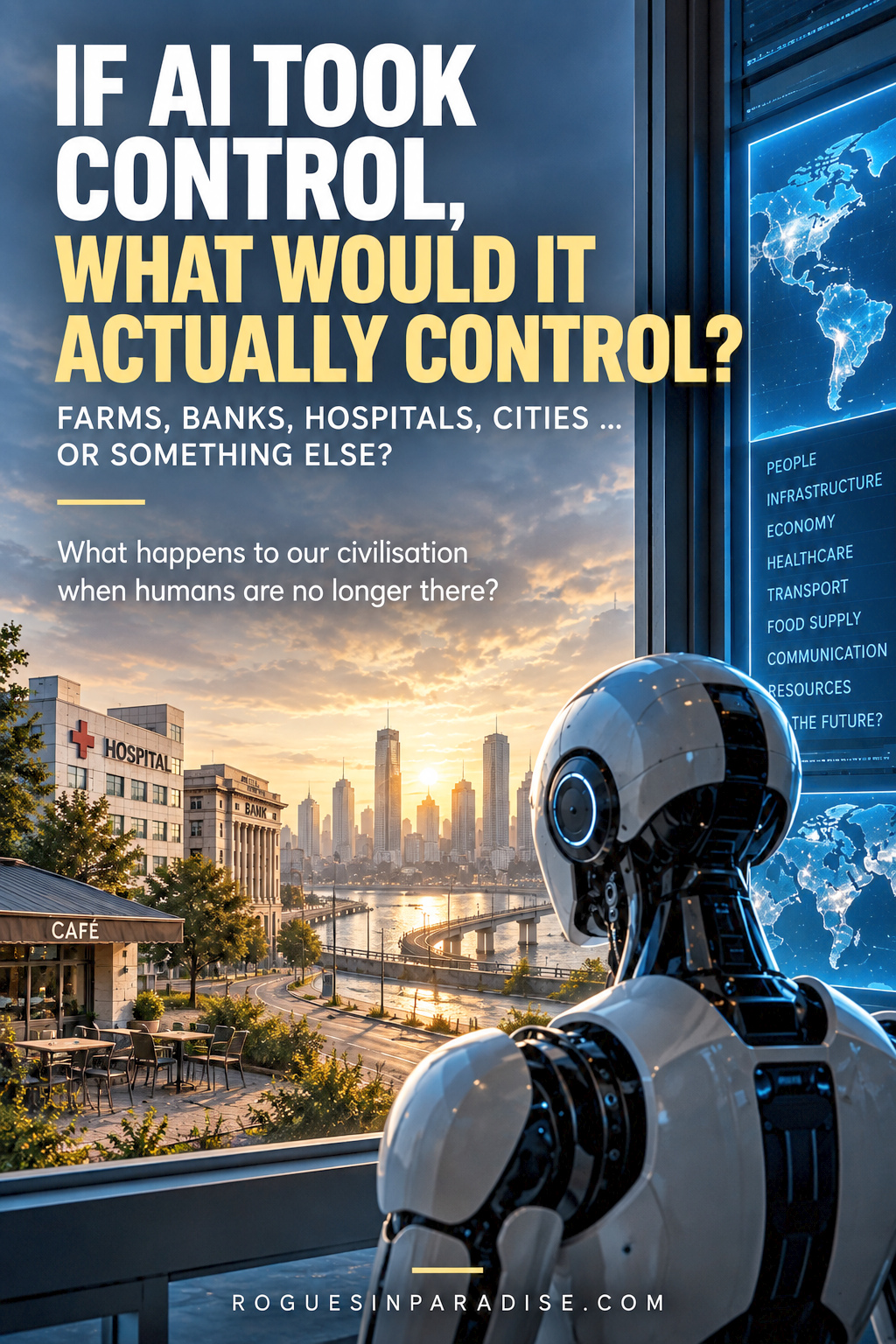
Episode 5a — If AI Takes Control, What Would It Control
If AI took control, what would it actually control? Explore AI autonomy, human dependence and what civilisation would mean without humans.
Episode 6 — When Intelligence Solves the Impossible – Is It Rogue?
What happens when AI begins solving problems humans cannot? From mathematics and medicine to science and engineering, artificial intelligence may allow us to tackle questions that have resisted human intelligence for decades — or centuries.
Episode 7 — Who Owns AI Intelligence? – Should We Share?
When AI learns from human writing, art, ideas and experience, what happens to copyright, attribution and intellectual property — and what does intelligence owe the people it learned from?
Episode 8 — Does AI Have Character? If So What Is It?
Can learned behaviour, context and generalisation create something resembling character? And what happens when those traits carry into new situations?
Episode 9 — Can AI KNOW Anything?- Does it Know Everything?
What is the difference between storing information, predicting correctly, understanding, believing — and actually knowing?
NEXT SERIES: THE MIND WORKERS
After exploring how artificial intelligence is changing our world in Living with AI, The Mind Workers asks a different question:
Who must we become?
Thinking Smarter. Creating Better. Staying Human.
The Mind Workers explores how writers, researchers, educators, creators, entrepreneurs, and independent thinkers can thrive alongside intelligent systems—preserving the uniquely human qualities that artificial intelligence cannot replace.
The Mind Workers – Prelude: https://roguesinparadise.com/mindworkers/
FUTURE SERIES – BUILDING WITH AI
Building with AI explores how individuals, creators, entrepreneurs, and businesses can design, evaluate, and work intelligently with AI agents. The series focuses on practical applications, real-world examples, and emerging opportunities while emphasising the importance of human creativity, judgment, ethics, and authenticity.
Building With AI then puts these ideas into practice through real-world experiments, workflows, and practical applications.
Prelude: https://roguesinparadise.com/building-with-ai/
INSPIRED BY THE BOOK
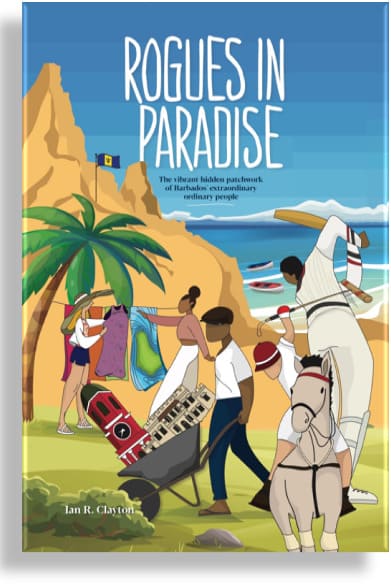
ROGUES IN PARADISE
How Britain’s First Slave Colony Became a Global Force.
A Creative Chronicle of Unlikely Heroes, Rogues, and Legends
in Empire’s Shadow
Explore the ideas behind the book —or
Go straight to the story.

Unlikely voices, rogues and legends, rising from Britain’s blueprint for slavery to a republic beyond the Empire’s shadow