(Part of the RoguesCulture podcast series)
Identity is often spoken about as something we inherit from history, ancestry, or place. But in Barbados, identity is not simply inherited. It is lived. It is shaped in the work people do, the faith they follow, the games they play, the art they create, and the visions they dare to imagine. It is not fixed. It is practised, performed, and continually remade.
From cane cutters and fishermen to healers, athletes, artists, and dreamers, identity reveals itself not as a label, but as a way of being in the world.
This article is part of the RoguesCulture Identity Series, which explores how identity is shaped by history, culture, and lived experience.
Work as Identity
From Cane Fields to the United Nations
Work has always shaped Barbadian identity. Cane cutters, fishermen, artisans, and teachers carried more than tools — they carried a sense of who they were. A fisherman once told me, “The sea raised me.” For him, fishing was not simply labour; it was identity, inheritance, and pride.
Nowhere is this more vivid than in the story of Selwin Hart, the cane cutter’s son. Four years after Barbados’ independence, a cane cutter’s wife gave birth to a boy who would go on to become a global leader in climate action — serving as Special Adviser and Assistant Secretary-General at the United Nations.
His journey shows how work, once tied to survival, can also be a foundation for transformation. Selwin’s story honours the dignity of his parents’ labour while transcending it, proving that identity is not fixed by occupation but shaped by what we carry from it: resilience, discipline, and vision.
In Barbados, work has never been only about survival. It has been about belonging — and the possibility of becoming more.
If work grounds identity in daily life, faith gives it direction and meaning.
Faith and Spiritual Identity
Faith in Barbados is not confined to churches or ritual; it is lived through action, service, and choice.
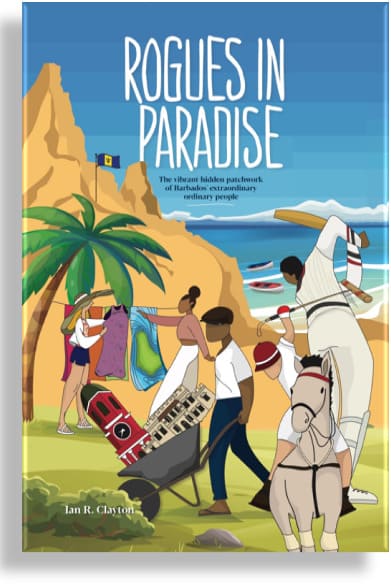
One example is Errol Griffith, whose journey I recount in Rogues in Paradise. Once vice president of the Barbados Tourism Authority, Errol helped pioneer the island’s digital tourism presence — a vision that was initially dismissed. Yet beyond innovation, his deeper calling has always been spiritual.
Guided by faith, he has spent years mentoring the misunderstood and the marginalised: working with prisoners, supporting the disadvantaged, and helping young people take responsibility for their lives.
His Power of Choice programme teaches a simple but profound truth: identity is not only inherited — it is shaped by the decisions we make each day.
Errol believes that dwelling solely on past injustice can become corrosive, breeding anger and division. Yet he also recognises that history cannot be ignored. The challenge, he insists, is how we carry it. For him, faith provides the compass — a reminder that change lies not in anger, but in choice.
If faith shapes inner purpose, sport projects identity outward — onto the world stage.
Sport and Global Identity
Sir Garry Sobers
If cricket is a religion in the Caribbean, then Sir Garfield Sobers is its high priest.
Universally regarded as the greatest all-rounder in the history of the game, Sobers is not only a sportsman but a symbol of Barbadian and West Indian identity carried onto the global stage.
The West Indian writer Ian McDonald captured it best:
“Batting touched by imagination beyond textbook… bowling full of creativity… fielding the quicksilverest of all men… an unmatchable life force.”
It takes a poet to describe such brilliance. Sobers himself often attributes his success to hard work, yet his genius went beyond discipline. Thousands trained; few reached his level. His instinct, timing, and creativity made him extraordinary.
When Sobers walked to the crease, he carried more than a bat. He carried Barbados — its resilience, its flair, its quiet confidence.
In him, identity became performance — a living demonstration that a small island could command the world stage not only through survival, but through mastery.
Where sport expresses identity through performance, art and music allow it to expand beyond boundaries.
Art, Music, and the Creative Self
If work grounds identity and faith gives it direction, art and music allow it to soar.
Creativity has always enabled Bajans to stretch beyond borders — to say, “I am not just Bajan, I am world.”
This expansiveness is heard in calypso, reggae, spouge, and tuk bands — rhythms born in small yards and village fêtes, yet carried far beyond the island.
Visual artists extend that reach even further. Alison Chapman-Andrews reimagines Barbados through bold landscapes. Martina Pile and Ann Dodson capture the lives of ordinary Bajans. Terrence Piggott plays with abstraction and imagination. Jamal Ince explores cultural memory through natural forms, while Lilian Sten-Nicholson blends the mystical and the symbolic in works that seem to rise out of history itself.
Through brushstrokes, rhythm, and voice, identity becomes expression — and expression becomes belonging.
The artist’s self is always larger than the categories imposed upon it. It reaches outward, while carrying home within.
And beyond expression lies imagination — where identity is no longer confined to place, but reaches toward something larger.
The Cosmic Self
Leo the Cosmic Barbadian
Some Bajans look to the land. Others look to the sea. Leo looks to the stars.
He calls himself the Cosmic Barbadian — a man who sees identity not as a boundary, but as a window onto the universe.
In Leo’s world, Barbados is not just an island. It is part of a larger story — one that connects coral reefs to cosmic dust, history to imagination, earth to sky.
His vision is playful, profound, and quietly radical. He speaks of consciousness as something shared, of identity as something expansive rather than fixed.
Yet he is deeply rooted. He carries Barbados in his humour, his rhythm, his way of seeing the world. For him, identity is not something to escape — it is something to extend.
Leo reminds us that identity is not only what we inherit or practice. It is also what we dare to imagine.
His cosmic self is the ultimate act of choice — a refusal to be confined by history or geography, and an embrace of belonging on a much larger scale.
Reflection
Identity is not a single thread, but a tapestry.
It is forged in work, shaped by belief, expressed through performance, expanded through creativity, and reimagined through vision.
In Barbados, these layers come together in ways that are both deeply local and unmistakably global. From the cane fields to the cricket pitch, from the church to the studio, from the rum shop to the cosmos, identity is lived — not as a fixed label, but as a continuous act of becoming.
What begins in inheritance is transformed through action and imagination.
And as the world moves into an age shaped by technology and change, this truth becomes even more important:
Identity begins in the past — but it is created in the present.
Watch the short overview of how identity is lived through work, faith, and imagination.
Soon!
This article is part of the RoguesCulture Identity Series, which explores how history, culture, and human experience shape identity in a rapidly changing world.
RoguesCulture Identity Series
Explore the RoguesCulture Identity Series — a journey from the roots of identity to its future in an age of AI.
Identity Is Not Inherited. It Is Lived. | The Full Story
PART I — ROOTS
Where identity comes from
- The Spoils of Identity in the Face of Colonialism
Colonial systems reshaped identity through power, law, and economics, with Barbados as an early case study of cultural disruption and resilience. - Barbados: Identity in Motion
Identity evolves through migration, culture, and adaptation. Barbados offers a living example of identity shaped by history and community.. - Identity Across Cultures: The World Order
Expands the conversation globally, exploring how language, geography, religion, and history shape identity across societies. - Africa: Origins and Echoes of Identity
Explores the diverse African cultures that shaped Caribbean identity—from warrior societies and desert traders to farmers, artisans, and storytellers.PART II — MEANING
What identity actually is
- Cosmic Identity
A philosophical reflection on identity beyond nationality—considering humanity’s shared cultural and existential connections. - Identity: AI vs Ancestry in 2026
As artificial intelligence reshapes communication and creativity, this essay asks what remains uniquely human—and how ancestry helps keep identity grounded.
>>>>(END OF START 1-6)PART III — THE FUTURE
What happens to identity next
- Identity and the Future
Explores how identity may evolve as societies adapt to rapid technological, cultural, and economic change. - Who Needs Identity Anyway?
Questions whether identity still matters in a globalised world—and why belonging and cultural continuity remain important. - Identity Is Fragile
Reflects on how identity can be distorted, politicised, or manipulated—and why cultural awareness is essential to protect it. - AI, Quantum Computing, and Power
Examines how emerging technologies may reshape global power structures—and the future of human identity itself.
Based on Rogues in Paradise — pre-screening chapters available
Related Blogs
Rogues Re-Framed: https://roguesinparadise.com/britains-first-slave-society-the-barbados-prototype/
Barbados: Britain’s Laboratory for Slavery: https://roguesinparadise.com/barbados-britains-laboratory-for-slavery/