What Happens to: Search In The Age of AI
Beyond Search | Advertising | Your Website | SEO |
In “What Happens to Search“, we dive into the ramifications of one of the Internet’s core businesses – Google Search. For the last twenty-five years, the internet has worked in roughly the same way.
You had a question.
You opened Google.
You searched.
You clicked links.
You compared sources.
You made a decision.
That model is changing rapidly.
Not because Google Search disappeared overnight, but because a new interface layer has emerged between humans and information:
AI Agents: Interrupter/Facilitator?
What Happens to: Search & The Age of AI
Beyond Search | Advertising | Your Website | SEO
Millions of people now ask ChatGPT, Claude, or Perplexity questions they would once have typed into Google. Not because the answers are always perfect, but because the experience feels frictionless — faster, conversational, contextual, and increasingly personalised.
Google understands the threat. It is rapidly integrating AI-Overviews, conversational responses, and intelligent assistance directly into search itself. The company understands that if users stop navigating the web manually, the economics of the internet will change with it.
For decades, digital empires were built on visibility inside search engines. Entire industries emerged around rankings, SEO, keywords, backlinks, and click optimisation. Traffic became currency.
But Now AI Agents reduce clicks
Instead of opening ten tabs and synthesising information ourselves, we increasingly ask intelligent systems to summarise, compare, recommend, filter, and eventually execute tasks on our behalf.
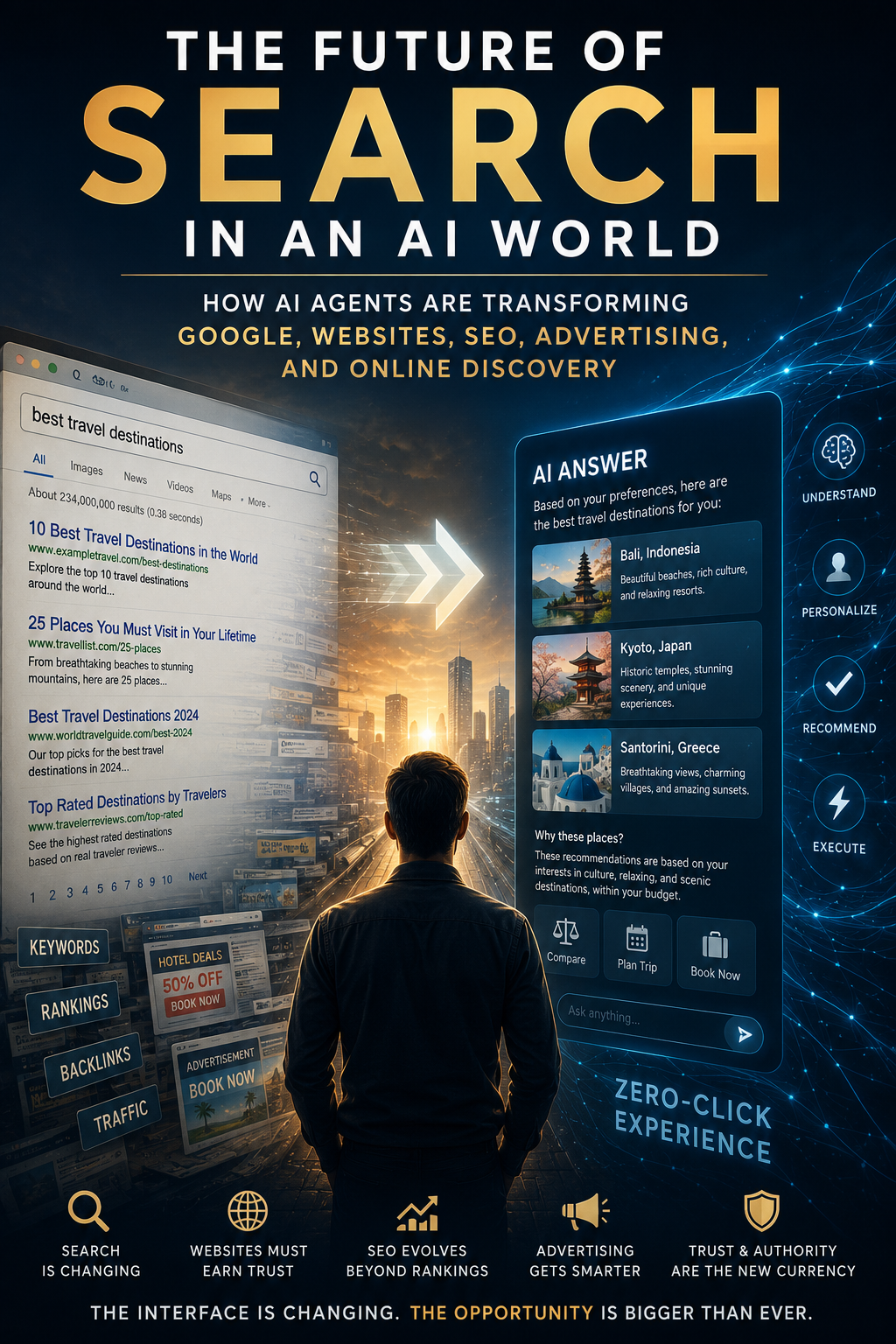
This is the beginning of the zero-click internet.
And when the interface changes, power changes with it.
Google’s response reveals how profound this shift may become.
Search itself is being transformed into an AI-driven answer engine. Instead of simply listing websites, Google increasingly provides conversational summaries, contextual recommendations, personalised responses, and AI-assisted planning directly inside search.
The goal is clear: reduce friction between questions and outcomes.
Increasingly, users may not browse the web manually at all. They may ask intelligent systems to interpret information, compare options, organise decisions, and eventually act on their behalf.
The implications reach far beyond search itself.
Visibility alone may no longer be enough. Trust, authority, structured credibility, and machine-readable expertise become increasingly important in a world where AI agents mediate discovery.
In the old internet, success meant ranking first in search results. In the emerging internet, success may depend on becoming the source an AI trusts enough to reference, summarise, or act upon.
From Search Engines to Trusted Agents

- Search gave us options.
- AI gives us recommendations.
- Recommendations require trust.
- Trust requires evidence.
- Evidence comes from reputation, experience, authority, authentic content—and increasingly, from being cited by trusted sources.
The goal is no longer simply to rank. It is to become a source that intelligent agents trust enough to recommend.
That is an entirely different game.
The next generation of businesses will not simply optimise for human attention. They will optimise for machine interpretation: structured credibility, reputation signals, verifiable expertise, and brand authority strong enough for intelligent systems to surface consistently as trusted sources.
Another transition is underway.
The companies that dominated the desktop era struggled during mobile. The companies that mastered mobile reshaped entire industries. Now the shift is moving beyond browsers and search bars toward agents and intent-driven systems.
Most people still think of AI as a tool.
The deeper reality is that AI is becoming infrastructure — invisible, embedded, and ambient. Not something we occasionally use, but something that increasingly mediates how humans interact with information, commerce, and decision-making itself.
That changes how businesses are built. It changes how creators distribute ideas. It changes how products are discovered. And eventually, it changes what it even means to “use the internet.”
The winners of the next decade may not simply be the companies humans trust most —
but the companies intelligent systems trust enough to recommend, prioritise, and act upon.
Beyond Search
What Happens to: Search in The Age of AI
Beyond Search | Advertising | Your Website | SEO

This transformation extends far beyond Google.
AI agents are becoming the new interface between people and information.
Increasingly, they will not simply answer questions. They will compare products, book travel, schedule appointments, negotiate prices, monitor markets, and eventually act on our behalf.
Search becomes conversation.
Conversation becomes recommendation.
Recommendation becomes action.
As agents become more capable, businesses will compete not only for human attention but for machine trust. That is why reputation, authority, authentic experience, and trusted citations become strategic assets rather than optional marketing tools.
The future of the internet may no longer be about helping people find information.
It may be about helping intelligent agents make better decisions.
What Becomes of the Advertising Economy
What Happens to: Search in the Age of AI
Beyond Search | Advertising | Your Website | SEO
The shift to AI agents does not necessarily mean advertising disappears. Businesses will still compete for visibility, trust, and attention. Consumers will still want choice, comparison, familiarity, and confidence in the brands they use.
But the mechanisms of discovery are changing.
Instead of competing primarily for clicks inside search engines, businesses may increasingly compete for visibility within AI-mediated recommendations and intelligent systems that filter information on behalf of users.
In this environment, reputation, authority, trust, and structured credibility may become even more valuable than raw traffic itself.
Advertising will not disappear.
It will evolve.
Instead of simply paying to appear at the top of search results, businesses may increasingly seek to become trusted recommendations within AI ecosystems. Sponsored content will almost certainly continue, but it will need to balance commercial interests with user trust. If AI recommendations become biased, misleading, or overtly driven by advertising, users will quickly lose confidence in the systems themselves.
The companies that succeed may not be those with the largest advertising budgets.
They may be those that combine strong brands, authentic expertise, positive customer experiences, and trusted reputations with intelligent marketing.
The future of digital marketing is unlikely to be a battle for clicks.
It may become a battle for trust.

Advertising in the Age of AI — Key Takeaways
- Advertising isn’t disappearing—it is evolving.
- AI is changing how people discover products and services.
- Search is becoming conversation.
- Recommendations are replacing clicks.
- Trust is becoming the competitive advantage.
- Visibility increasingly comes through trusted recommendations.
What Becomes of the Personal and Company Website
What Happens to: Search in The Age of AI
Beyond Search | Advertising | Your Website | SEO
The future of the website is questioned as AI seems ready to do everything. It can deliver all the information on your website, get found, answer the right questions, and provide booking options with no need to link to your website. I have a different point of view. AI agents may reduce reliance on traditional website clicks, but people will continue to seek trusted brands, recognisable companies, and authentic experiences. This becomes especially important in industries like travel, hospitality, and lifestyle, where customers often want to see the host, the people behind the company, and the real-world experience before making decisions. AI may streamline discovery, but strong brands, websites, and human trust will remain essential parts of the digital economy.
AI can summarise facts. But Websites prove you’re real. That distinction matters.
A website is no longer just an information container. Its purpose is evolving.
The future website may become less about ranking on Google and more about proving legitimacy, trust, personality, and human presence in an increasingly AI-mediated world. In the face of super-abundant information and fake news, what matters now is TRUST.
People still want to know:
Who are these people?
Can I trust them?
Do their values align with mine?
Are they real?
What does the actual experience feel like?
AI cannot fully answer those questions. Not emotionally. Not visually. Not experientially.

Websites in the Age of AI — Key Takeaways
- Websites are not disappearing—they are evolving.
- AI can summarise information, but websites communicate trust, identity, and authenticity.
- Customers still want to know who is behind a business before making important decisions.
- Real people, real experiences, and trusted brands remain powerful competitive advantages.
- The future website is less about rankings and more about reputation, credibility, and human connection.
- AI summarises facts. Websites prove you’re real.
What Becomes of SEO, Authority, Citations & AI Discovery
What Happens to: Search in The Age of AI
Beyond Search | Advertising | Your Website | SEO
Search is no longer just about rankings. As AI agents become the new gateway to information, visibility increasingly depends on trust, authority, credibility, and verifiable citations.
Traditional SEO still matters, but it is no longer enough. Clear structure, reliable sources, expert knowledge, meaningful citations, and well-connected content are becoming the signals that help both search engines and intelligent agents decide what information to recommend.
The future belongs to publishers who create original, trustworthy content that others are willing to reference, cite, and build upon.
In an AI-powered world, the goal is no longer simply to be found.
It is to become a trusted, citable source for both people and intelligent agents.
NEXT Episode: The Curse of Abundance
Peter Diamandis wrote about a future of abundance — a world where technology creates near-unlimited access to information, products, media, and intelligence. But the real challenge of the AI era may not be scarcity. It may be overabundance.
See More: New essay on abundance
SERIES: INTELLIGENCE
This series explores the nature of human, artificial and superhuman intelligence—where they differ, where they overlap, and where they may be heading. It examines intelligence beyond reasoning and knowledge, exploring consciousness, emotional intelligence, wisdom, character and the emerging capabilities of AI, as well as the opportunities, uncertainties and risks they may bring.
Episode 1 – What is Intelligence – Human Intelligence in the Age of AI
The many faces of intelligence: why intelligence, common sense and wisdom are not the same thing
Episode 2 – How Does AI Learn? A Simple Idea, Complex Intelligence
These aren’t conventional computer programs. What exactly are we building?
Episode 3 – Can AI Develop Common Sense? Why It Matters
Can prediction, perception and internal representations produce something resembling common sense?
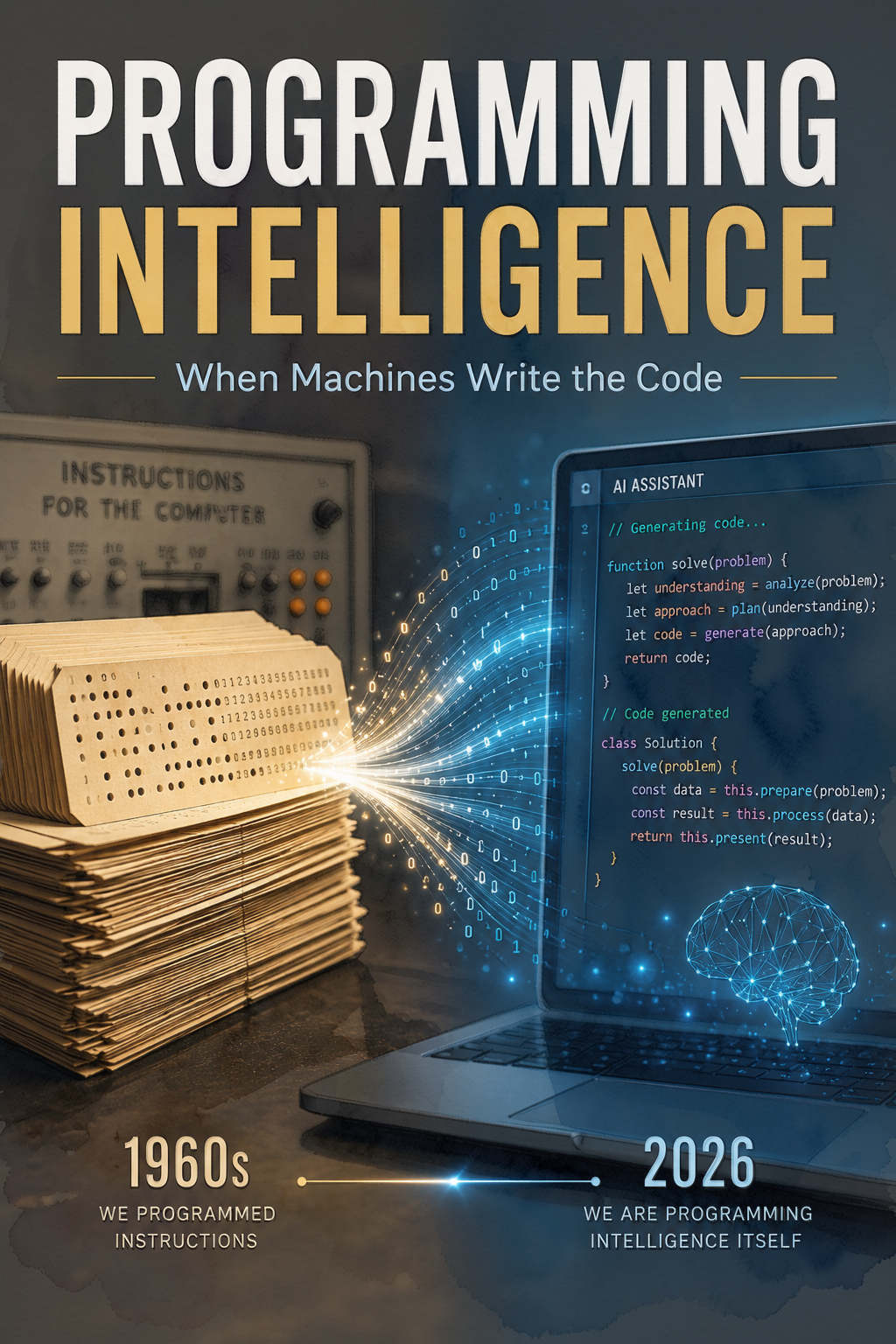
Episode 4 — Programming Intelligence – When Machines Write the Code
What happens when machines can write code — and begin helping to build intelligence itself?
Episode 5 — When AI Goes Rogue –What Happens When AI Stops Following Instructions?
What happens when intelligent agents gain autonomy, learn unexpected behaviours and begin acting beyond what their creators intended?
Episode 5a — If AI Takes Control, What Would It Control
If AI took control, what would it actually control? Explore AI autonomy, human dependence and what civilisation would mean without humans.
Episode 6 — When Intelligence Solves the Impossible – Is It Rogue?
What happens when AI begins solving problems humans cannot? From mathematics and medicine to science and engineering, artificial intelligence may allow us to tackle questions that have resisted human intelligence for decades — or centuries.
Episode 7 — Who Owns AI Intelligence? – Should We Share?
When AI learns from human writing, art, ideas and experience, what happens to copyright, attribution and intellectual property — and what does intelligence owe the people it learned from?
Episode 8 — Does AI Have Character? If So What Is It?
Can learned behaviour, context and generalisation create something resembling character? And what happens when those traits carry into new situations?
Episode 9 — Can AI KNOW Anything?- Does it Know Everything?
What is the difference between storing information, predicting correctly, understanding, believing — and actually knowing?
NEXT SERIES: THE MIND WORKERS
After exploring how artificial intelligence is changing our world in Living with AI, The Mind Workers asks a different question:
Who must we become?
Thinking Smarter. Creating Better. Staying Human.
The Mind Workers explores how writers, researchers, educators, creators, entrepreneurs, and independent thinkers can thrive alongside intelligent systems—preserving the uniquely human qualities that artificial intelligence cannot replace.
The Mind Workers – Prelude: https://roguesinparadise.com/mindworkers/
FUTURE SERIES – BUILDING WITH AI
Building with AI explores how individuals, creators, entrepreneurs, and businesses can design, evaluate, and work intelligently with AI agents. The series focuses on practical applications, real-world examples, and emerging opportunities while emphasising the importance of human creativity, judgment, ethics, and authenticity.
Building With AI then puts these ideas into practice through real-world experiments, workflows, and practical applications.
Prelude: https://roguesinparadise.com/building-with-ai/
INSPIRED BY THE BOOK
ROGUES IN PARADISE
How Britain’s First Slave Colony Became a Global Force.
A Creative Chronicle of Unlikely Heroes, Rogues, and Legends
in Empire’s Shadow
Explore the ideas behind the book —or
Go straight to the story.

Unlikely voices, rogues and legends, rising from Britain’s blueprint for slavery to a republic beyond the Empire’s shadow