If you ask me where I’m from, I pause.
There is a tidy answer—passports and paperwork—but it never feels complete.
And perhaps that’s the point.
I was born in one place, raised across others, and have lived long enough in yet another to call it home. I’ve got family stories that drift across oceans and time, DNA results that wink at Vikings and Irish roots, and a life stitched together by friendships, work, and island breezes. None of it, on its own, feels like identity. And yet, all of it does.
Identities Fall and Rise
When friends and I talk about identity, many say they don’t really have one. They shrug at the question, as if identity is a team jersey you either put on or you don’t. I don’t think it’s that simple. Most of us carry several identities at once, some chosen, some inherited, some thrust upon us by history, class, accent, or skin. They rise and fall depending on where we are and who is asking. The self that greets a border control officer is not the same one that greets a neighbour. The self that argues about art is not the same one that negotiates a bill. We move through our days switching codes and costumes with unconcern, until someone demands we pick just one.
It’s odd how easily identity becomes a demand. Forms and politics love singular boxes. So do culture wars. “Pick your side. Declare your label. Explain yourself.” But living doesn’t feel like that. Living feels like tide and weather: shifting, repeatable in pattern but never exactly the same. I can say I’m Caribbean, and that lands one way in London and another in Bridgetown. I can say I’m from here and from there, and watch people decide what that should mean. Often they’re wrong, not maliciously, just tidily.
Who Decides Who You Are?
There is another curious thing about identity.
Sometimes we spend less time deciding who we are than listening to other people tell us who we are not.
A man asked me recently where I was from.
“Trinidad,” I replied.
He looked at me and said, “You may have lived in Trinidad, but you’re not a Trini.”
I smiled. I was born there. I grew up there before leaving for school in Ireland, and I returned every summer. My closest childhood friendships were formed there. Much of my humour, rhythm, and outlook on life still feel unmistakably Trinidadian.
So I answered him—not with an argument, but in Trinidad dialect.
“Well, if dat’s what yuh want, ah could be more Trini for yuh. Doh mamaguy me, eh! Ah born det, grow up dey, and if yuh keep dat up, ah go bounce yuh pon yuh head with meh flitcan. Den yuh go have to run to Hi-Lo and buy some Phensic to fix it!. Ah ain’t Skylarking, das a fac”
He looked at me for a moment…
…then burst out laughing.
So did I.
The conversation changed immediately. It reminded me that identity is often judged by appearances before it is understood through experience.
The incident stayed with me because it raised a larger question.
Who gets to decide who we are?
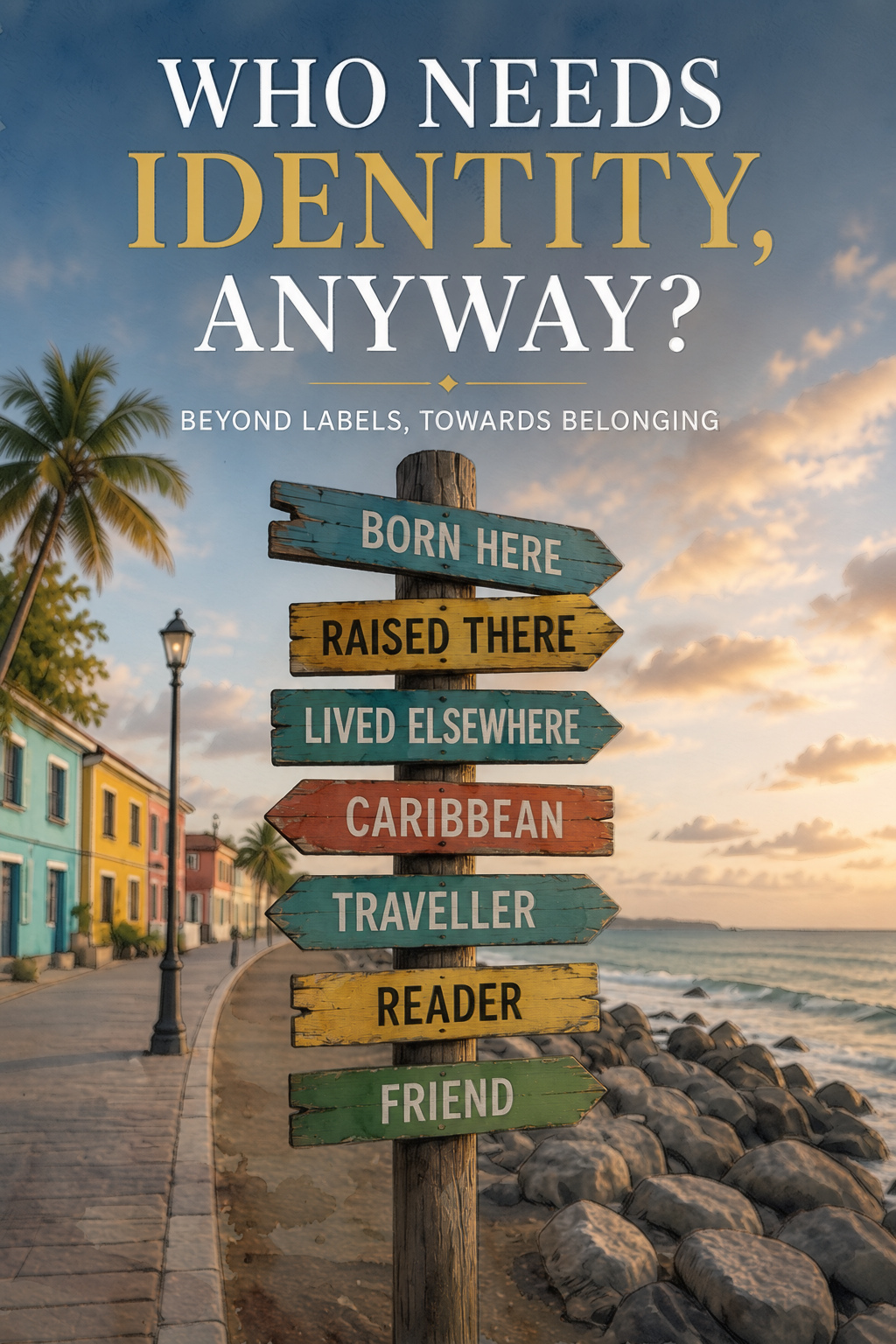
- Our birthplace?
- Our ancestry?
- Our accent?
- The colour of our skin?
- Our passport?
- Or the life we have actually lived?
Perhaps identity belongs less to those who classify us than to those who have walked beside us.
Cricket Calypso, and Laughter
The Caribbean teaches a particular humility about labels. Barbados was once called Little England; now it is unapologetically itself, a republic with a long memory and a modern appetite. The island’s identity never was a single thing—it is coral rock and sugar ash, church bells and rum shops, migration and return, cricket and calypso, laughter in the face of insult. That multiplicity is not confusion. It’s a method. It’s how small places endure big histories: by refusing to be only one story.
When people say they don’t have an identity, I hear two truths at once. First, that their everyday life—family, work, errands, music—feels too ordinary to count. Second, the official stories on offer feel too narrow to fit. So the word “identity” becomes either too small or too grand. Too small to hold the little rituals that make us recognisable to ourselves—how we greet the sea in the morning, which jokes we share, what we cook when someone is ill. Too grand, because it arrives with flags and anthems, with claims about purity and tradition that no real life can sustain.
Maybe identity is not a noun to be possessed
Maybe it is a verb to be practised.
Not “I have an identity,” but “I am identifying”—with people, with places, with memories and hopes. Some days, I identify with the islander who knows the cut of the wind before the rain. Some days with the traveller who can sleep in any airport. Some days, with the reader who finds a home on the page. All of these are me; none of them is me alone.
Of Course, there’s Danger in Identity.
History shows how quickly pride hardens into a border, and a border into a bruise. We’ve seen what happens when a story insists on being the only story. That kind of identity is a locked door: comforting for those inside, suffocating for those excluded. The antidote isn’t to have no identity; it’s to hold identity lightly.
Be Proud, yes—but Curious too.
Proud of the road that brought you here, curious about the roads others took. Proud of the music you grew up with, curious about the rhythms that move your neighbour. Identity used well is a bridge; poorly used, it’s a wall.
There’s also relief in admitting that some parts of identity are seasonal. The self that belonged to a childhood street might not survive the move to a new country. The self that rose to a crisis might not be needed every day. Let them go and let them return. The point is not to prove coherence but to sustain aliveness. If we are lucky, the person we are at fifty would not have satisfied the person we were at twenty.
Growth looks messy close up;
Only later does it read as character.
So—who needs identity, anyway? I think we all do, but not the kind that shouts. We need a sense of self that can breathe: a way to recognise our reflection, even as the light changes. We need the small anchors of habit and affection, the words and gestures that tell us, “Yes, this is mine.”
We need permission to carry several passports of the soul, to answer “Where are you from?” with a story rather than a slogan.
Living in the In-Betweens
If I must name it, I’d say my identity lives in the in-betweens: in the pause before the answer, in the laugh that crosses accents, in the shared memory of salt spray on a hot day. It lives in the people I love and the places that love me back. It lives in the work I do and the questions I can’t stop asking. It’s the sum of my loyalties and the ways I fail them and try again. It is nothing like a certificate. It’s everything like a practice.
Perhaps the better question is not “Who are you?”
But “Who are you becoming?”
That puts the emphasis where it belongs—on motion, choice, responsibility. I can’t change my ancestry. I can choose my commitments. I can listen better. I can resist the temptation to make someone else small so that my story seems large. I can belong without owning. I can remember without being consumed. I can honour where I come from and still walk forward.
Identity Is the Story We Tell Ourselves
In the end, identity is the story we tell ourselves about who we are—and whether we allow that story to be edited by experience, enlarged by generosity, and tempered by truth. Some days the story is quiet and domestic; some days it is public and loud. Some days it is the sea; some days the stone. It doesn’t need to be definitive to be real. It only needs to be honest enough to hold.
So who needs identity? We do—so long as it stays human-sized: a jacket we wear, not armour we sleep in; a compass, not a cage. If it helps us meet each other with a little more grace, it’s doing its job. And on the days when it fails, we can take it off, fold it gently, and try again tomorrow.
RoguesCulture Identity Series
A journey from the roots of identity to its future in an age of AI.
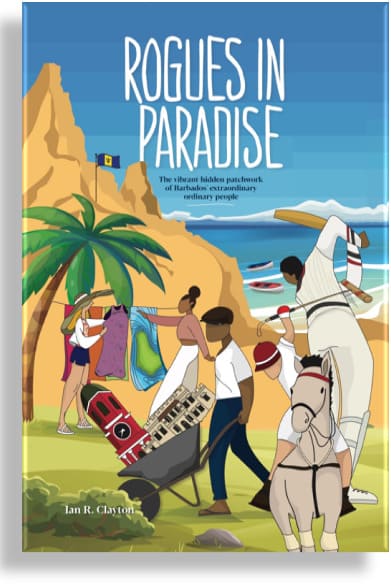
Inspired by the Book Rogues in Paradise
In Empire’s Shadow: Britain’s Laboratory for Slavery and the Island That Transcended
Dive deeper into Rogues In Paradise —
Voices, Empire, and Beyond Paradise
Explore the Book Behind the Series →
Discover the philosophical bridge between identity, empire, and modern systems
—or Go straight to the story
Identity In The Age of AI
Identity Is Not Inherited. It Is Lived. | The Full Story
PART I — ROOTS
Where identity comes from
- The Spoils of Identity in the Face of Colonialism
Colonial systems reshaped identity through power, law, and economics, with Barbados as an early case study of cultural disruption and resilience. - Barbados: Identity in Motion
Identity evolves through migration, culture, and adaptation. Barbados offers a living example of identity shaped by history and community.. - Identity Across Cultures: The World Order
Expands the conversation globally, exploring how language, geography, religion, and history shape identity across societies. - Africa: Origins and Echoes of Identity
Explores the diverse African cultures that shaped Caribbean identity—from warrior societies and desert traders to farmers, artisans, and storytellers.
-4a. African Echoes
Explores the influence of African heritage on Barbados and Caribbean identity: Featuring culture, memory, music, spirituality, and everyday life across the RoguesCulture series.
PART II — MEANING
What identity actually is
- Cosmic Identity
A philosophical reflection on identity beyond nationality—considering humanity’s shared cultural and existential connections. - Identity: AI vs Ancestry in 2026
As artificial intelligence reshapes communication and creativity, this essay asks what remains uniquely human,
and how ancestry helps keep identity grounded. - Identity and the Future
Explores how identity may evolve as societies adapt to rapid technological, cultural, and economic change.
>>>>(END OF START 1-7)
INTERLUDE – In EMPIRE’S SHADOW
How systems persist
Empires do not disappear when colonial rule ends.
The system of power continues to shape identity, culture, and society today.
PART III — SYSTEMS & FRAGILITY
What happens to identity next
- Identity Is Fragile
Reflects on how identity can be distorted, politicised, or manipulated—and why cultural awareness is essential to protect it. - Who Needs Identity Anyway?
Questions whether identity still matters in a globalised world—and why belonging and cultural continuity remain important.
NEW SERIES
Living with AI explores how intelligent agents are reshaping work, creativity, and decision-making
—and how humans can thrive alongside them.
BUILDING WITH AI
Building with AI explores how individuals, creators, entrepreneurs, and businesses can design, evaluate, and work intelligently with AI agents. The series focuses on practical applications, real-world examples, and emerging opportunities while emphasising the importance of human creativity, judgment, ethics, and authenticity.
Coming soon.
Based on The Book: ‘Rogues in Paradise’
Unlikely voices, rogues and legends, rising from Britain’s blueprint for slavery to a republic beyond the Empire’s shadow
Explore the ideas behind the book —or
Go straight to the story.
Related Blogs
Rogues Re-Framed: https://roguesinparadise.com/britains-first-slave-society-the-barbados-prototype/
Barbados: Britain’s Laboratory for Slavery: https://roguesinparadise.com/barbados-britains-laboratory-for-slavery/