After all this thinking, I didn’t expect to arrive here.
The intention was to explore identity—how it is shaped by culture, history, place, and belonging. Each essay looked outward, examining societies, traditions, inherited narratives, and collective experience.
Instead, it led me somewhere unexpected.
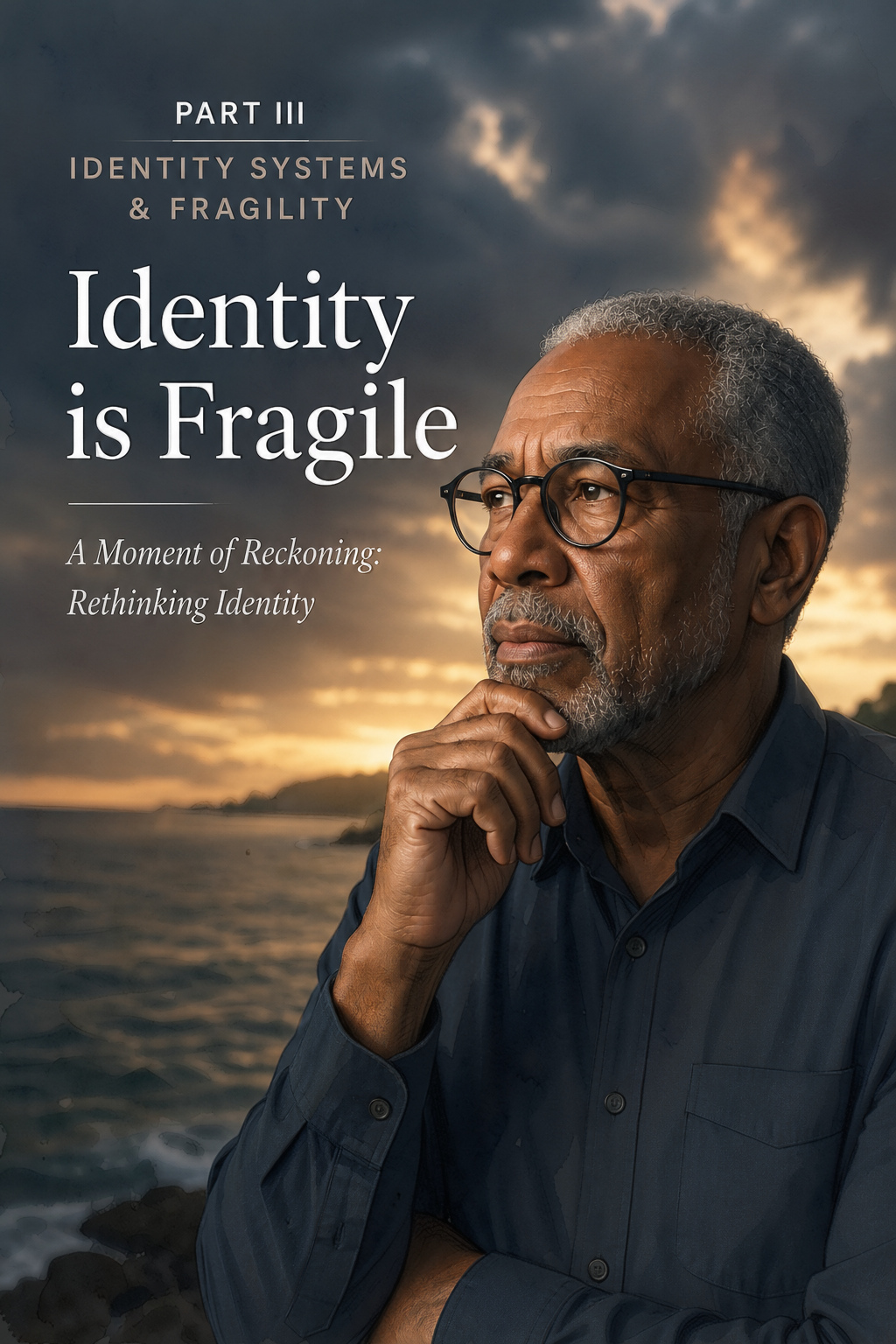
Identity is Fragile
This question did not arise for me in theory — it has deep roots in Barbados.
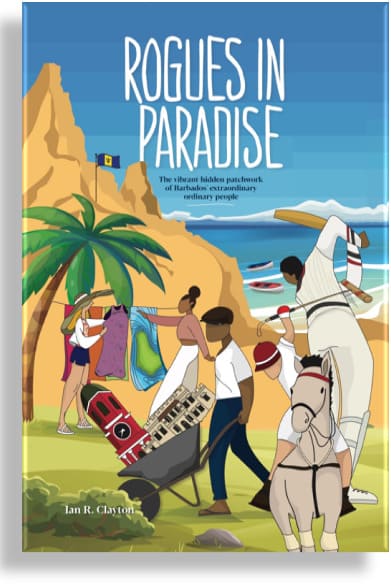
It emerged while writing Rogues in Paradise, as I studied the legacies of slavery, colonialism, emancipation, and freedom. In those histories, identity was never a fixed inheritance. It was shaped by circumstance, resilience, humour, trauma, hope, and the sheer determination to live with dignity inside — and beyond — oppression.
Identity did not mean the same thing to everyone.
For some, it was survival.
For others, dignity.
For many, it became a quiet confidence — a way of being that drew strength from community, character, and lived experience rather than from status or legacy.
Barbados revealed identity not as an ideology, but as something continuously negotiated — between history and the present, between belonging and independence, between what people had endured and who they chose to become. It is a place where identities emerge, overlap, collide, and diverge across generations.
The Paradox
Often called “Little England,” Barbados is rooted in a people of overwhelmingly African heritage, yet shaped by centuries of British institutions, customs, and traditions. It lives within a paradox. For some, colonial rule is remembered as a history of domination, extraction, and racial injustice — and the call for reparations rises out of anger, pain, and the unresolved grief of lives constrained by power. Their voices carry urgency, impatience, and a refusal to let history be quietly forgiven.
For others, echoes of colonial Britain are entwined with social memory, discipline, manners, and education. There is nostalgia in the rituals, warmth in the formality, and sometimes even humour and affection for the world that shaped them. Like the sharp-witted woman in Pompasetting who jokes, “I waitin’ for de Queen,” these voices reveal a different kind of loyalty — part satire, part defiance, part comfort in what is familiar.
Positions of Tension
And many Barbadians move somewhere between these positions, sometimes a mix of both — questioning, adapting, laughing, grieving, and negotiating identity in the daily rhythms of ordinary life. In Barbados, identity is not resolved by consensus. It lives in tension — between repair and remembrance, between resistance and inheritance, between the past that formed people and the future they are still learning to claim.
It was there that I first began to understand how identity can fracture, reform, and deepen under pressure — and how profoundly it is shaped by the worlds we move through.
Conspiracy, misinformation, and forms of populist certainty offer something seductive: explanation, belonging, and clarity in moments of fear. When those forces take hold, beliefs can falter, and identity can be reshaped with surprising speed.
What appears as conviction is often adaptation. I had seen versions of this before in Barbados — identity reshaping itself under pressure, then finding new forms of strength and meaning.
And when that happens across cultures and communities, it becomes difficult not to ask whether identity is as solid as we assume — or far more vulnerable to the environments we inhabit.
Identity Under Pressure
I began to notice how easily identity can shift — not over generations, but over months. Sometimes weeks. Sometimes, almost overnight.
Friends I had known for years — thoughtful, open, politically liberal people — began repeating ideas they would once have questioned. Nuance gave way to certainty. Curiosity narrowed. The tone changed first, then the positions, and eventually the posture of who they seemed to be.
It wasn’t just opinions that moved.
It was how they listened.
How they spoke.
Who they trusted.
And this wasn’t confined to a single ideology, a single country, or a single culture. Similar shifts were happening everywhere, under different pressures, in different environments.
That was unsettling.
Not because people changed — change is human — but because the changes seemed to follow environments rather than reflection. New media ecosystems. New peer groups. New fears. New forms of belonging.
Identity appeared to reorganise itself around whatever narrative offered certainty and community in that moment.
That observation reframed everything that came before it.
It suggested that identity may not be the stable foundation we often assume it to be. Instead, it may be far more responsive — and far more fragile — than we like to admit.
When people move into new social environments, they don’t just adapt their language or behaviour. They often adapt their sense of self. Not consciously. Not deliberately. But gradually, through repetition, reinforcement, and reward.
The environment does the shaping.
This doesn’t mean identity is false.
It means identity may be conditional.
And that raises a harder question.
If identity can be reshaped so quickly by pressure, fear, or belonging, what remains when those conditions change again?
This reflection does not reject identity. It questions our reliance on it. If identity can be reshaped so easily by culture, fear, environment, or a sense of belonging, perhaps it cannot be the deepest foundation of who we are.
What follows is not an argument.
It is a moment of reckoning.
Video Summary
Keywords
identity, identity is fragile, identity systems, cultural identity, personal identity, social identity, Barbados identity, belonging, identity and culture, identity and history, misinformation, conspiracy theories, populism, changing beliefs, identity under pressure, identity crisis, human behaviour, social psychology, environment and identity, RoguesCulture
RoguesCulture Identity Series
A journey from the roots of identity to its future in an age of AI.
Inspired by the Book Rogues in Paradise
In Empire’s Shadow: Britain’s Laboratory for Slavery and the Island That Transcended
Dive deeper into Rogues In Paradise —
Voices, Empire, and Beyond Paradise
Explore the Book Behind the Series →
Discover the philosophical bridge between identity, empire, and modern systems
—or Go straight to the story
Identity In The Age of AI
Identity Is Not Inherited. It Is Lived. | The Full Story
PART I — ROOTS
Where identity comes from
- The Spoils of Identity in the Face of Colonialism
Colonial systems reshaped identity through power, law, and economics, with Barbados as an early case study of cultural disruption and resilience. - Barbados: Identity in Motion
Identity evolves through migration, culture, and adaptation. Barbados offers a living example of identity shaped by history and community.. - Identity Across Cultures: The World Order
Expands the conversation globally, exploring how language, geography, religion, and history shape identity across societies. - Africa: Origins and Echoes of Identity
Explores the diverse African cultures that shaped Caribbean identity—from warrior societies and desert traders to farmers, artisans, and storytellers.
-4a. African Echoes
Explores the influence of African heritage on Barbados and Caribbean identity: Featuring culture, memory, music, spirituality, and everyday life across the RoguesCulture series.
PART II — MEANING
What identity actually is
- Cosmic Identity
A philosophical reflection on identity beyond nationality—considering humanity’s shared cultural and existential connections. - Identity: AI vs Ancestry in 2026
As artificial intelligence reshapes communication and creativity, this essay asks what remains uniquely human,
and how ancestry helps keep identity grounded. - Identity and the Future
Explores how identity may evolve as societies adapt to rapid technological, cultural, and economic change.
>>>>(END OF START 1-7)
INTERLUDE – In EMPIRE’S SHADOW
How systems persist
Empires do not disappear when colonial rule ends.
The system of power continues to shape identity, culture, and society today.
PART III — SYSTEMS & FRAGILITY
What happens to identity next
- Identity Is Fragile
Reflects on how identity can be distorted, politicised, or manipulated—and why cultural awareness is essential to protect it. - Who Needs Identity Anyway?
Questions whether identity still matters in a globalised world—and why belonging and cultural continuity remain important.
NEW SERIES
Living with AI explores how intelligent agents are reshaping work, creativity, and decision-making
—and how humans can thrive alongside them.
BUILDING WITH AI
Building with AI explores how individuals, creators, entrepreneurs, and businesses can design, evaluate, and work intelligently with AI agents. The series focuses on practical applications, real-world examples, and emerging opportunities while emphasising the importance of human creativity, judgment, ethics, and authenticity.
Coming soon.
Based on The Book: ‘Rogues in Paradise’
Unlikely voices, rogues and legends, rising from Britain’s blueprint for slavery to a republic beyond the Empire’s shadow
Explore the ideas behind the book —or
Go straight to the story.
Related Blogs
Rogues Re-Framed: https://roguesinparadise.com/britains-first-slave-society-the-barbados-prototype/
Barbados: Britain’s Laboratory for Slavery: https://roguesinparadise.com/barbados-britains-laboratory-for-slavery/